

In 2026, speed has become a deciding factor in how customers choose who to do business with. A Forbes study found that 53% of customers are more likely to pick a company that responds faster, even if it costs more.
This is where agentic AI comes in. Many still equate AI with chatbots and scripted replies, but agentic AI voice systems represent a major evolution. What began as basic automation has transformed into voice-based, autonomous assistants that support sales and GTM teams by handling live conversations, qualifying intent, and moving outcomes forward. Agentic AI voice is no longer a tool on the sidelines; it is becoming an active partner in how modern teams engage, convert, and scale.
This blog explores what agentic AI voice is, how it works in real sales and GTM environments, and why it’s becoming a critical channel for scaling conversations, qualification, and revenue in 2025 and beyond.
Key insights at a glance
- Agentic AI voice goes beyond chatbots, enabling autonomous, real-time sales conversations that qualify intent and advance pipeline at scale.
- Unlike scripted AI or dialers, agentic AI voice initiates calls, adapts mid-conversation, and completes multi-step sales workflows end to end.
- GTM teams use agentic AI voice to scale outbound without scaling headcount, ensuring consistent coverage across markets and time zones.
- Live intent qualification during conversations reduces low-quality handoffs, allowing sales reps to focus only on high-momentum opportunities.
- Agentic AI voice turns outbound execution into a continuous, intelligence-driven system where conversations, not tasks, drive revenue growth.
What is agentic AI voice? Relevance in 2026
Agentic AI voice is a new class of voice-based AI that doesn’t just respond, it acts. Unlike traditional voice bots that wait for instructions and follow predefined flows, agentic voice AI operates with intent and autonomy. It can initiate conversations, understand context as it unfolds, make decisions in real time, and carry tasks to completion without constant human oversight.
Instead of stopping at conversation, agentic voice AI connects dialogue to execution. It can handle multi-step workflows such as qualifying a lead, updating systems, scheduling next steps, or escalating issues when needed, all through natural, human-like voice interactions. Over time, it improves by learning from outcomes, not just inputs.
This shift turns voice AI from a support layer into an active operator, capable of managing real business objectives rather than isolated interactions.
How agentic AI voice differs from traditional AI
Both traditional AI systems and agentic voice AI engage in real-time dialogue. The difference lies in autonomy: traditional systems follow structured response paths, while agentic voice AI can reason, adapt, and proactively execute toward a goal.
Here are some key differences between the two:
In practical terms, traditional AI helps answer questions. Agentic AI voice helps get work done. That difference is what makes it increasingly valuable for sales, GTM, and customer-facing teams that need scale without sacrificing judgment or continuity.
Agentic AI voice agents in sales and GTM
Outbound sales is one of the hardest functions to scale. GTM teams face constant pressure to reach more accounts, respond faster, and maintain relevance, all while relying on manual calling, follow-ups, and inconsistent human availability. As pipelines grow, this model becomes expensive, slow, and operationally fragile.
Agentic AI voice changes how sales engagement scales. Instead of supporting reps from the sidelines, voice agents participate directly in outbound execution. They initiate conversations, qualify prospects, handle early objections, and move opportunities forward through natural, human-like dialogue.
This allows GTM teams to expand pipeline coverage without proportionally increasing headcount.
From dialers to decision-making voice agents
Traditional outbound tools like dialers and IVR-style systems focus on activity, not outcomes. They automate dialing but still depend on reps to manage conversations, interpret intent, and decide next steps.
Agentic AI voice agents like Loro represent the next evolution. Powered by modern language models, they can carry real sales conversations, adapt to prospect responses, and make decisions in real time.
Rather than routing calls or playing prompts, they listen for buying signals, identify objections, and respond with context-aware follow-ups that keep conversations moving.
How agentic AI voice drives revenue for GTM teams
Agentic voice AI delivers impact across the outbound sales funnel. Here’s how it does that:
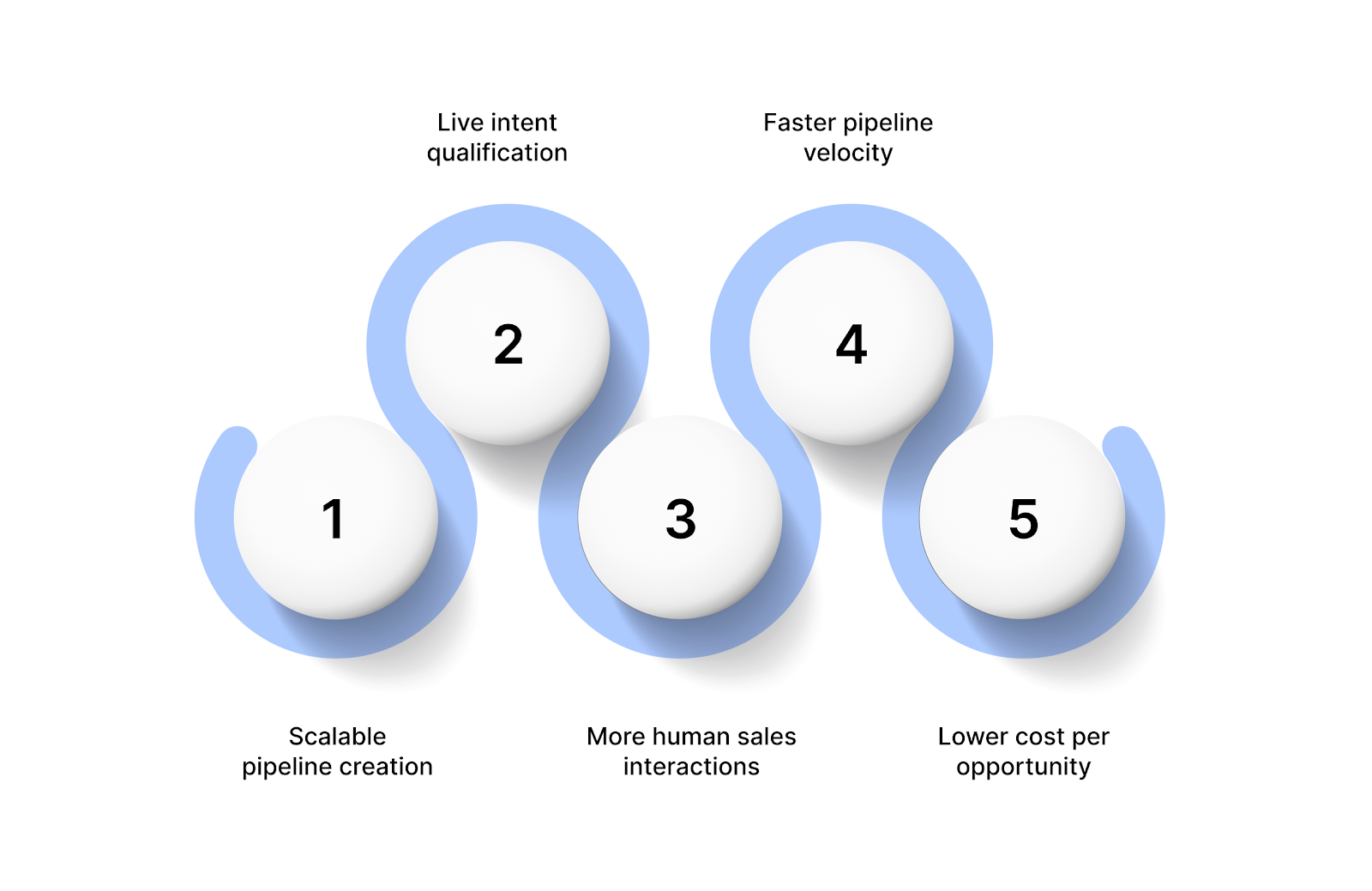
- Scalable pipeline creation: Voice agents can engage thousands of prospects concurrently, ensuring consistent first contact and eliminating gaps caused by limited rep capacity.
- Live intent qualification: Instead of scoring leads after the fact, intent is identified during the conversation, filtering out low-quality opportunities before reps get involved.
- More human sales interactions: Conversations feel natural and adaptive, increasing pickup rates and engagement compared to scripted outreach.
- Faster pipeline velocity: Qualified prospects are moved forward immediately, reducing delays between first touch, follow-up, and meeting booking.
- Lower cost per opportunity: GTM teams can expand outbound coverage without continuously adding SDRs, improving efficiency without sacrificing quality.
Agentic AI voice agents don’t replace sales teams. They remove friction at the top of the funnel, allowing human SDRs to focus on what they do best: building relationships, handling complex negotiations, and closing deals that already have momentum.
Want to turn first conversations into qualified meetings at scale? See how Loro by Cloudtech enables outbound GTM—book a live demo.
Benefits of agentic AI voice for GTM teams
Agentic AI voice changes outbound sales by shifting execution to autonomous systems that can listen, reason, and act in real time. Instead of treating outreach as a volume game driven by scripts and sequences, agentic voice introduces an execution layer that understands buyer responses, adapts mid-conversation, and advances deals without waiting for manual intervention.
For GTM teams, this means outbound is no longer limited by rep capacity or follow-up discipline. Conversations happen continuously, qualification occurs live, and pipeline is created through intent-driven dialogue rather than static data signals. The result is a sales motion where effort is replaced by intelligence, and consistency is built directly into execution rather than enforced through process.
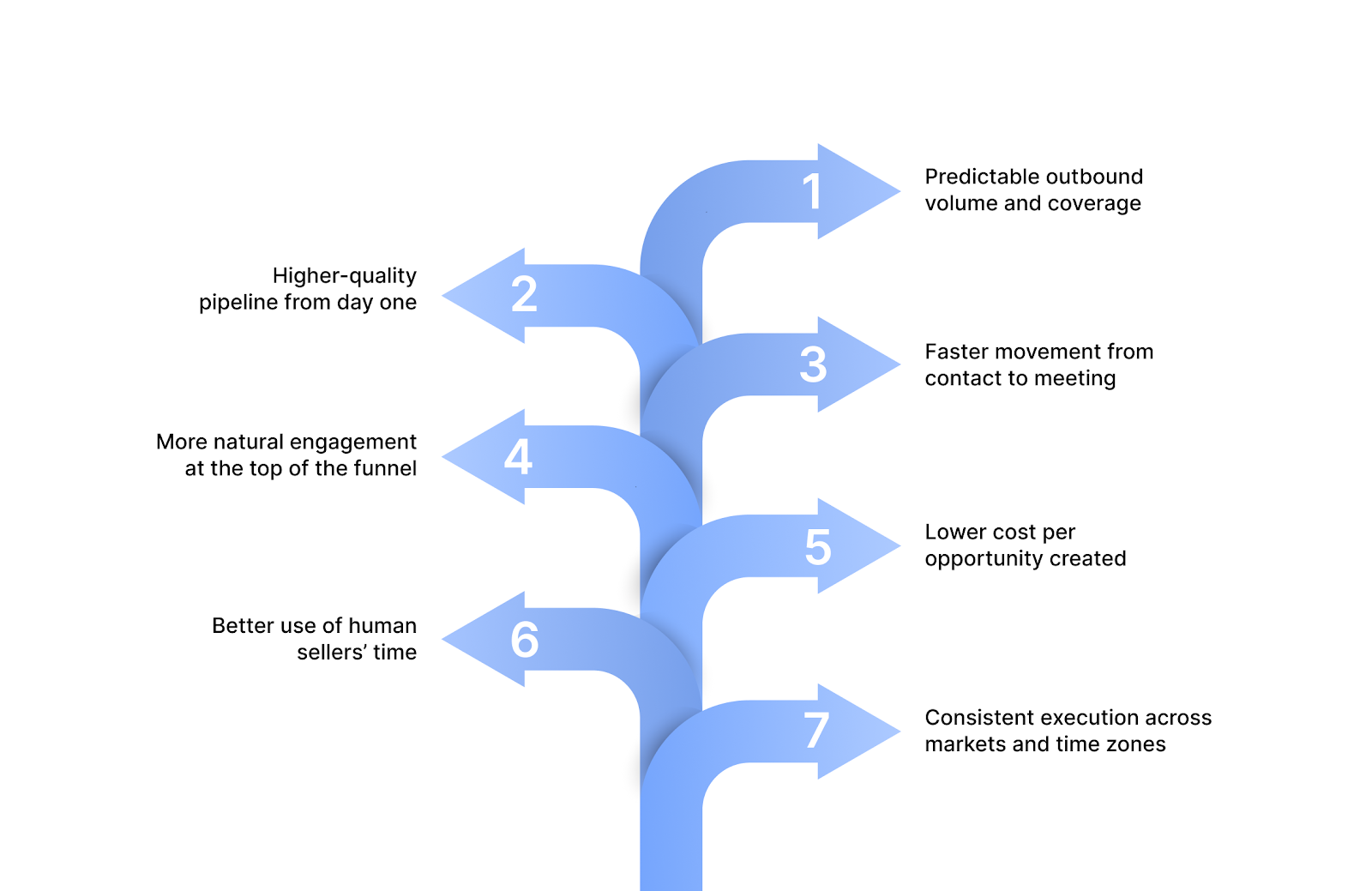
Here are some of the benefits of using agentic AI for GTM teams:
1. Predictable outbound volume and coverage
Agentic AI voice systems don’t rely on human availability, call fatigue, or manual task switching. They execute outreach continuously and consistently, ensuring no lead or account goes untouched.
How GTM teams achieve this: Use AI voice agents as the primary execution layer for first-touch outreach and follow-ups, guaranteeing consistent coverage across the entire outbound list.
2. Higher-quality pipeline from day one
Instead of capturing surface-level data, agentic AI voice qualifies prospects through live dialogue. Intent, urgency, objections, and buying readiness are identified in real time.
How GTM teams achieve this: Configure voice agents to qualify prospects during conversations and only hand off opportunities that meet defined intent and readiness thresholds.
3. Faster movement from contact to meeting
Agentic AI voice can respond instantly, adapt to the prospect’s answers, and progress the conversation without waiting for human follow-ups or callbacks.
How GTM teams achieve this: Allow AI voice agents to handle objections, confirm interest, and move prospects directly to the next step within the same call.
4. More natural engagement at the top of the funnel
Unlike scripted systems, agentic AI voice adapts tone, pacing, and responses based on how prospects speak, making conversations feel fluid rather than transactional.
How GTM teams achieve this: Deploy AI voice agents designed for conversational adaptability rather than rigid call scripts, especially for early-stage outreach.
5. Lower cost per opportunity created
Agentic AI voice replaces repetitive outbound labor while maintaining or improving qualification quality, reducing reliance on large SDR teams.
How GTM teams achieve this: Shift high-volume dialing and early qualification from human reps to voice agents, keeping SDRs focused on high-value conversations.
6. Better use of human sellers’ time
Human reps are no longer pulled into low-intent conversations. They engage only after interest, context, and momentum are already established.
How GTM teams achieve this: Position agentic AI voice as the front line of outbound execution, with structured handoffs to reps once intent is confirmed.
7. Consistent execution across markets and time zones
Agentic voice operates continuously without performance drop-offs, regardless of region, language, or working hours.
How GTM teams achieve this: Run AI voice agents as an always-on outbound layer to maintain uniform execution across geographies and segments.
Agentic AI voice transforms outbound sales from a manual, effort-driven motion into a systematic, intent-led pipeline engine, where conversations happen on time, qualification happens live, and sellers engage only when it matters most.
Conclusion: Where agentic AI voice reshapes sales execution
GTM teams rarely struggle because they lack tools or playbooks. The real challenge shows up in execution, when outbound depends on human timing, follow-ups slip, and early buying signals never turn into real conversations. That friction compounds quietly, slowing pipeline long before deals reach a seller.
Loro addresses this at the source. It doesn’t wait to assist after outreach happens, they are the outreach. It initiates live conversations, adapts in real time, assesses intent as it emerges, and moves qualified prospects forward without pauses or handoffs slowing things down. Sales execution becomes continuous rather than episodic.
This creates a fundamentally different GTM motion. Conversations start earlier, intent is captured when it’s fresh, and human sellers step in only when momentum already exists. Pipeline grows through dialogue, not task volume.
Explore how Loro by Cloudtech brings agentic AI voice into outbound GTM. Book a Demo Today to see autonomous voice agents driving real sales conversations at scale.
FAQs: Agentic AI voice
1. What makes agentic AI voice different from automated calling systems?
Agentic AI voice is not a dialing or playback system. It operates as an autonomous decision-making agent that holds live conversations, adapts its language based on responses, and changes direction mid-call when new information emerges. Instead of following fixed trees or scripts, it reasons through conversations in real time, allowing it to qualify prospects, handle objections, and decide next actions without human input.
2. How does agentic AI voice fit into an outbound GTM stack?
Agentic AI voice sits between lead sourcing and human sellers. It consumes leads from CRMs or outbound systems, initiates conversations, and returns structured insights, intent level, objections raised, readiness, and next steps, back into the GTM stack. This turns outbound from a task-driven process into a signal-driven pipeline where reps engage only when real buying interest is present.
3. Can agentic AI voice personalize conversations at scale?
Yes. Agentic voice AI dynamically personalizes conversations using firmographic data, prior interactions, call context, and real-time responses. Personalization isn’t limited to name or company references, it extends to how questions are framed, which value points are emphasized, and how objections are addressed, all adjusted live during the call.
4. How does agentic AI voice handle objections without sounding robotic?
Instead of preloaded objection scripts, agentic AI voice evaluates objections as signals. It understands whether a response reflects timing issues, budget hesitation, authority gaps, or disinterest, then adapts its approach accordingly. This allows conversations to feel fluid and human, with responses shaped by reasoning rather than predefined flows.
5. What metrics improve first when teams adopt agentic AI voice?
Teams typically see faster speed-to-first-conversation, higher contact rates, and improved meeting-to-opportunity conversion. Because agentic AI voice qualifies intent before handoff, sales reps spend less time on low-intent conversations and more time advancing deals already in motion.