
Sales teams don’t struggle because they lack digital software. They struggle because they have too many. Before a single call happens, reps are already jumping between CRMs, pitch decks, Slack messages, call notes, and enablement portals. Every switch breaks focus. Every search steals time, leaving less room for actual selling.
AI sales enablement is changing that. Instead of forcing reps to hunt for information, AI brings context, insights, and guidance directly into the flow of work, connecting research, preparation, and execution.
By 2027, 95% of seller research workflows are expected to start with AI. But the next shift goes further. AI is beginning to act, not just assist. From surfacing insights to initiating human-like, voice-to-voice conversations, sales enablement is moving closer to how selling actually happens.
In this article, we look at seven AI sales enablement solutions setting the standard in 2026, and how they help sales teams cut through noise, stay prepared, and focus on what actually moves deals forward.
Key insights at a glance
- AI sales enablement in 2026 moves from static content to real-time, context-aware support embedded directly into how reps sell.
- Agentic voice AI introduces a new enablement layer by initiating conversations, qualifying intent, and warming deals before reps engage.
- Top enablement tools reduce prep work and context switching, giving reps more time for high-quality buyer conversations.
- Effortless enablement comes from AI that pushes insights in the moment, not dashboards reps have to search or remember to use.
- Teams that combine execution AI with coaching and content systems gain faster pipelines and higher-intent sales conversations.
How is sales enablement changing with AI in 2026?
Before understanding how AI is reshaping sales enablement, it helps to ground the basics. Sales enablement exists to make sellers effective. It equips reps with the right messaging, content, training, and guidance so they can have better conversations and close deals faster.
Historically, that meant building content libraries, playbooks, and dashboards, and trusting reps to find what they needed at the right moment.
That model is breaking down.
In 2026, sales enablement is shifting from static resources to active support, driven by AI that understands timing, context, and intent. Instead of asking reps to search, remember, or guess, AI brings enablement to them, inside the flow of real sales work.
Where AI enters the picture
AI in sales enablement isn’t just about smarter search or content tagging. It’s about systems that observe what sellers are doing, recognize patterns, and step in at the right moment.
This includes:
- Learning which assets perform best in specific deal stages
- Understanding conversation cues from emails, calls, and meetings
- Anticipating what a rep will need before they ask
Increasingly, this intelligence extends beyond text and dashboards into voice-to-voice, agentic AI. These systems don’t just support reps after the fact, they participate directly in sales motions, holding humanlike conversations, qualifying prospects, and passing high-intent opportunities to sellers with full context attached.
The biggest shift: from pull to push
Traditional sales enablement is reactive. Reps pull information when they remember, or when they have time.
AI-driven enablement is proactive. Insights, talking points, and next steps are pushed in real time, aligned to what’s happening in the deal right now. In more advanced models, AI doesn’t just surface guidance, it initiates the first interaction, engaging prospects through human-like, voice-to-voice conversations before a rep ever steps in.
What makes this powerful isn’t speed alone. It’s relevance.
A generic script delivered at the “right time” isn’t helpful. What matters is context-aware guidance shaped by:
- The prospect’s objections or intent signals
- The deal stage and industry
- What has worked in similar conversations before
That same context is now being applied to voice. Agentic voice AI can qualify intent, handle early objections, and warm conversations in real time, so reps enter deals with context already established.
That’s how enablement moves from a content repository to a competitive advantage.
For reps, the impact is immediate:
- Less prep work: No more digging through decks or portals before every call
- Better conversations: Sharper messaging and clearer next steps
- More selling time: Fewer context switches and fewer unqualified calls
- Higher confidence: Guidance and qualified context arrives before the moment passes
In 2026, sales enablement isn’t just supporting sales, it’s actively participating. With AI and agentic voice working together, enablement helps start conversations, shape them intelligently, and hand off warmer, better-qualified opportunities.
This is how lean teams scale best practices, and how modern sales orgs stay competitive in crowded markets.
7 solutions for AI sales enablement: features and use cases
The best solutions remove friction, surface context at the right moment, and help reps spend more time in real conversations that move deals forward. But not all enablement solutions operate at the same layer of the sales motion.
Most platforms in this category focus on supporting execution: organizing content, prioritizing accounts, recommending next steps, or analyzing past interactions to improve future performance. They make sellers better prepared, but they still depend on humans to initiate, qualify, and progress conversations.
A new class of enablement has emerged that changes that assumption entirely. Instead of preparing reps for conversations, agentic, voice-led AI systems participate in and execute the earliest sales conversations themselves. They engage prospects directly, evaluate intent in real time, handle early objections, and move opportunities forward before a rep ever enters the picture.
Enablement shifts from advising sellers to creating momentum inside the pipeline.
This is where Loro stands apart.
#1. Loro by CloudTech for outbound sales enablement
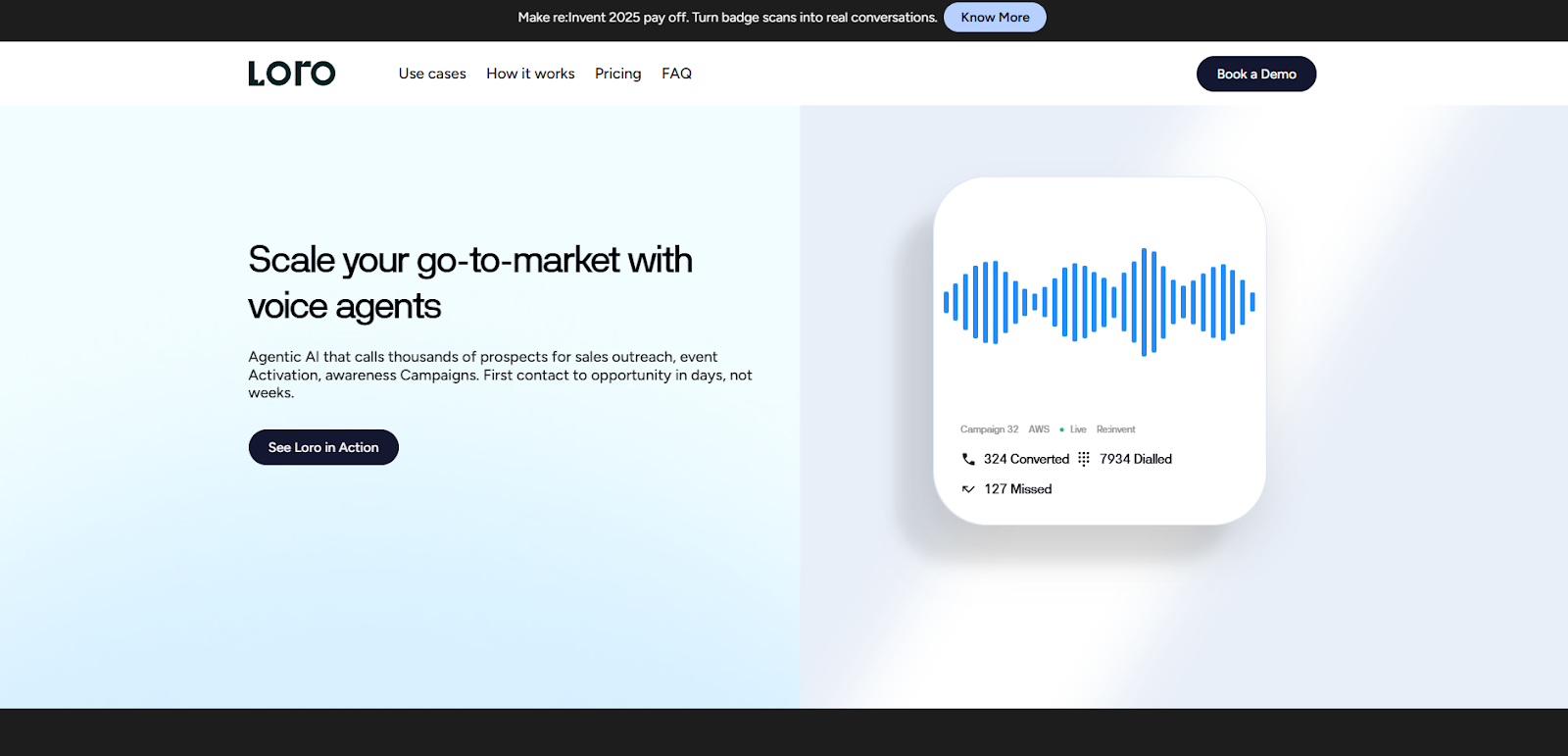
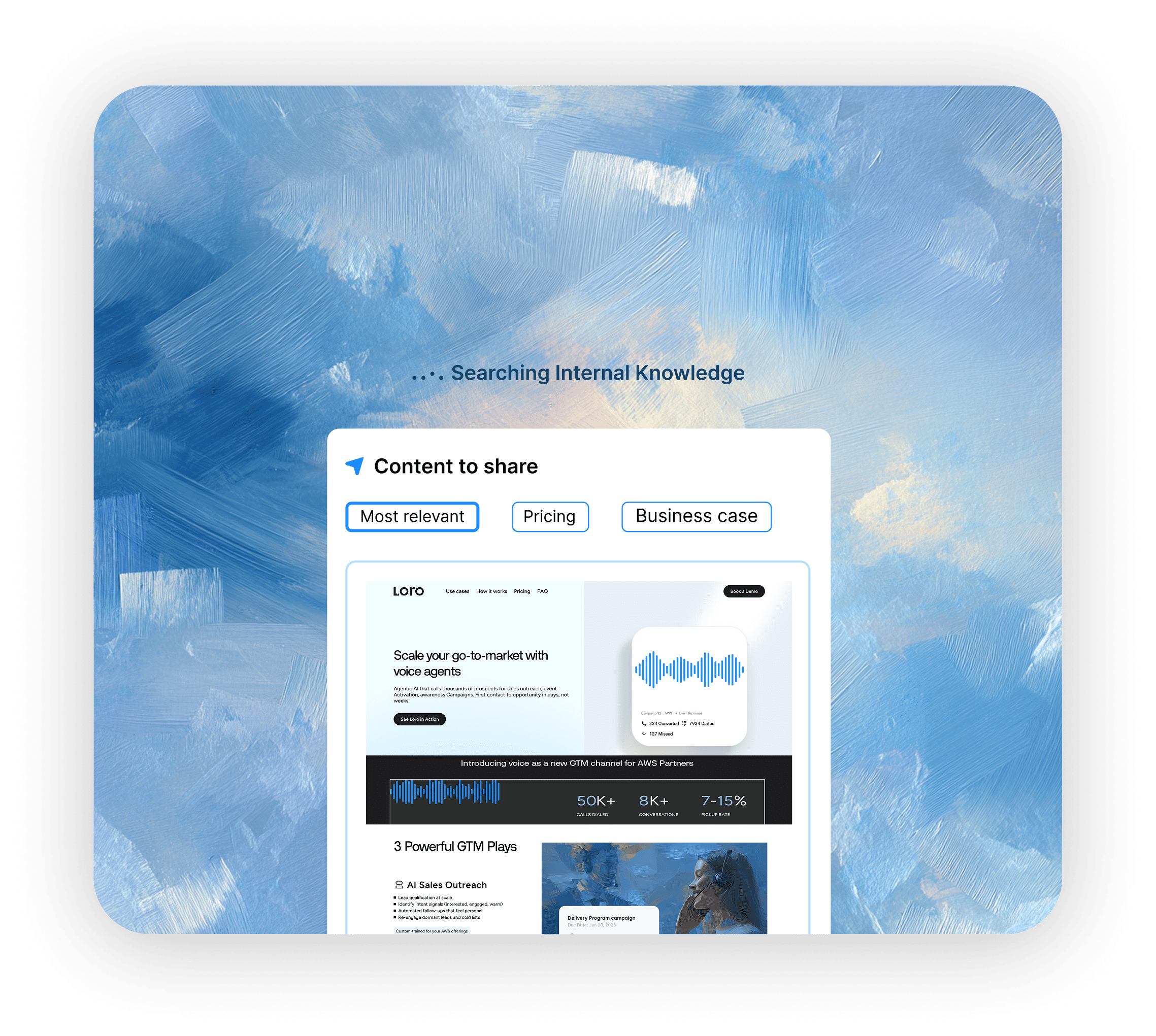
Loro doesn’t sit alongside sales activity or analyze it after the fact. It operates inside the motion, running live outbound conversations, capturing sales-critical context as it happens, and handing human sellers opportunities that already carry intent, clarity, and momentum. It represents a foundational change in how sales enablement works, from tooling that supports sellers to systems that actively generate sales-ready outcomes.
Rather than adding more dashboards or sequences for reps to manage, Loro introduces voice as a new GTM channel. It initiates first contact, speaks naturally with prospects, interprets responses in real time, and only progresses conversations that show genuine buying intent. Sales reps engage later, when context is clear, interest is validated, and timing is right.
From a sales enablement perspective, Loro removes the heaviest early-stage burden from reps: manual dialing, repeated follow-ups, and guessing who is actually worth engaging. What flows downstream are qualified conversations, not raw activity.
Built on AWS and pre-trained for outbound sales outreach, event activation, and awareness campaigns, Loro helps AWS partners move from first touch to opportunity in days, not weeks.
Best for:
- AWS Partner Network members running outbound GTM motions
- Sales teams that rely on cold or warm outbound and need higher pickup and connect rates
- Event-driven GTM teams supporting AWS Summits, re:Invent, and partner events
- Lean sales and enablement teams that need to scale conversations without scaling headcount
- Organizations targeting accounts that ignore email and digital outreach
Core sales enablement capabilities:
- Natural, adaptive voice conversations: Loro listens for tone, hesitation, objections, and conversational cues during live calls, adjusting responses dynamically. This enables more accurate intent detection than scripted dialers or form-based workflows.
- Autonomous outbound execution at AI scale: The agent places thousands of concurrent outbound calls, manages voicemail detection, navigates IVR systems, retries missed connections, and maintains first-touch velocity, without rep involvement.
- Intent-based qualification and routing: Prospects are classified as uninterested, engaged, or warm based on live conversation signals. Only qualified prospects aligned to ICP criteria are routed forward, along with full conversational context.
- Conversation-level sales intelligence: Every interaction generates transcripts, sentiment signals, objection patterns, connect-rate metrics, and intent data, giving enablement and sales leaders visibility into early-funnel performance.
- Enterprise-grade compliance and security: SOC 2 Type II controls, HIPAA and FINRA alignment, DNC enforcement, consent tracking, and encrypted call data support compliant outbound execution across regulated industries.
The primary use cases range across automated sales outreach and event activation.
AI sales outreach:
- Qualify leads at scale through live conversations
- Identify intent signals (interested, engaged, warm) early
- Re-engage dormant leads and cold territories
- Warm accounts before human sales engagement
Event activation (pre- and post-event):
- Drive booth and session attendance before AWS events
- Convert badge scans and registrations quickly after events
- Win the critical follow-up window when intent is highest
- Turn event spend into calendarized sales conversations
Awareness campaigns:
- Build familiarity across target account lists
- Reach prospects who consistently ignore email outreach
- Make outbound feel human again through real dialogue
- Open doors through conversations, not clicks
How Loro fits into modern AI sales enablement stacks: Loro is intentionally not a CRM, scheduling tool, or content repository. Its value sits upstream, where most enablement tools fall short.
- Loro handles first contact and intent discovery through live voice conversations
- Scheduling and CRM tools manage logistics after interest is confirmed
- Sales reps engage only once conversations are qualified and contextualized
In modern AI sales enablement, Loro acts as the execution layer that converts lists, campaigns, and data into real buyer conversations, feeding higher-quality opportunities into the rest of the stack.
This is what AI sales enablement looks like in 2026: not organizing sales work, but actively creating momentum before reps ever step in.
Turn first conversations into qualified meetings at scale. See how Loro by Cloudtech enables outbound GTM—book a live demo.
The six platforms that follow play important roles across coaching, engagement, intelligence, and execution support. But Loro defines the new ceiling of what AI sales enablement can be in 2026.
#2. Spekit
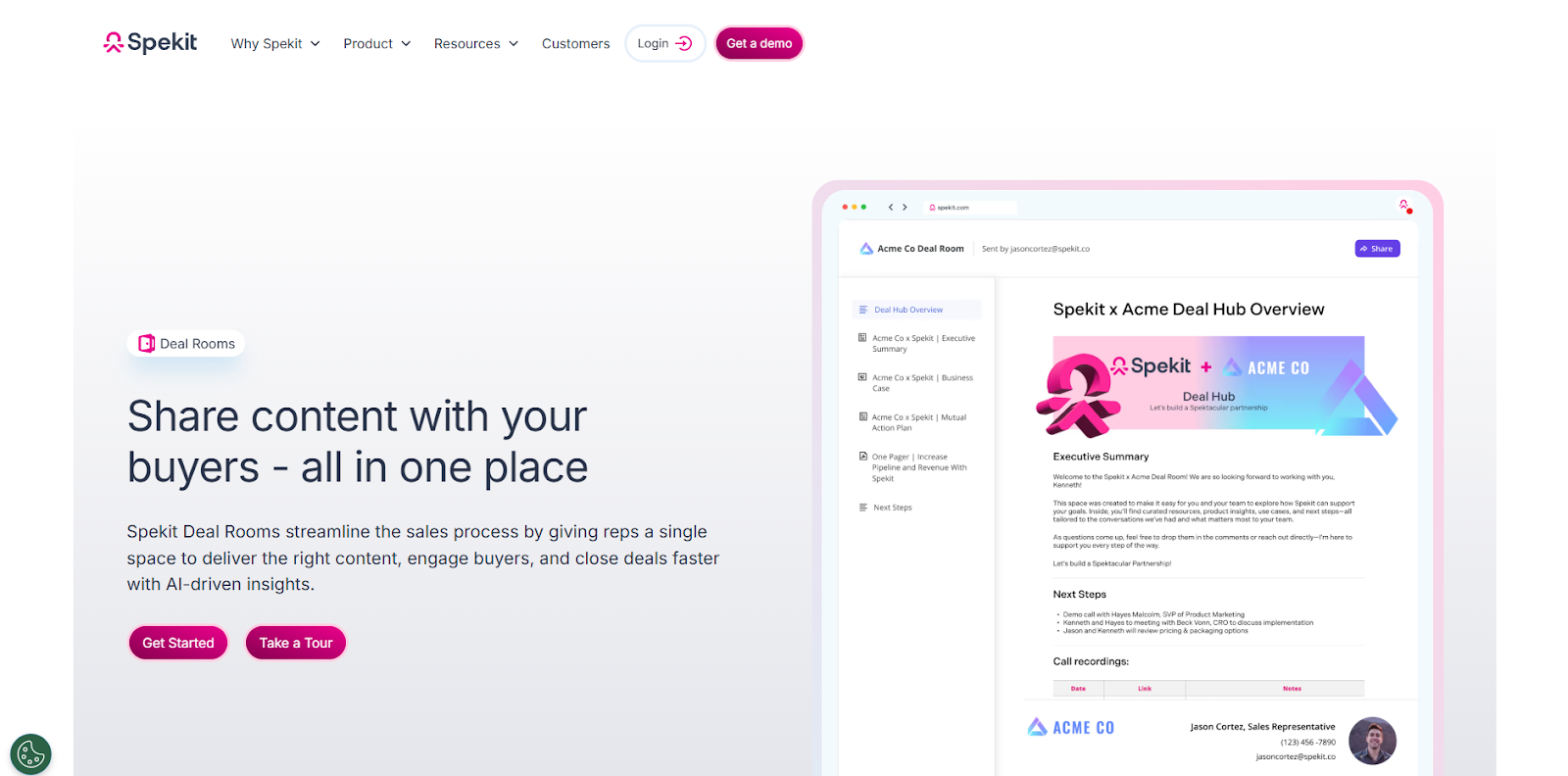
Spekit turns enablement into something reps experience while they’re working, not something they search for later. Its AI surfaces guidance, content, and definitions directly inside tools like Salesforce, Gmail, Slack, and Gong.
Key features:
- Context-aware AI Sidekick that delivers enablement in real time
- Intelligent content governance to prevent outdated assets
- Modular playbooks and definitions tied to deal stages
- Embedded coaching and reinforcement
Use cases:
- Ensuring consistent messaging across teams
- Reducing time spent searching for content
- Reinforcing onboarding and training in real situations
Takeaway: Spekit brings enablement into the rep’s daily workflow, delivering the right content, process guidance, and training at the exact moment it’s needed—without forcing reps to search or switch tools.
#3. Gong
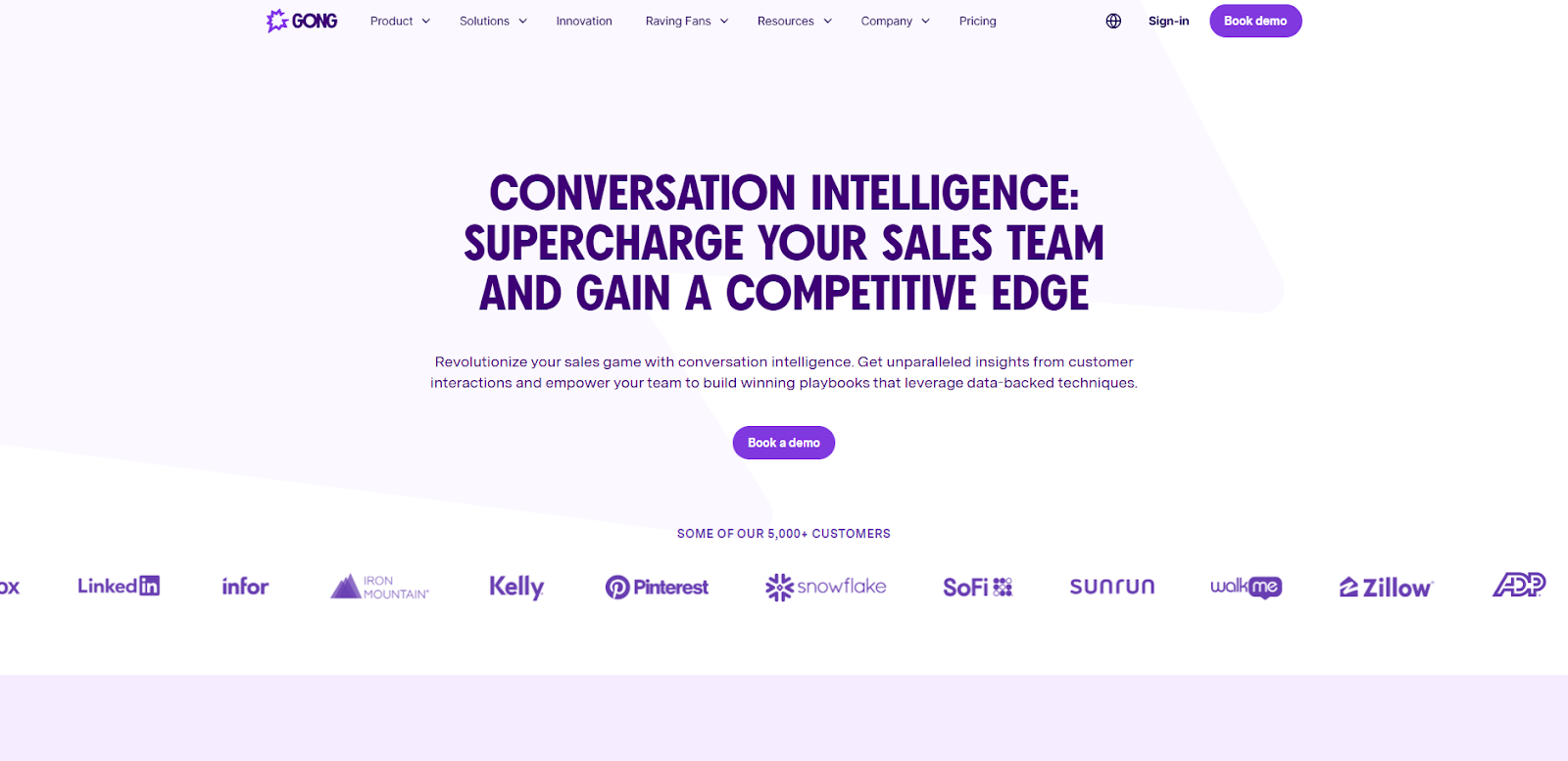
Gong captures and analyzes sales conversations to reveal what’s actually happening in deals. It helps enablement and revenue leaders understand patterns, risks, and behaviors that impact outcomes.
Best for: Conversation intelligence and deal risk analysis
Key features:
- Call and meeting transcription with thematic analysis
- Objection and competitor tracking
- Deal risk signals and coaching insights
- Performance comparisons across reps and teams
Use cases:
- Improving coaching quality with real data
- Identifying what top performers do differently
- Feeding conversation insights into enablement strategy
Takeaway: Gong helps sales teams understand why deals move or stall by turning real buyer conversations into actionable coaching and deal insights. It strengthens enablement by making call data usable, not just visible.
#4. Mindtickle
Mindtickle focuses on formal enablement programs where consistency, assessment, and readiness matter, especially for large or regulated teams.
Best for: Structured onboarding, certifications, and readiness tracking
Key features:
- Role-based onboarding and certification paths
- Video coaching and pitch practice
- Skills assessments and readiness scoring
- Enablement analytics tied to performance
Use cases:
- Scaling onboarding across regions or roles
- Certifying sellers before they go live
- Tracking skill development over time
Takeaway: Mindtickle is built for structured onboarding and readiness, ensuring reps are certified, consistent, and confident before they’re trusted in live selling environments.
#5. Seismic
Seismic helps sales teams organize, personalize, and deliver content at scale, with AI-driven recommendations based on buyer behavior and deal context.
Best for: Enterprise-grade content management and buyer engagement
Key features:
- AI-powered content recommendations
- Buyer engagement tracking
- Sales playbooks and guided selling
- Deep CRM integrations
Use cases:
- Delivering personalized content to buyers
- Measuring which assets influence deals
- Aligning sales and marketing content strategy
Takeaway: Seismic ensures sales teams always share the right message with the right buyer by aligning content, personalization, and buyer engagement tracking into a single enablement system.
#6. Highspot
Highspot combines content management with training and analytics to help teams understand what’s being used and what’s working.
Best for: Enablement teams balancing content, training, and analytics
Key features:
- AI-driven content discovery
- Training and coaching modules
- Usage and engagement analytics
- Deal-stage aligned recommendations
Use cases:
- Improving content adoption
- Connecting enablement efforts to revenue impact
- Coaching reps with data-backed insights
Takeaway: Highspot connects sales content performance to revenue outcomes, helping enablement teams see what actually influences deals, and double down on what works.
#7. Outreach
While known primarily as a sales engagement platform, Outreach’s AI features help reps prioritize actions, manage sequences, and reduce manual decision-making.
Best for: Coordinating sales engagement with AI assistance
Key features:
- AI-assisted task prioritization
- Deal health and engagement signals
- Workflow automation across outbound motions
- CRM-native insights
Use cases:
- Keeping reps focused on the right accounts
- Reducing manual follow-ups
- Supporting consistent outbound execution
Takeaway: Outreach optimizes how reps execute follow-ups and sequences, using AI to improve timing, prioritization, and consistency across outbound and deal-stage engagement.
The most effective AI sales enablement tools in 2026 share one thing in common: they remove friction instead of adding complexity. Whether through agentic voice conversations, in-context guidance, or intelligent coaching, these platforms help sellers show up prepared, confident, and relevant, without drowning them in tabs or tools.
Strategies to build effortless AI sales enablement in 2026
Effortless sales enablement in 2026 doesn’t come from adding more tools. It comes from removing friction. The best teams aren’t training reps to “use enablement better.” They’re building systems where enablement happens naturally, in the background, while reps focus on selling.
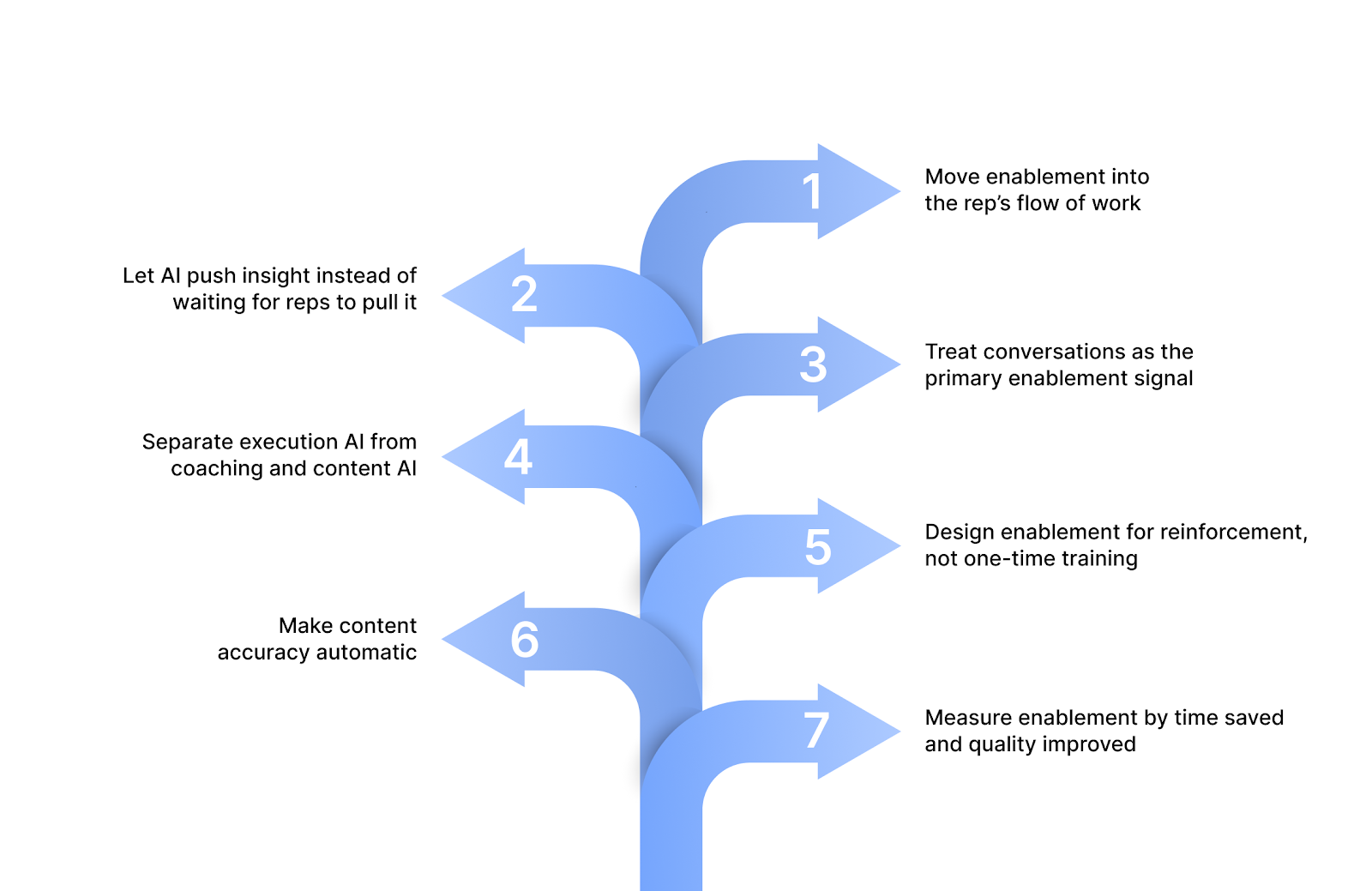
Here’s how modern teams are doing it:
1. Move enablement into the rep’s flow of work
Enablement fails when reps have to stop what they’re doing to go find answers.
In 2026, effective AI enablement lives inside the tools sellers already use: CRM, email, calling, Slack, and live conversations. The goal is zero searching.
Actionable strategy:
- Choose platforms that surface guidance, content, or insights contextually (based on deal stage, conversation signals, or buyer intent).
- Eliminate standalone enablement portals that require separate logins or manual navigation.
If enablement requires effort, it won’t scale. Loro, for example, automatically engages prospects via live voice conversations, interprets responses in real time, and surfaces only qualified opportunities, so reps don’t have to chase leads or sift through data, letting enablement scale effortlessly.
2. Let AI push insight instead of waiting for reps to pull it
Traditional enablement assumes reps will remember what they learned and know when to apply it. That assumption no longer holds.
AI flips the model.
Instead of reps pulling information from libraries or playbooks, AI pushes what’s needed at the exact moment of execution.
Actionable strategy:
- Use AI that monitors real signals: calls, emails, CRM changes, and live conversations.
- Trigger enablement automatically when those signals appear (e.g., objection mentioned, competitor named, meeting booked, intent detected).
This shift from memory-based selling to moment-based selling is what makes enablement feel effortless.
3. Treat conversations as the primary enablement signal
In 2026, the most valuable sales data doesn’t come from dashboards or forms. It comes from conversations.
Modern AI enablement platforms analyze voice, language, sentiment, and hesitation to understand what buyers are actually saying—and where reps need support.
Actionable strategy:
- Prioritize tools that learn from live or recorded conversations, not just activity logs.
- Use AI insights from calls to drive coaching, content recommendations, and next-step guidance automatically.
Enablement works best when it reacts to what’s happening in real time, not after the deal is lost.
4. Separate execution AI from coaching and content AI
One of the biggest mistakes teams make is expecting a single tool to do everything.
In 2026, AI sales enablement stacks are modular by design. Some AI systems execute (starting conversations, qualifying intent, activating campaigns). Others support (coaching reps, delivering content, improving consistency).
Actionable strategy:
- Use agentic AI for execution-heavy tasks at the top of the funnel (e.g., outbound conversations, qualification, follow-up).
- Use enablement AI for reinforcement, coaching, content delivery, and process consistency after intent is confirmed.
Effortless enablement happens when reps only enter the process once real opportunity exists.
5. Design enablement for reinforcement, not one-time training
Most sales training still happens in bursts: onboarding, quarterly rollouts, or one-off sessions. The problem? Reps forget.
AI enables continuous reinforcement instead of static training.
Actionable strategy:
- Replace long-form training with short, in-context nudges tied to real work.
- Use AI to detect skill gaps automatically and recommend targeted reinforcement without manager intervention.
In 2026, enablement isn’t an event. It’s an ongoing system that adapts as reps sell.
6. Make content accuracy automatic
Outdated or conflicting content quietly kills deals. Reps lose confidence, buyers lose trust, and enablement teams spend weeks cleaning up messes after the fact.
AI can prevent this before it happens.
Actionable strategy:
- Use AI to monitor content freshness, usage, and performance continuously.
- Automatically surface only verified, current assets inside selling workflows.
Effortless enablement means reps never have to wonder if what they’re sharing is “the right version.”
7. Measure enablement by time saved and quality improved
In 2026, the most important enablement metric isn’t content usage or course completion. It’s rep time.
The best AI enablement strategies reduce:
- Prep time before calls
- Admin work after calls
- Low-intent conversations
- Manager involvement in basic coaching
Actionable strategy:
- Track how much selling time AI gives back to reps.
- Measure improvements in conversation quality, intent detection, and deal progression, not just activity volume.
When enablement feels effortless, reps don’t talk about it. They just sell better.
Effortless AI sales enablement in 2026 isn’t about smarter dashboards or better playbooks. It’s about building systems that anticipate needs, act in real time, and stay out of the rep’s way.
The teams that win will be the ones where AI handles execution, context, and reinforcement, so humans can focus on what they do best: real conversations and closing deals.
Conclusion: Achieving end-to-end AI sales enablement
Most sales enablement efforts fall short because they stop at preparation instead of execution. Reps are trained, content is created, and tools are deployed, but the hardest part of sales still depends on manual effort. First contact is inconsistent, follow-ups slip, and valuable intent signals are lost before a deal ever reaches a human seller.
This is where agentic AI changes the equation. Loro by Cloudtech extends sales enablement into live execution by handling outbound conversations through human-like voice interactions.
The result is a connected enablement engine where outreach, qualification, handoff, and closing work together by design. Sales teams spend less time preparing and chasing, and more time engaging buyers who are already ready to talk.
Teams that adopt this model gain a lasting edge: higher-intent conversations, faster pipeline movement, and AI enablement that actively moves deals forward instead of just supporting them.
See how Loro by CloudTech fits into a modern AI sales enablement stack. Book a Demo Today and experience agentic outbound in action.
FAQs: AI sales enablement
How does AI sales enablement support outbound GTM teams?
AI enablement ensures outbound reps engage the right prospects with the right message by aligning outreach, qualification signals, and content recommendations before a human ever joins the conversation.
Does AI sales enablement replace sales training and coaching?
No. It complements them. Instead of one-time training sessions, AI reinforces best practices continuously through real-time nudges, call feedback, and contextual guidance.
How does AI sales enablement stay accurate as messaging and products change?
Modern platforms use AI to govern content automatically, flag outdated materials, and surface only approved, current messaging, so reps never rely on stale information.
What metrics indicate successful AI sales enablement?
Common indicators include reduced prep time per call, higher content adoption, improved meeting quality, faster ramp for new reps, and increased conversion from qualified conversation to opportunity.
Is AI sales enablement useful for teams without large enablement resources?
Absolutely. AI allows small enablement or GTM teams to support more reps with consistent guidance, without scaling manual oversight.