

Airline customer support has shifted from a back-office function to a real-time operational layer. Every delay or cancellation triggers thousands of passenger interactions across voice, messaging, and mobile apps within minutes. Airlines are expected to respond instantly, maintain context, and resolve issues without pushing passengers into queues.
A leading US airline, for example, automated 31% of cancellation calls and 64% of wheelchair-service requests using multimodal AI, while maintaining CSAT between 82–90% and freeing agents for complex cases.
This blog explores what conversational AI means for airlines, why support systems are under pressure, key use cases, and the shift toward real-time passenger engagement; and what airlines need to get right in 2026.
Key Highlights:
- Airline support is shifting from queue-based systems to real-time passenger engagement during live disruptions
- Disruptions create simultaneous, high-stakes interactions across voice, apps, and messaging channels
- Conversational AI now supports rebooking, updates, and assistance during active travel moments
- Real-time engagement reduces delays, improves resolution speed, and eases pressure on support teams
- Loro enables voice-first, continuous conversations that drive faster resolution during critical situations
What Is Conversational AI for Airlines Customer Support?
Conversational AI in airlines is no longer a front-end support layer; it operates as part of the airline’s real-time operations. Every passenger interaction, whether during booking or a disruption, now sits within a continuous flow of updates across voice, messaging, and mobile apps.
Instead of handling isolated queries, modern conversational systems are embedded into live travel scenarios. They assist passengers while flights are delayed, gates change, or rebooking becomes necessary; making them part of disruption management, not just support.
What defines conversational AI in airline support today:
- Real-time support across voice, messaging, and mobile channels
- AI-driven passenger interactions tied to live operational events
- Context-aware responses based on booking history and travel stage
- Continuous engagement instead of one-time query handling
As airlines deal with high-volume, high-stakes interactions, conversational AI is becoming a core support infrastructure; helping manage passenger communication as it happens, not after the fact.
Why Airline Customer Support Is Under Pressure in 2026
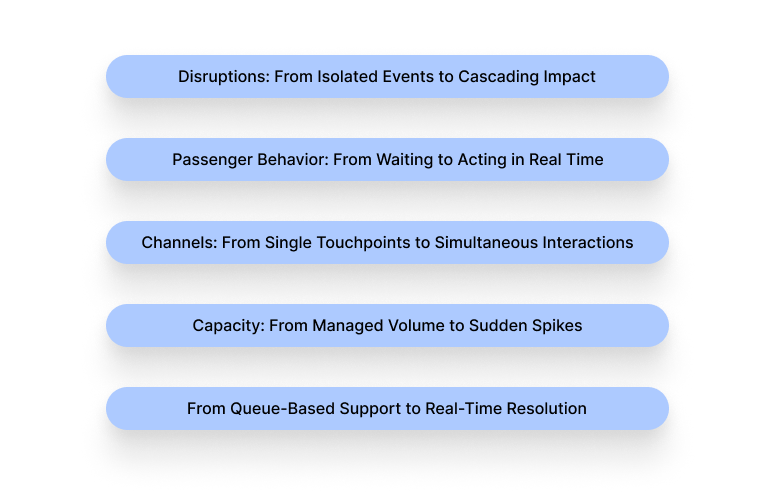
Airline customer support has traditionally been structured around queues. Passengers raise requests, wait for responses, and get resolution when an agent becomes available. This model worked when interactions were predictable and spread out over time.
Today, that model is breaking. Support demand is no longer linear; it spikes instantly, often triggered by live operational events. When disruptions happen, thousands of passengers need help at the same moment, not eventually.
Disruptions: From Isolated Events to Cascading Impact
Airline operations are tightly interconnected. A delay in one location can ripple across routes, crews, and schedules. Weather disruptions, technical issues, and airport congestion often lead to:
- Missed connections
- Last-minute cancellations
- Sudden rebooking demand
Instead of isolated support requests, airlines face waves of passenger issues unfolding in real time.
Passenger Behavior: From Waiting to Acting in Real Time
Passengers are no longer willing to wait in queues during disruptions. They actively try to resolve issues while their journey is still in progress. This means:
- Rebooking attempts happen immediately after delays
- Multiple support channels are used at once
- Passengers expect instant clarity on next steps
Support is no longer reactive; it is expected to keep pace with live travel decisions.
Channels: From Single Touchpoints to Simultaneous Interactions
Airline support is no longer limited to call centers. Passengers move between:
- Voice calls
- Mobile apps
- Messaging platforms
- Airport counters
Often within the same journey.
This creates overlapping interactions where the same passenger may engage across multiple channels simultaneously, expecting continuity.
Capacity: From Managed Volume to Sudden Spikes
Support teams cannot scale instantly during peak disruption periods. Airlines face:
- Staffing constraints during high-demand windows
- Sharp spikes in cancellations and rebooking requests
- Increased complexity per interaction
Even well-staffed teams struggle when demand surges within minutes.
From Queue-Based Support to Real-Time Resolution
The core challenge is not just volume; it is concurrency. Thousands of passengers need resolution at the same time, during high-stress situations.
Traditional systems process requests sequentially. But during disruptions, delayed responses directly impact passenger outcomes.
Airline support is now shifting from queue-based handling to real-time interaction models; where systems must respond instantly, maintain context, and support passengers as events unfold.
How Can Conversational AI Optimize Airline Customer Service
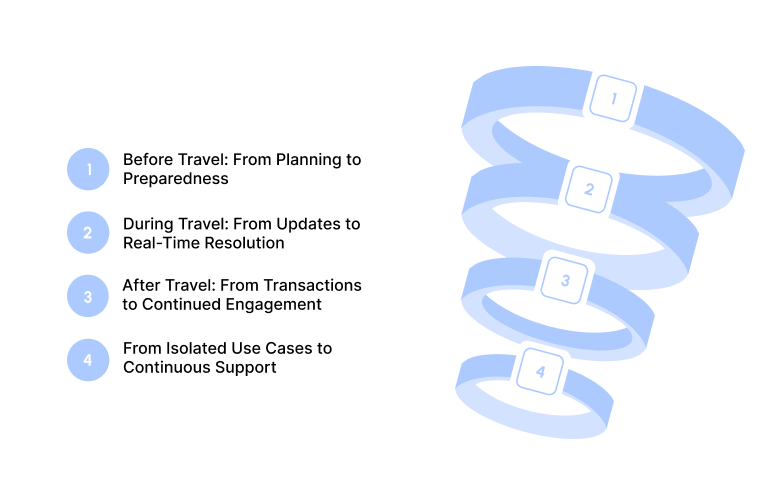
Conversational AI in airlines is most effective when aligned with how passengers actually experience travel; not as isolated features, but as support across key journey moments.
From planning to post-travel engagement, these systems handle continuous passenger interactions across voice and messaging channels.
Before Travel: From Planning to Preparedness
Before a trip begins, passengers need clarity and quick access to information. This is where conversational systems help reduce friction early in the journey.
They support:
- Booking assistance through voice and messaging interactions
- Itinerary management and modifications
- Baggage rules and policy-related queries
- Pre-travel reminders and updates
Instead of navigating static pages or waiting for support, passengers can resolve queries conversationally and move forward faster.
During Travel: From Updates to Real-Time Resolution
This is the most critical phase, where disruptions and uncertainty are highest. Conversational AI becomes part of live travel operations, helping passengers respond to changes as they happen.
Key use cases include:
- Real-time flight status updates and gate changes
- Rebooking during delays, cancellations, or missed connections
- Multilingual passenger assistance across global routes
- Voice-based support for urgent or high-friction scenarios
Here, voice interactions play a crucial role; especially when passengers need immediate help without navigating apps or typing queries.
After Travel: From Transactions to Continued Engagement
Support does not end when the journey is complete. Post-travel interactions shape long-term passenger relationships and loyalty.
Conversational AI enables:
- Refund processing and follow-ups
- Loyalty program support and personalized offers
- Feedback collection and issue resolution
- Re-engagement for future travel
From Isolated Use Cases to Continuous Support
Across all stages, the role of conversational AI is expanding. It is no longer about handling individual requests; it is about maintaining continuous, context-aware passenger interactions across voice and messaging channels.
This journey-based approach sets the foundation for real-time engagement, especially during high-impact moments like disruptions.
If you want to turn conversations into qualified opportunities at scale, see how Loro enables real-time outbound engagement—book a live demo.
Benefits of Conversational AI for Airlines in 2026
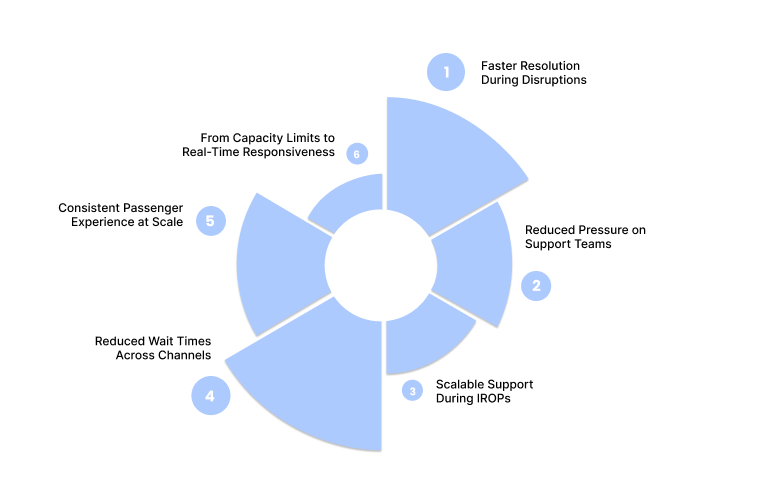
The value of conversational AI in airlines is not abstract, it shows up during operational stress. When disruptions hit and passenger demand spikes, these systems help airlines respond faster, maintain consistency, and reduce pressure on support teams handling high volumes.
Faster Resolution During Disruptions
When flights are delayed or canceled, speed directly impacts passenger outcomes. Conversational AI enables immediate interaction, helping passengers rebook, get updates, or explore alternatives without waiting in queues.
This leads to:
- Faster passenger rerouting during cancellations and missed connections
- Shorter resolution windows for time-sensitive requests
- Reduced dependency on manual intervention for routine scenarios
Reduced Pressure on Support Teams
Support teams often carry the burden during peak disruption periods. Conversational systems absorb a significant portion of high-frequency requests, allowing agents to focus on complex, high-value interactions.
Operational impact includes:
- Reduced load on call centers during disruption spikes
- Lower dependency on overflow or temporary staffing
- Better allocation of human agents to critical cases
Scalable Support During IROPs
Irregular operations (IROPs) create unpredictable demand surges. Traditional systems struggle to scale instantly, but conversational AI can handle large volumes of simultaneous interactions.
This enables:
- Consistent support across thousands of concurrent passenger requests
- Continuity of service even during large-scale disruptions
- Stable performance without degradation in response times
Reduced Wait Times Across Channels
Passengers often face long hold times during peak travel periods. Conversational AI distributes interactions across voice and messaging channels, reducing bottlenecks.
Key outcomes:
- Lower call wait times and faster first responses
- Immediate engagement through messaging and voice interfaces
- Smoother handling of multi-channel support demand
Consistent Passenger Experience at Scale
During high-pressure scenarios, consistency becomes difficult to maintain across teams and channels. Conversational systems ensure that passengers receive accurate, policy-aligned responses every time.
This results in:
- Uniform handling of cancellations, refunds, and policy queries
- Fewer errors during high-volume interaction periods
- More predictable support outcomes across channels
From Capacity Limits to Real-Time Responsiveness
The core benefit is not just handling more queries, it is the ability to respond when it matters most. Airlines move from being constrained by support capacity to operating with systems that can engage passengers instantly, at scale, and in real time.
What Matters Most in 2026: Real-Time Passenger Engagement
Airline support is moving from reactive ticket handling to continuous passenger engagement. This shift is being driven by how disruptions actually unfold; fast, unpredictable, and across multiple touchpoints at once.
Why Delayed Support Breaks During Disruptions
Traditional support models rely on queues and sequential handling. That approach fails when operational events cascade across the network.
During disruptions:
- Queues grow faster than they can be resolved
- Passengers switch between voice, apps, and messaging channels
- Support interactions lose context across touchpoints
- Delayed responses lead to missed rebooking opportunities
The result is not just slower support, it is fragmented passenger experiences during critical travel moments.
Why Airlines Are Shifting to Real-Time Engagement
To keep up with live travel scenarios, airlines are moving toward systems that engage passengers as events unfold, not after.
This includes:
- Proactive notifications during delays and cancellations
- Conversational rebooking while flights are still changing
- Live itinerary assistance based on real-time updates
- Voice-based escalation handling for urgent situations
Instead of waiting for passengers to reach out, support becomes an active part of the travel experience.
Why Continuity Across Channels Matters
Passengers do not think in channels, they think in journeys. Yet most support systems treat each interaction separately.
In practice, a single passenger may move between:
- Mobile apps
- Messaging platforms
- Voice calls
- Airport counters
When context is lost between these touchpoints, passengers are forced to restart conversations, repeat information, and navigate delays again.
From Interactions to Continuous Conversations
The next phase of airline support is not about handling more tickets,it is about maintaining continuous, context-aware conversations across the entire journey.
Real-time engagement ensures that:
- Passengers receive support without interruption
- Context carries across channels and interactions
- Resolution happens within the flow of travel, not outside it
This shift defines what effective conversational AI looks like in 2026, and sets the foundation for how airlines manage passenger experience at scale.
Loro: Moving From Airline Automation to Real-Time Support Execution
Most conversational AI systems in airlines improve interaction quality but fall short in execution. They handle queries, automate responses, and support workflows, yet struggle to operate effectively during real-time disruptions.
This creates a gap between support capability and passenger expectations.
Platforms like Loro are built to close this gap by enabling real-time, conversation-driven passenger support.
With Loro, airlines move:
- From queue-based handling → real-time passenger conversations
- From reactive support → proactive disruption engagement
- From fragmented interactions → continuous, context-aware journeys
Loro turns conversational AI into live, execution-ready support, helping airlines engage passengers during critical travel moments, not after.
What Loro Enables
1. Real-time voice-to-voice passenger engagement at scale: Loro initiates and manages live conversations with passengers, enabling immediate interaction during delays, cancellations, and high-stress travel scenarios.
2. Immediate support during disruption events: Instead of waiting for passengers to reach out, Loro engages as disruptions occur, supporting rebooking, updates, and next steps in real time.
3. Adaptive conversations, not scripted workflows: Loro responds dynamically based on passenger context, travel status, and urgency, allowing conversations to evolve naturally rather than follow rigid flows.
4. Context-aware interaction across channels: It maintains continuity across voice, messaging, and other touchpoints, ensuring passengers do not have to repeat information or restart conversations.
5. Seamless transition from interaction to resolution: Loro connects conversations directly to outcomes, whether it is rebooking, itinerary changes, or issue resolution within the same interaction.
Proven Impact
- 130K+ calls dialed
- 10K+ conversations handled
- 8–25% pickup rates
Instead of relying on delayed workflows and fragmented support systems, airlines can operate with real-time conversational infrastructure, capable of handling passenger needs as they arise, at scale, and without loss of context.
Conclusion: Achieving Real-Time Passenger Engagement
Most airlines are already using conversational AI, but many still struggle to apply it where it matters most: during live travel disruptions. Automation improves response capacity, yet passenger interactions often remain reactive, delayed, and disconnected from real-time journey events.
Loro helps close that gap by turning conversational AI into real-time support execution. Its agentic, voice-to-voice AI engages passengers instantly, adapts to travel context, supports decisions during disruptions, and connects interaction directly to resolution outcomes.
The result is a more resilient support model, where conversational AI does more than assist. It actively manages passenger engagement, maintains continuity across channels, and drives faster resolution during critical travel moments.
See how Loro enables real-time passenger engagement at scale. Book a demo today.
FAQs
1. How do airlines handle sudden spikes in customer support demand?
Airlines typically rely on a mix of overflow staffing, outsourcing, and digital support systems. However, during large-scale disruptions, these measures often fall short. Increasingly, airlines are adopting real-time conversational systems to handle simultaneous passenger interactions without creating long queues.
2. Can conversational AI integrate with airline reservation systems?
Yes, modern conversational systems are designed to integrate with Passenger Service Systems (PSS), booking engines, and CRM platforms. This allows them to access live flight data, booking details, and passenger history to provide accurate, context-aware responses.
3. How does conversational AI support multilingual passengers?
Conversational AI can handle multiple languages across voice and messaging channels, allowing airlines to support global passengers without scaling language-specific support teams. This is especially important during international travel disruptions.
4. What role does voice play in airline customer support?
Voice remains critical, especially in urgent or high-stress situations like cancellations or missed connections. Conversational AI enables airlines to handle voice interactions at scale, providing immediate assistance without long hold times.
5. Is conversational AI secure for handling passenger data?
Airline-grade conversational systems are built with security and compliance in mind. They follow strict data protection standards and integrate with existing secure infrastructure to ensure passenger information is handled safely.