
AI has already reshaped how teams discover and qualify potential customers, turning what used to be manual prospecting into a data-driven engine for growth. Today’s AI lead generation tools can scan large datasets, predict buying intent, and personalize outreach faster than any traditional workflow.
But in 2026, the next frontier is no longer just faster analysis or better scoring. As GTM teams raise their outbound volume and aim for higher-quality first touches, a new category is emerging at the center of lead generation: voice-to-voice agentic AI.
Instead of relying solely on emails, forms, or static chatbots, AI agents can now hold natural phone conversations, interpret intent in real time, and qualify prospects with the same nuance as a trained rep.
This blog breaks down how AI lead generation is changing, why voice-to-voice agentic AI is redefining outbound GTM, and where Loro fits in this next wave.
Key insights at a glance
- AI lead generation is shifting from passive scoring to active conversation, with agentic voice-to-voice AI becoming the defining outbound innovation of 2026.
- Conversational AI upgrades pipeline quality and volume, ensuring faster first touches, fewer missed leads, and more consistent qualification.
- Agentic AI integrates easily with CRM and GTM data, creating a self-improving system that adapts to buyer behavior and strengthens topline growth.
- Modern outbound motions scale without headcount, as AI handles repetitive dials and early qualification while human reps focus on higher-value selling.
- Loro by Cloudtech introduces an autonomous frontline for GTM teams, making thousands of humanlike calls and qualifying prospects in real time.
What is AI lead generation? The rise of conversational AI
AI lead generation refers to the use of AI technologies to identify, attract, and nurture potential customers with greater speed and accuracy. Instead of relying solely on manual research or static rules, AI can automate repetitive work, analyze large datasets, and surface the prospects most likely to convert.
This allows GTM teams to focus their time on high-value conversations rather than administrative tasks. According to Salesforce, modern AI tools improve lead quality through capabilities such as intelligent scoring, behavioral analysis, and personalized outreach, creating a more efficient, precise, and scalable pipeline engine.
How AI enhances lead generation today:
- Efficiency: AI automates segmentation, scoring, and data cleanup so teams spend less time on manual prep.
- Precision: Machine learning models identify intent signals and patterns that reveal higher-quality prospects.
- Scalability: AI systems process massive datasets, enabling consistent lead management even as volume grows.
- Personalization: AI tailors messages and timing to each prospect, improving engagement and conversions.
The shift toward conversational AI
The next major evolution is happening now: AI is moving from silent data analysis to active, conversational engagement. Agentic voice-to-voice AI, like Loro, introduces an entirely new frontline for lead generation, where autonomous systems can initiate outbound calls, interpret intent, handle objections, and qualify prospects in real time.
This represents the first time AI can not only find high-potential leads, but also talk to them, enabling:
- Real-time qualification through natural dialogue
- More consistent outreach to every segment
- Faster routing of ready-to-buy prospects to human reps
- A GTM motion that scales without adding headcount
In 2026, this shift marks the beginning of AI-driven outbound that is proactive, conversational, and fully integrated into the sales engine.
How does AI lead generation work? (and how agentic AI improves it)
AI for lead generation works by automating the steps traditionally handled by SDRs, which include researching prospects, qualifying interest, and initiating first contact.
Most teams use AI inside CRM systems to score leads, send personalized emails, and surface intent signals so reps can prioritize the right accounts.
But the next shift is already underway: AI is moving from passive automation to active, conversational engagement. Instead of only scoring leads or sending emails, agentic AI like Loro can speak to prospects, interpret intent, and advance them through early pipeline stages autonomously.
How traditional AI lead gen works:
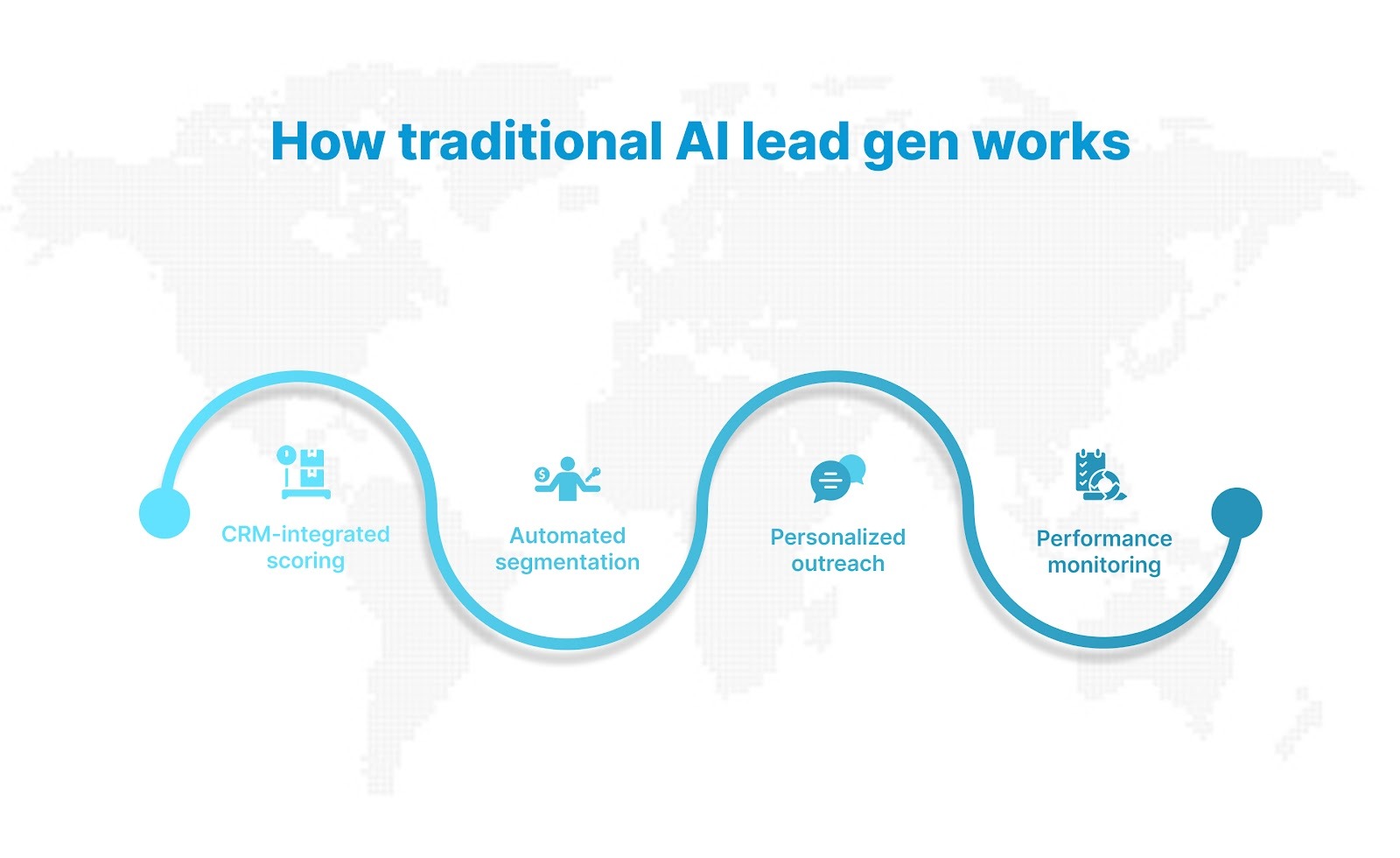
- CRM-integrated scoring: AI ranks prospects based on behavior, fit, and probability of conversion.
- Automated segmentation: Prospect data is grouped by ICP criteria, product needs, or buying stage.
- Personalized outreach: NLP models generate tailored messaging for each audience segment.
- Performance monitoring: Teams track conversion rates, reply rates, and intent trends to refine targeting.
These systems streamline the process, but they still require human reps to handle calls, objections, and qualifications.
How agentic voice AI evolves lead generation
Agentic voice AI introduces a fundamentally new motion: autonomous outbound conversation. Instead of waiting for leads to respond to emails or forms, the AI initiates real-time dialogues at scale, giving GTM teams a new frontline engine for qualification.
Here’s what changes:
- Proactive engagement: AI calls thousands of prospects concurrently, reaching audiences that digital outreach often misses.
- Real conversational qualification: The system listens, asks follow-up questions, handles objections, and identifies intent signals instantly.
- Instant follow-ups: Prospects receive confirmations, meeting links, or handoffs without human bottlenecks.
- Continuous optimization: Transcripts, sentiment data, and connect metrics feed back into the GTM motion for improvement.
What this means for GTM teams:
- More qualified conversations without adding headcount
- Faster conversion from first touch → meeting booked
- Better use of rep time by eliminating repetitive dials
- Stronger pipeline coverage after events, campaigns, and launches
- A predictable, scalable layer of outbound that runs 24/7
While many tools assist with AI scoring and email automation, agentic voice AI is where the real step-change happens.
Loro by Cloudtech gives businesses an autonomous outbound engine, making thousands of calls, holding humanlike conversations, and qualifying leads in real time. It’s the next evolution of AI lead generation, built for GTM teams that need speed, scale, and accuracy.
How agentic AI signifies the biggest change in GTM execution
For most of the last decade, AI in lead generation focused on inputs, including better data, smarter enrichment, and more precise scoring. These tools helped teams decide who to reach, but they didn’t solve the hardest part of outbound: actually running consistent, high-quality execution at scale.
Agentic AI represents a structural shift. Instead of assisting humans with recommendations or automation, agentic systems take ownership of execution. They initiate outreach, manage live interactions, interpret responses as they happen, and determine next steps without waiting for human intervention.
This changes lead generation in several important ways:
- Execution replaces sourcing as the bottleneck: Modern GTM teams rarely lack leads; they lack the capacity to engage them effectively. Agentic AI moves value from list-building to real-time execution.
- Conversations become the unit of lead creation: Leads are no longer generated by forms, clicks, or sequences. They are created through live conversations where intent, timing, and objections surface naturally.
- Qualification happens inside the interaction: Instead of scoring leads after the fact, agentic systems assess interest during the conversation itself, deciding whether to advance, pause, or disengage.
- Momentum is preserved end to end: Because the system owns dialing, follow-ups, and early-stage dialogue, opportunities don’t stall between handoffs or depend on rep availability.
- Human sellers enter only when it matters: Sales teams engage once intent is clear and context is already established, making pipeline more predictable and time-to-opportunity shorter.
In GTM terms, agentic AI collapses multiple outbound stages, including first touch, follow-up, early qualification, and routing, into a single execution layer that runs continuously. It doesn’t replace sales teams; it removes the operational drag that keeps them from focusing on closing.
Loro by Cloudtech exemplifies this shift. As an agentic voice-to-voice system, it applies these principles in practice by running live outbound conversations, qualifying intent in real time, and advancing only sales-ready opportunities, showing how lead generation in 2026 is increasingly defined by execution, not data alone.
Strategies for designing an AI-enabled outbound GTM motion
Building a modern, scalable outbound motion requires more than just adding AI tools; it means rethinking how GTM workflows operate from first touch to qualification. Agentic AI, especially voice-to-voice systems, becomes most effective when it’s woven into existing processes rather than layered on top of legacy outreach.
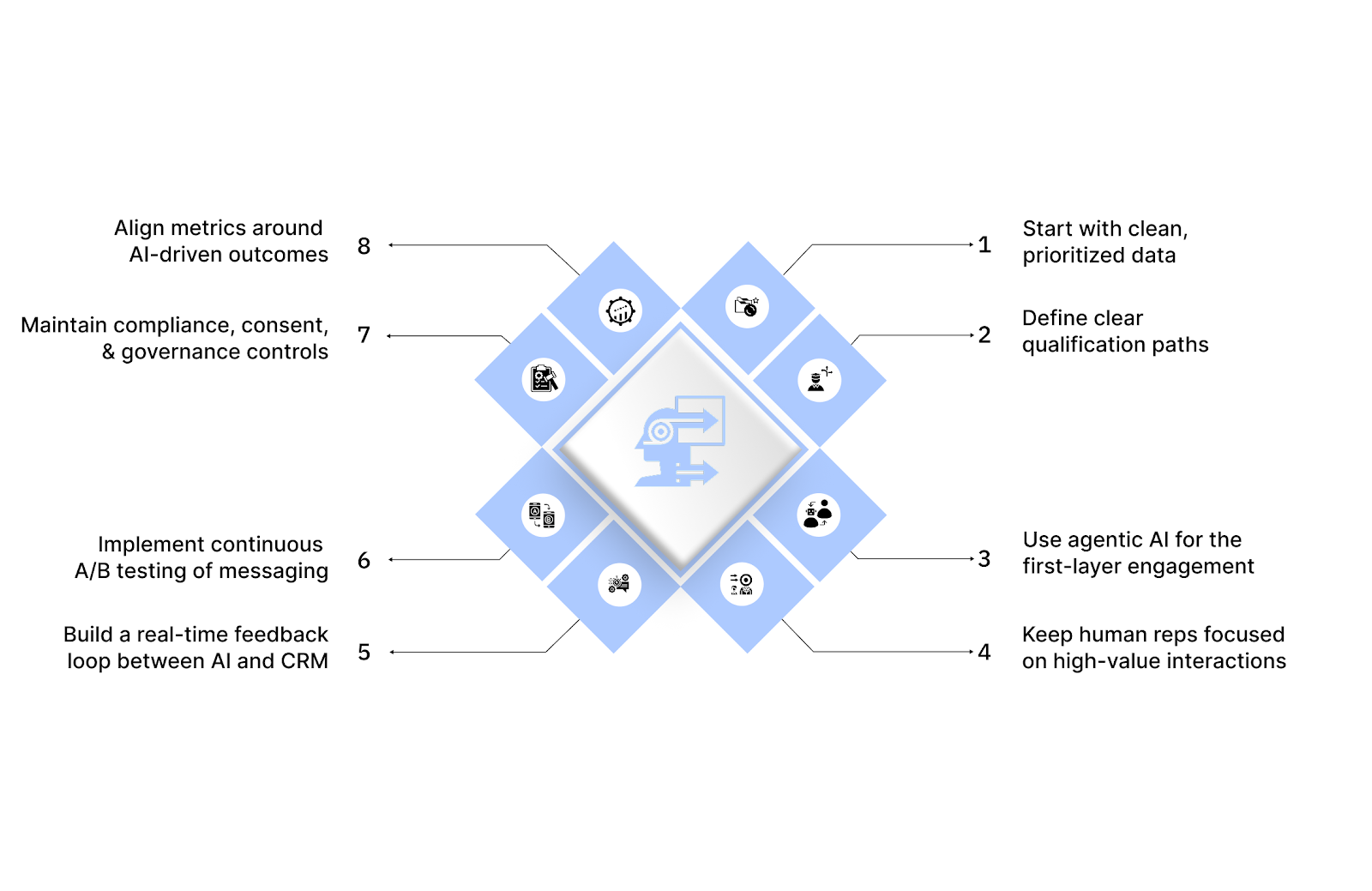
Here are the strategies high-performing teams use to create a high-efficiency, AI-enhanced GTM workflow:
1. Start with clean, prioritized data
Agentic AI performs best when your CRM and targeting data are accurate.
- Remove duplicates and outdated contacts.
- Prioritize accounts by ICP fit, buying stage, and territory.
- Align GTM teams on which lists should be activated through AI first.
This ensures AI outreach focuses on high-yield targets instead of burning cycles on unqualified lists.
2. Define clear qualification paths
AI-driven conversations should follow the same logic your reps use.
- Outline qualification triggers (interest, urgency, budget signals).
- Create branching paths for objections and common scenarios.
- Align qualification criteria with your CRM fields to avoid manual cleanup.
This builds consistency into thousands of conversations and ensures AI-qualified leads meet rep expectations.
3. Use agentic AI for the first-layer engagement
Human teams shouldn’t spend time dialing, waiting on rings, or navigating IVRs. Agentic AI can handle:
- First outreach attempts
- Re-engaging cold and dormant lists
- Post-event follow-up
- Early-stage qualification
- Scheduling and warm handoff
This preserves rep time for deeper selling conversations while ensuring every account gets touched.
4. Keep human reps focused on high-value interactions
As AI handles volume and first contact, reps should shift to:
- Mid-funnel progression
- Account-specific strategy
- Technical conversations
- Multi-threading key opportunities
This division of labor increases team productivity without increasing headcount.
5. Build a real-time feedback loop between AI and CRM
Efficiency emerges when AI and CRM data reinforce each other.
- Log every conversation, objection, and sentiment change.
- Feed AI outcomes (interested, engaged, warm) into lead scoring.
- Use these insights to adjust ICP lists and campaign messaging.
This creates a self-improving outbound engine where learning compounds rapidly.
6. Implement continuous A/B testing of messaging
Agentic AI makes it easy to run structured outbound experiments at scale. Test variations of:
- Opening lines
- Qualification questions
- Value propositions
- Event follow-up scripts
The goal isn’t automation, it’s precision. AI gives teams a fast way to identify what resonates in each territory or segment.
7. Maintain compliance, consent, and governance controls
A modern GTM system must stay compliant as volume increases.
- Enforce consent management and DNC rules.
- Use encrypted call recordings.
- Maintain clear audit trails in CRM.
These guardrails let teams scale confidently without risking compliance violations.
8. Align metrics around AI-driven outcomes
Track the metrics that matter for an agentic AI–enabled motion:
- Connect rate
- Conversation-to-warm rate
- Meeting booked rate
- Speed-to-connect after events
- Pipeline created per AI campaign
This prevents teams from optimizing for vanity metrics like dials or email opens.
Takeaway: Driving a predictable pipeline and strengthening topline growth
Agentic AI doesn’t just make outbound faster; it makes pipeline creation more predictable and revenue growth more dependable.
By engaging thousands of prospects simultaneously through natural, humanlike voice conversations, AI expands the top of the funnel without expanding headcount.
How it enhances pipeline quality and volume:
- Higher coverage: Every lead is contacted within minutes or hours, not days.
- Better qualification: AI screens for fit and intent, ensuring reps only receive sales-ready conversations.
- Reduced leakage: No more missed follow-ups or stale lists that never get activated.
- Faster cycle velocity: Prospects move from first touch to meeting booked at unprecedented speed.
How it contributes to topline impact:
- More qualified interactions = more meetings
- More meetings = more pipeline
- More pipeline = stronger, more predictable topline revenue
This is how modern GTM teams transform outbound from a manual, inconsistent channel into a scalable revenue engine, one where conversational AI does the heavy lifting and humans focus on closing.
When businesses want to operationalize these strategies at scale, Loro makes it possible, powering high-volume, humanlike conversations that turn first contact into a pipeline within days.
Conclusion: Transform lead generation with agentic AI
For growing GTM teams, the mandate is clear: choose solutions that are secure, cloud-native, and built to scale. Loro by Cloudtech transforms lead data, CRM signals, and multi-channel engagement into real pipeline outcomes, without adding operational complexity. Its autonomous agents extend sales capacity, enrich leads in real time, and surface intent signals earlier in the funnel.
As markets shift toward automation-first prospecting, Loro becomes a future-ready partner for GTM teams, helping them build stronger pipelines, enter new markets with precision, and reduce lead leakage across the funnel. Teams can generate, qualify, and activate leads faster than traditional workflows allow.
For businesses ready to turn raw interest into measurable revenue growth, Loro offers the strategic advantage that makes next-generation lead generation possible today. To see how it can accelerate your GTM pipeline in 2026, Book a Demo Today.
FAQs: Agentic AI for lead generation
How does agentic AI improve early-funnel lead quality?
Agentic AI autonomously verifies contact data, enriches profiles from trusted sources, and evaluates fit based on predefined ICP rules. This reduces bad data and ensures only accurate, relevant leads enter the funnel.
Can AI identify buying intent without third-party data providers?
Yes. Modern agentic systems can infer intent from behavioral signals, such as website activity, email replies, content engagement, and historical CRM patterns, without relying solely on external intent feeds.
Does AI-supported lead generation work for small outbound teams?
Correct. AI agents reduce manual research and follow-up tasks, helping small teams run larger outreach programs without increasing headcount. This creates a steadier, more predictable pipeline.
How does agentic AI maintain accuracy as markets change?
Agentic systems continuously retrain on new conversation data, CRM outcomes, and pipeline results. This ongoing adaptation keeps qualification logic and targeting aligned with real buyer behavior.
What metrics should teams track when using AI for lead generation?
Key indicators include enrichment accuracy, first-touch speed, qualification rate, cost per qualified lead, and pipeline contribution. These metrics show whether AI is improving top-of-funnel efficiency and revenue impact.