

AI is already shaping how buyers evaluate vendors. According to Forrester, 94% of B2B buyers now use AI in their buying process, often before engaging with sales teams.
At the same time, AWS conversational AI services like Amazon Lex and Amazon Transcribe are making it easier to build systems that understand and respond to human language.
But access to these capabilities is not the same as execution.
Most GTM teams struggle to turn AWS conversational AI into something that fits seamlessly into outbound workflows. Building, integrating, and managing real-time conversations is complex.
This blog explores how AWS conversational AI is changing sales, where it falls short for outbound execution, and how platforms like Loro turn it into real, pipeline-driving conversations.
Key takeaways:
- AWS conversational AI enables real-time interaction and scale, but turning these capabilities into consistent, pipeline-driving outbound execution remains complex.
- Most GTM teams struggle not with AI access but with execution, as building, integrating, and managing real-time conversations on AWS requires significant effort.
- Buyer expectations are shifting toward instant, relevant interaction, making static outreach and sequence-based outbound models increasingly ineffective today.
- Outbound sales in 2026 requires real-time engagement, voice-led interaction, and persistent context, which are not delivered by AWS conversational AI alone.
- Platforms like Loro turn AWS conversational AI into execution by enabling real conversations, qualifying intent, and driving pipeline through scalable outbound interactions.
What is AWS conversational AI? Significance in 2026
AWS conversational AI refers to a set of cloud services that enable systems to understand, process, and respond to human language across voice and text. Instead of a single product, it is a stack of capabilities that teams combine to build conversational experiences.
At the core of this stack are services like:
- Amazon Lex for natural language understanding and dialogue management
- Amazon Transcribe for converting spoken input into text
- Amazon Polly for generating human-like voice responses
Together, these enable three foundational functions:
- Speech recognition (voice → text)
- Language understanding (intent and context detection)
- Response generation (text or voice output)
Why this matters in 2026
These capabilities are reshaping how sales teams think about interaction. Instead of relying on static outreach, teams can now build systems that:
- Engage prospects through voice or text in real time
- Handle conversations at scale
- Integrate with CRM and data systems
This opens the door to more dynamic, responsive engagement across the outbound funnel.
The reality for GTM teams
However, AWS conversational AI is fundamentally infrastructure, not execution. While it provides the building blocks, teams still need to:
- Design conversation logic
- Manage dialogue flow and edge cases
- Integrate multiple services into a working system
- Ensure conversations actually drive outcomes
This is where many teams struggle. The technology can process language, but turning it into consistent, pipeline-generating outbound conversations requires more than just assembling services.
How AWS conversational AI is changing sales
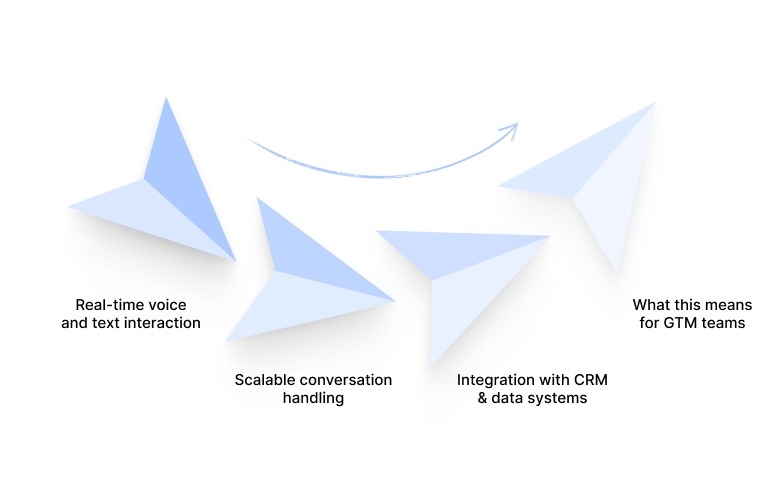
AWS conversational AI is reshaping sales by making real-time, scalable, data-driven interaction technically possible. It allows teams to process voice and text instantly, connect conversations to systems of record, and operate beyond human bandwidth.
But the distinction matters. AWS provides the infrastructure to enable conversations, not the logic to run outbound sales end-to-end.
Real-time voice and text interaction
With services like Amazon Transcribe and Amazon Polly, systems can process and respond to spoken or written input instantly.
This fundamentally changes interaction timing:
- Conversations can start and continue without delay
- Prospects no longer wait for the next touchpoint
- Engagement becomes event-driven rather than sequence-based
This aligns with broader buyer behaviour. 67% of B2B buyers prefer a rep-free experience for parts of their journey, indicating a shift toward faster, AI-mediated interaction.
However, AWS enables response speed, not conversation quality. The system can reply instantly, but it does not inherently decide how to guide a sales interaction.
Scalable conversation handling
Using Amazon Lex, teams can handle thousands of simultaneous interactions across channels.
This creates operational advantages:
- Outreach can run continuously without SDR constraints
- Global coverage becomes feasible without increasing headcount
- Common interactions can be standardized and handled consistently
But scalability at this level is primarily throughput-driven. It ensures that conversations can happen at scale, not that they will be:
- Contextually relevant
- Multi-turn and adaptive
- Progressively moving toward qualification or conversion
Without additional layers, these systems often remain limited to structured exchanges rather than dynamic sales conversations.
Integration with CRM and data systems
A major strength of AWS is its ability to integrate conversational systems with broader data infrastructure.
This allows conversations to be enriched with:
- CRM data such as account history, deal stage, and prior interactions
- External data sources for enrichment and personalization
- Workflow systems for routing, scoring, and follow-up actions
This matters because relevance directly impacts engagement. 73% of B2B buyers avoid sellers who send irrelevant outreach, making context-aware interaction essential.
In practice, integration enables:
- More informed responses based on account context
- Better routing of conversations to the right teams
- Alignment between conversation data and pipeline systems
Still, integration ensures data availability, not conversation effectiveness. Having context does not guarantee that the system can use it to drive a meaningful sales dialogue.
What this means for GTM teams
AWS conversational AI is shifting the foundation of sales engagement:
- Real-time interaction is now technically achievable
- Conversations can scale beyond human limitations
- Data can be embedded into every interaction
But these are enabling capabilities, not complete solutions. For GTM teams, the challenge is no longer access to AI. It is translating these capabilities into structured, adaptive, outcome-driven conversations that:
- Engage prospects effectively
- Handle variability in real interactions
- Progress toward qualified pipeline
That gap between capability and execution is what defines how conversational AI impacts outbound sales in 2026.
Why AWS conversational AI alone does not solve outbound sales
AWS provides powerful building blocks for conversational AI, but outbound sales is not a single capability. It is a coordinated system of timing, context, and interaction flow.
Most teams do not struggle because AWS is limited. They struggle because turning infrastructure into outbound execution is complex.
Requires stitching multiple services together
To create even a basic conversational system on AWS, teams must combine services like Amazon Lex, Amazon Transcribe, and Amazon Polly, along with backend systems.
This involves:
- Orchestrating multiple APIs and services
- Managing data flow between components
- Ensuring low-latency, real-time performance
Each layer adds complexity, especially when scaling across use cases.
Needs custom logic for conversation flow
AWS can process inputs and generate responses, but it does not define how a sales conversation should progress.
Teams must build:
- Dialogue structures for different scenarios
- Logic for handling objections and edge cases
- Rules for moving conversations toward qualification
This is where most systems break down. They can respond to inputs but cannot adapt dynamically across multi-turn conversations.
Hard to manage real-time outbound interactions
Outbound sales is not reactive. It requires initiating and sustaining conversations in real time.
That introduces challenges such as:
- Triggering conversations at the right moment
- Maintaining continuity across interactions
- Coordinating follow-ups without losing context
Even with AWS infrastructure, managing this at scale requires significant engineering and operational effort.
The execution gap
This is where the core issue lies. Despite widespread AI adoption, results remain inconsistent. Many organizations invest in AI capabilities but struggle to translate them into measurable outcomes.
The problem is not access to tools. It is the difficulty of turning those tools into repeatable, pipeline-driving workflows.
What this means for GTM teams
AWS conversational AI makes advanced interaction possible, but it does not deliver outbound execution out of the box.
For GTM teams, success depends on:
- Converting capabilities into structured conversations
- Ensuring interactions lead to qualification and meetings
- Maintaining consistency across scale
Without that layer, AWS remains a foundation, not a complete outbound solution.
What outbound sales actually needs in 2026
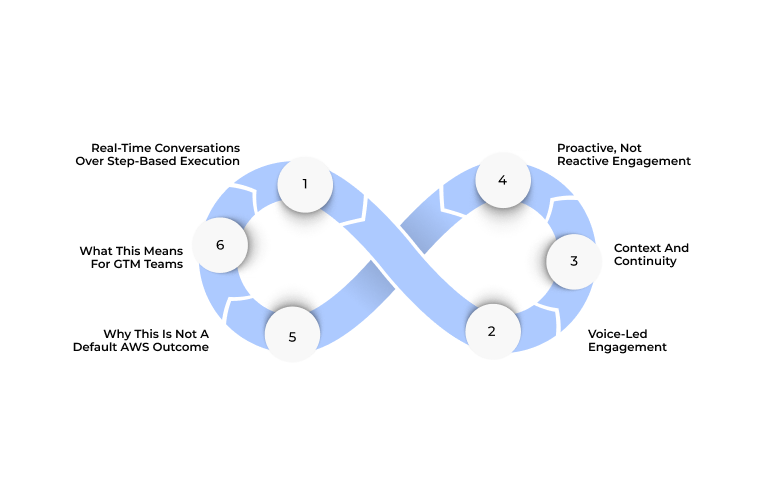
Outbound sales is no longer defined by sequences or activity volume. It is defined by how effectively teams can engage prospects in the moment and move interactions forward. The shift is from planned outreach to live, adaptive engagement.
This changes what teams actually need.
Real-time conversations over step-based execution
Modern outbound depends on timing. Prospects expect responses when they engage, not hours or days later.
That means teams need systems that can:
- Engage immediately when intent appears
- Maintain momentum without gaps
- Adjust direction based on responses
Sequences help structure outreach, but they cannot handle real-time interaction.
Voice-led engagement
Sales conversations are naturally verbal. Voice introduces speed, clarity, and nuance that text-based outreach cannot match.
It allows teams to:
- Handle objections more fluidly
- Move conversations forward faster
- Create interactions that feel closer to real sales conversations
This is what makes outbound feel less like a campaign and more like a conversation.
Context and continuity
Relevance in outbound comes from continuity. Each interaction should build on what came before, not restart from scratch.
In practice, this requires:
- Access to past conversation history
- Use of CRM and account-level context
- The ability to adapt responses based on prior interactions
Without this, even well-timed outreach feels generic.
Proactive, not reactive engagement
Most systems are built to respond. Outbound requires the ability to initiate and sustain interaction. This includes:
- Starting conversations based on signals or timing
- Re-engaging prospects without manual effort
- Continuing interactions without relying on SDR follow-ups
This is what turns outreach into a consistent pipeline engine.
Why this is not a default AWS outcome
AWS conversational AI provides the foundation for language processing, voice interaction, and system integration. But it does not inherently deliver:
- Real-time outbound conversation management
- Persistent context across interactions
- Proactive engagement logic
What this means for GTM teams
The gap is no longer about access to AI. It is about aligning those capabilities with how outbound actually works.
Teams that succeed will move beyond workflows and focus on managing conversations as they happen, ensuring that every interaction contributes to pipeline progression.
Turning AWS conversational AI into outbound execution
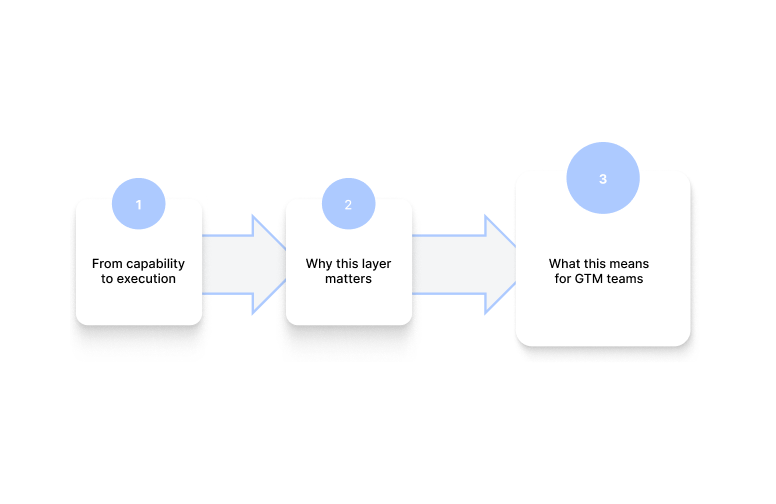
AWS makes conversational AI possible. It provides the infrastructure to process language, handle voice, and connect systems. But for most GTM teams, the challenge is not access to these capabilities. It is turning them into something that actually drives outbound pipeline.
This is where the gap shows up. Building on AWS means stitching services together, designing conversation logic, and managing real-time interactions. The result is often a system that can respond, but not consistently initiate, adapt, and progress sales conversations.
From capability to execution
Instead of building from scratch, platforms like Loro operationalize AWS conversational AI for outbound sales.
Loro acts as the execution layer on top of AWS, translating infrastructure into real, working outbound interactions. It does not replace AWS. It builds on it to deliver what GTM teams actually need.
In practice, this means:
- Initiating live, voice-to-voice conversations with prospects
- Engaging in real time rather than relying on sequences
- Handling objections and questions as they arise
- Qualifying intent during the interaction
- Routing only relevant opportunities to sales teams
Why this layer matters
AWS provides the foundation, but outbound success depends on how conversations are executed.
By adding an execution layer, teams can:
- Move from assembling tools to running conversations
- Replace delayed outreach with real-time engagement
- Ensure interactions consistently lead to pipeline outcomes
What this means for GTM teams
The shift is not about choosing between AWS and a platform. It is about closing the gap between capability and execution.
AWS enables conversational AI. Platforms like Loro make it usable for outbound sales by turning those capabilities into repeatable, scalable, pipeline-driving conversations.
How Loro powers conversational AI for outbound sales
Most conversational AI platforms stop at understanding language. They can respond, but they do not actively drive outbound pipeline.
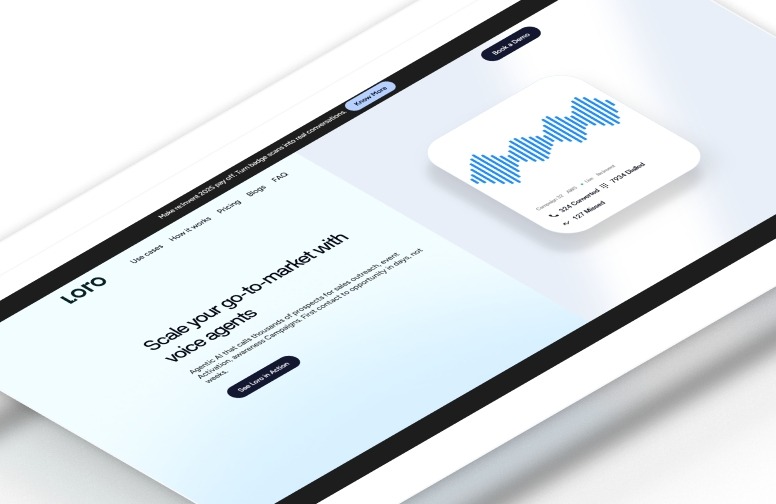
Loro is built for a different role. It applies conversational AI directly to outbound sales execution, where the goal is not just interaction, but creating and progressing pipeline through real conversations.
From conversational AI to outbound execution
While typical platforms focus on chat or support use cases, Loro operates where outbound breaks most often: the first interaction. It does this by:
- Initiating live, voice-to-voice conversations with prospects
- Engaging in real time instead of relying on sequences or delays
- Handling early objections and questions naturally
- Qualifying intent during the conversation itself
This turns conversational AI from a passive system into an active outbound engine.
What this means for GTM teams
In practical terms, Loro enables teams to:
- Run first-touch outreach without manual effort
- Maintain consistent engagement across all leads
- Filter out low-intent prospects before they reach sales
- Convert conversations into meetings faster
Instead of increasing SDR activity, it increases meaningful conversations that move the pipeline forward.
Why this matters in 2026
As outbound shifts from sequences to conversations, the limiting factor is no longer messaging quality. It is the ability to start and sustain real interactions at scale.
Loro addresses that gap directly.
Rather than supporting sales after interest exists, it helps create that interest through human-like, adaptive conversations, making it a core part of how modern GTM teams execute outbound.
In the context of conversational AI, Loro represents the shift from systems that respond to inputs to platforms that own the conversation from first touch to conversion.
How Loro uses AWS to power outbound conversations
AWS provides the underlying capabilities for conversational AI. Loro builds on top of this foundation to turn those capabilities into real outbound sales execution.
Instead of requiring teams to assemble and manage multiple services, Loro uses AWS infrastructure to deliver ready-to-run, conversation-driven outbound workflows.
From infrastructure to live conversations
Loro uses AWS services such as Amazon Transcribe, Amazon Polly, and Amazon Lex to power the core layers of interaction.
On top of this, it enables:
- Initiation of voice-to-voice conversations with prospects
- Real-time processing and response during interactions
- Natural handling of questions, objections, and intent signals
This removes the need for teams to build and coordinate these layers themselves.
Built for outbound sales, not generic interaction
Where AWS provides the ability to process and respond, Loro is designed to manage outbound conversations end to end.
This includes:
- Starting conversations based on outreach triggers
- Maintaining flow across multi-turn interactions
- Qualifying intent within the conversation
- Routing only relevant opportunities to human sellers
The focus is not just on interaction, but on progressing the conversation toward a clear outcome.
Scaling conversations without SDR constraints
Because Loro operates on top of AWS infrastructure, it can handle large volumes of simultaneous conversations without adding human bandwidth.
In practice, this allows teams to:
- Run consistent first-touch outreach across all leads
- Engage prospects instantly, regardless of volume
- Maintain quality of interaction at scale
This shifts outbound from a resource-limited function to a scalable system of engagement.
From AI capability to pipeline generation
The key shift is how conversational AI is applied.
- AWS enables language processing and voice interaction
- Loro turns those capabilities into pipeline-driving conversations
For GTM teams, this means moving from experimenting with AI features to running repeatable outbound execution that consistently generates qualified opportunities.
AWS makes conversational AI possible. Loro makes it work for outbound sales.
Conclusion: Turning AWS conversational AI into outbound execution
Most GTM teams are already investing in AWS conversational AI, but many still struggle to apply it where it matters most: pipeline creation and buyer engagement. The infrastructure is there, but first-touch outreach, qualification, and follow-up often remain fragmented, manual, or difficult to scale.
Loro helps close that gap by turning AWS conversational AI into real outbound execution. Its agentic, voice-to-voice AI initiates live conversations, qualifies intent in real time, and routes sales-ready opportunities to reps with context already attached.
The result is a more connected outbound motion where AWS conversational AI does more than enable capability, it helps drive pipeline.
See how Loro powers outbound GTM in action. Book a demo today.
FAQs
1. What AWS services are used to build conversational AI?
AWS conversational AI is typically built using services like Amazon Lex for natural language understanding, Amazon Transcribe for speech-to-text, and Amazon Polly for text-to-speech. These services work together to process input, interpret intent, and generate responses across voice and text interactions.
2. Can AWS conversational AI be used for outbound sales use cases?
Yes, AWS conversational AI can be adapted for outbound use cases, but it requires additional layers for conversation logic, orchestration, and real-time interaction. On its own, AWS provides the infrastructure, not a complete outbound execution system.
3. How long does it take to build a conversational AI system on AWS?
Timelines vary depending on complexity, but building a production-ready system often requires weeks or months. This includes integrating services, designing conversation flows, handling edge cases, and connecting with CRM and data systems.
4. What are the main challenges of using AWS conversational AI for sales?
Common challenges include managing multiple services, designing adaptive conversation flows, maintaining context across interactions, and ensuring conversations lead to meaningful outcomes like qualified leads or meetings.
5. Do sales teams need developers to implement AWS conversational AI?
In most cases, yes. Implementing AWS conversational AI typically requires engineering support to configure services, build integrations, and manage infrastructure. This can slow down adoption for GTM teams without technical resources.