

Modern buyers don’t wait patiently in funnels. They explore, hesitate, disengage, and re-engage on their own timeline. Traditional sales outreach struggles to keep pace with that behavior, especially when every interaction depends on manual effort.
Conversational AI for sales closes that gap. It enables GTM teams to engage prospects through natural, two-way conversations at scale, listening for intent, handling early questions, and responding instantly when interest appears.
In 2026, conversational AI has moved far beyond scripted bots. It acts as a front-line extension of the sales team, qualifying intent, warming conversations, and handing off context-rich opportunities to reps at exactly the right moment.
This shift is redefining how businesses connect with buyers, and how sales teams scale without burning out. In this article, you will explore what conversational AI for sales truly means in 2026 and how it’s reshaping modern go-to-market teams.
Key insights at a glance
- Conversational AI for sales in 2026 shifts from scripted automation to agentic, voice-driven systems that initiate, qualify, and advance real sales conversations.
- Outbound conversational AI matters most because it creates pipeline proactively, qualifying intent live instead of waiting for buyers to raise their hand.
- Agentic voice AI scales first-touch outreach, handles objections in real time, and delivers context-rich opportunities directly to human sellers.
- Modern conversational AI works as an execution layer, compressing time from first contact to qualified meeting through live intent detection.
- When optimized correctly, conversational AI turns outbound sales into a repeatable, scalable system driven by conversations, not manual activity.
What is conversational AI for sales? Relevance in 2026
Conversational AI in sales refers to AI systems that can engage prospects in real, two-way conversations, understand intent as it’s expressed, and take action based on that understanding.
In 2026, this category has moved far beyond text chat and scripted bots. The most advanced form is agentic, voice-to-voice conversational AI is AI that speaks, listens, reasons, and responds like a human sales rep would.
Unlike traditional automation that supports sales around the conversation, agentic conversational AI operates inside it. It can initiate calls, ask qualifying questions, handle early objections, detect buying signals, and decide what to do next in real time. This makes it especially powerful for sales teams that need to scale conversations, not just workflows.
Conversational AI’s real impact on sales depends on whether it waits for buyers to engage or takes the initiative itself. In 2026, that difference increasingly separates tools that support sales from systems that actively create and enhance pipelines.
Conversational AI for inbound vs. outbound sales:
Inbound conversational AI helps businesses respond faster and route interest efficiently. It’s valuable, but it depends on buyers raising their hand first.
Outbound conversational AI is different, and more transformative.
Why conversational AI matters most for outbound sales
Outbound has always been the hardest part of sales to scale. It requires timing, persistence, relevance, and human judgment, all at once. Email sequences and dialers automate activity, but they don’t create conversations. Reps still spend hours dialing, following up, and guessing who’s actually interested.
Agentic conversational AI changes that dynamic. Voice-based AI can initiate thousands of conversations, listen for real intent, and qualify prospects before a human ever joins. Instead of reps chasing leads, qualified conversations are delivered to them with context attached.
This is why conversational AI is becoming foundational for outbound GTM in 2026. It compresses the gap between first touch and opportunity, eliminates wasted effort on low-intent accounts, and ensures human reps spend time where it matters most: live conversations that are already moving forward.
For businesses, the result is simple but powerful, with more meaningful conversations, faster pipeline creation, and outbound sales that finally scale like software.
How conversational AI for sales works in practice
Once conversational AI moves beyond theory, its real value shows up in execution, especially in outbound sales. Modern sales-focused conversational AI systems operate as continuous, real-time workflows rather than isolated interactions.
Instead of waiting for buyers to engage, agentic conversational AI initiates outreach, manages live conversations, and advances prospects through the funnel autonomously.
The outbound conversational AI workflow
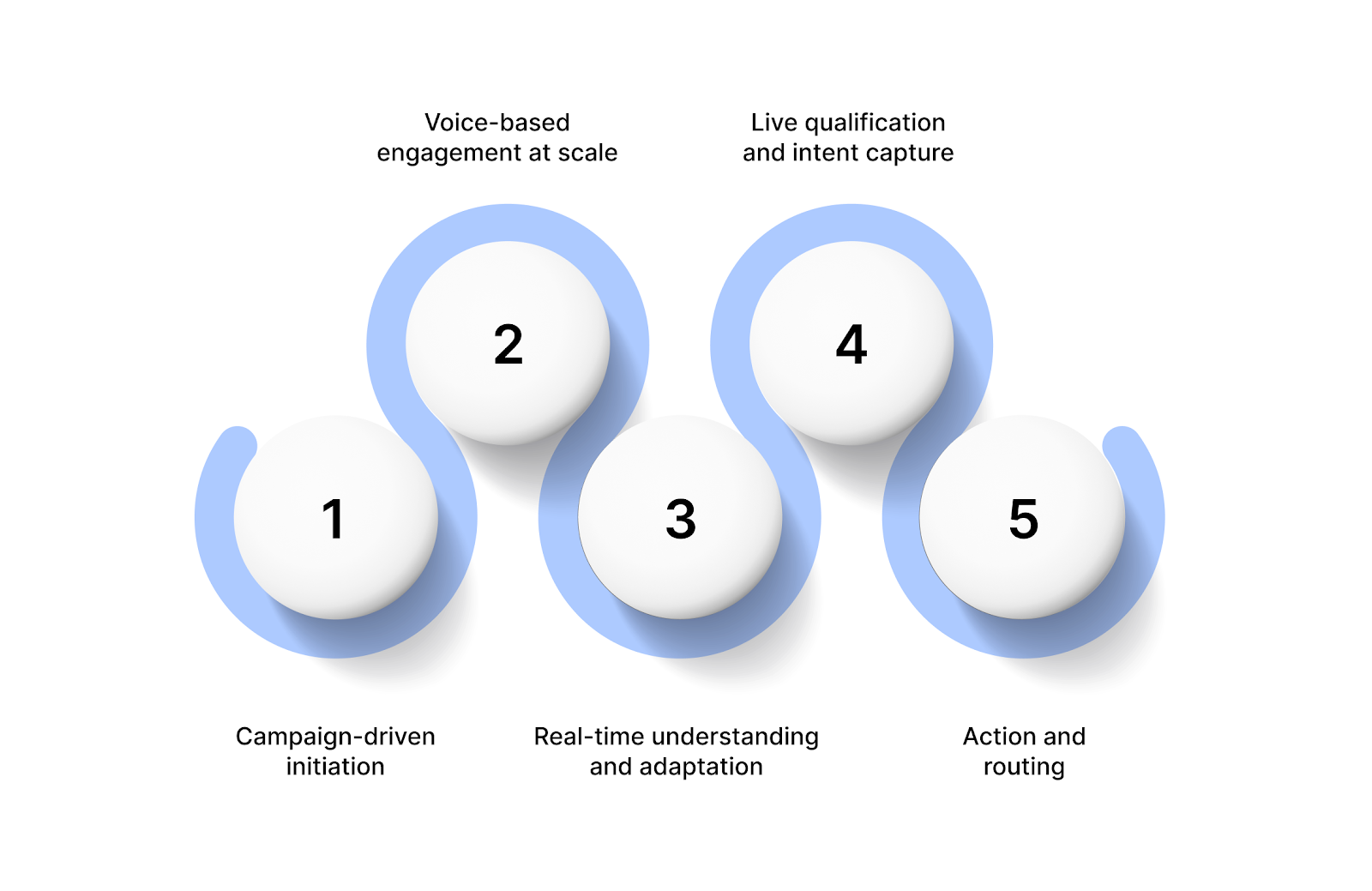
In an outbound sales context, conversational AI follows a clear operational sequence:
1. Campaign-driven initiation: Conversational AI starts with a defined GTM objective, which can be sales outreach, event follow-up, or awareness. The system is configured with messaging, qualification criteria, and ideal customer profile (ICP) parameters aligned to specific offerings or campaigns.
2. Voice-based engagement at scale: The AI places outbound calls concurrently, managing dialing logic, retries, voicemail detection, and IVR navigation automatically. When a prospect answers, the AI stays in the conversation rather than handing it off, enabling immediate engagement without human involvement.
3. Real-time understanding and adaptation: As the prospect speaks, conversational signals such as intent, hesitation, objections, and sentiment are interpreted live. Responses adjust dynamically based on what the prospect says, allowing conversations to flow naturally instead of following rigid scripts.
4. Live qualification and intent capture: Throughout the call, the system evaluates whether the prospect shows interest, engagement, or buying readiness. Qualification happens through conversation, not forms, scoring models, or post-call analysis.
5. Action and routing: When intent is confirmed, the AI takes action immediately. This may include booking a meeting, triggering a follow-up, or notifying sales teams with full conversational context attached. Prospects without intent are filtered out automatically.
This closed-loop process allows outbound sales motions to move continuously, without waiting for manual review or rep availability.
What enables this to work reliably
Conversational AI for sales relies on several operational layers working together:
- Speech recognition and NLP to interpret spoken language and conversational nuance
- Dialogue management to maintain flow and decide next actions in real time
- Qualification logic aligned to ICP, campaign goals, and sales criteria
- Automation layers that trigger meetings, alerts, and follow-ups instantly
- Conversation analytics that generate transcripts, intent signals, and performance metrics
These systems improve with volume. Each conversation strengthens qualification accuracy and response handling over time.
Applying this model in outbound GTM
Loro by Cloudtech applies this conversational AI workflow directly to outbound GTM for AWS partners. It initiates live voice conversations, handles early objections, classifies intent during the call, and routes only qualified opportunities forward. By operating before a human rep is involved, Loro removes manual dialing, repeated follow-ups, and early-stage guesswork from the sales process.
The result is outbound execution that scales through conversations, not activity, allowing sales teams to spend their time where it matters most: engaging prospects who are already ready to talk.
Turn first conversations into qualified meetings at scale. See how Loro by Cloudtech enables outbound GTM—book a live demo.
Best practices for optimizing outbound sales with conversational AI
Conversational AI delivers the most value in outbound sales when it’s treated as a selling system, not just a dialing layer. Teams that see real gains focus on how voice-to-voice agents fit into their GTM motion, how conversations are designed, and how humans and AI work together.
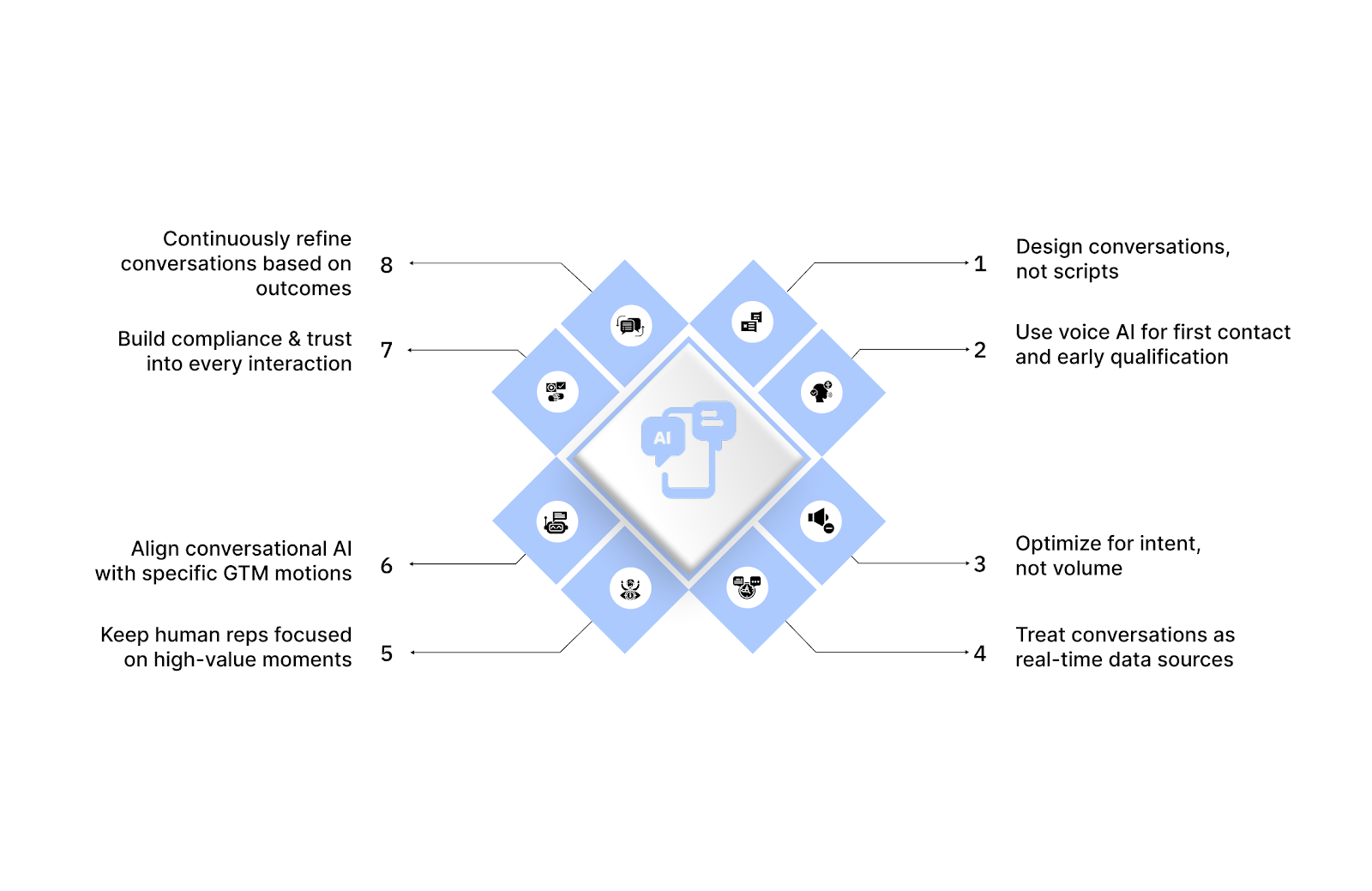
Here are some best practices to extract the most value from conversational AI in sales:
1. Design conversations, not scripts
Static scripts limit conversational AI. High-performing teams structure conversations around goals and decision paths instead of word-for-word responses.
Agentic voice AI should understand intent, handle interruptions, and adapt tone based on how the prospect responds, creating a natural exchange rather than a linear pitch.
So, define conversation objectives, qualifying signals, and objection themes, then allow the AI to navigate dynamically within those boundaries.
2. Use voice AI for first contact and early qualification
Outbound sales breaks down most often at the first touch. Agentic voice-to-voice AI performs best when it handles initial outreach, where scale and consistency matter most.
By qualifying interest live, AI prevents reps from spending time on uninterested or misaligned prospects.
So, let conversational AI own first contact, intent detection, and early objections before handing off to human sellers.
3. Optimize for intent, not volume
High call volume alone doesn’t improve pipeline quality. Modern conversational AI systems are most effective when optimized around intent signals such as engagement, curiosity, and readiness to continue the conversation.
So, measure success by qualified conversations, not dials or pickup rates, and continuously refine qualification criteria based on outcomes.
4. Treat conversations as real-time data sources
Every outbound call generates valuable intelligence. Agentic conversational AI can capture sentiment, objections, and engagement patterns that traditional outreach misses.
So, use conversation-level insights to adjust messaging, improve targeting, and inform downstream sales and enablement decisions automatically.
5. Keep human reps focused on high-value moments
Conversational AI works best when it removes low-value work from reps’ plates. That means no manual dialing, no repeated follow-ups, and no guesswork around who is worth calling.
So, route only qualified, context-rich conversations to human sellers so they enter deals with clarity, timing, and intent already established.
6. Align conversational AI with specific GTM motions
Outbound conversational AI is most effective when tied to defined use cases such as sales outreach, event follow-up, or territory warming. Generic deployment leads to generic results.
So, configure separate conversational flows for each GTM motion, with distinct messaging, qualification logic, and success metrics.
7. Build compliance and trust into every interaction
Voice-to-voice AI operates in regulated, trust-sensitive environments. Long-term success depends on respecting consent, honoring do-not-call rules, and maintaining transparent data handling.
So, ensure conversational AI enforces compliance automatically so scale never comes at the cost of trust or brand credibility.
8. Continuously refine conversations based on outcomes
Outbound markets change quickly. Conversational AI systems improve when teams regularly review outcomes and adjust conversation logic accordingly.
So, analyze which conversations convert, which objections stall progress, and where prospects disengage, then refine flows to reflect real buyer behavior.
When optimized correctly, agentic voice-to-voice conversational AI becomes more than an outreach tool. It becomes a scalable execution layer that starts conversations, qualifies intent, and feeds human sellers only the opportunities that matter.
Conclusion: Turning conversational AI into real sales execution
Most sales teams invest heavily in enablement but still struggle where it matters most: real conversations. Playbooks, training, and content prepare reps for outreach, yet first contact, follow-ups, and early qualification remain manual, inconsistent, and easy to miss. That gap is where deals quietly stall.
Loro by Cloudtech changes this dynamic by moving enablement into live execution. The agentic voice AI solution can initiate outbound conversations, qualify intent in real time, and pass context-rich opportunities to human sellers at the right moment. Instead of supporting sales from the sidelines, Loro becomes an active participant in the pipeline.
The outcome is a connected sales motion where outreach, qualification, and handoff work as one system. Reps focus on engaged buyers, pipelines move faster, and conversations, not tasks, drive growth.
See how Loro applies conversational AI to outbound sales execution. Book a Demo Today to experience agentic voice-driven selling in action.
FAQs: AI sales enablement
1. Is conversational AI for sales the same as a sales chatbot?
No. Conversational AI for sales, especially agentic voice AI, goes beyond chatbots. It conducts real-time, voice-to-voice conversations, understands intent, asks follow-up questions, and takes actions like qualifying leads or booking meetings, rather than responding to scripted prompts.
2. How does conversational AI improve outbound sales performance?
Conversational AI removes manual bottlenecks in outbound sales by initiating calls at scale, handling first conversations consistently, and capturing intent signals instantly. This ensures no lead goes untouched and sales reps engage only when interest is confirmed.
3. Can conversational AI replace human sales representatives?
No. Conversational AI is designed to augment sales teams, not replace them. It handles early-stage conversations and qualification, then hands off warm, context-rich opportunities to human reps for closing and relationship building.
4. How does conversational AI know when a lead is sales-ready?
Agentic conversational AI evaluates intent signals during live conversations, such as engagement level, objections, buying timelines, and responses to qualifying questions. These signals determine when a prospect should be escalated to a human seller.
5. Is conversational AI for sales compliant and secure?
Modern conversational AI platforms are built with enterprise-grade security controls, including consent management, call recording permissions, encryption, and regulatory compliance such as SOC 2. Compliance safeguards are embedded directly into the outbound workflow.