

Conversational AI is no longer an emerging technology. It is already part of how modern teams operate. Today, 75% of knowledge workers use AI at work, and nearly half started using it within the last six months, showing how quickly adoption is accelerating.
Yet adoption alone does not guarantee impact. Many teams implement conversational AI, but struggle to translate it into meaningful engagement or measurable outcomes.
This creates a gap between using AI and using it effectively.
High-performing teams approach conversational AI differently. They move beyond basic chatbots and workflows, focusing instead on real-time interaction, continuous conversations, and outcome-driven engagement.
This blog explores the best practices that set these teams apart, where most implementations fall short, and what it takes to turn conversational AI into real execution.
Key Highlights:
- Conversational AI adoption is rising fast, but most teams still struggle to move from basic automation to real interaction and outcomes.
- Traditional implementations rely on chatbots and workflows, which limit engagement due to delayed responses and rigid conversation design.
- Foundational best practices like intent recognition, context retention, and multi-turn handling are critical but not enough on their own.
- High-performing teams focus on real-time engagement, continuous conversations, voice-first interaction, and outcome-driven design.
- Platforms like Loro close the gap between design and execution by enabling real-time, scalable conversations that drive measurable results.
What Are Conversational AI Best Practices?
Conversational AI best practices are the principles and design approaches that ensure AI systems deliver meaningful, natural, and effective interactions, not just functional responses. They go beyond building chatbots or automating replies and focus on how conversations are structured, delivered, and continuously improved.
At a basic level, many teams implement conversational AI to handle tasks like answering questions or routing requests. But as adoption scales, the difference between working systems and high-performing systems becomes clear.
Why Best Practices Matter As Adoption Scales
As more teams deploy conversational AI, expectations shift from simple automation to quality of interaction. Poorly designed systems create friction, while well-designed ones improve engagement and outcomes.
Without clear best practices, teams often face:
- Inconsistent user experiences across channels
- Low engagement despite high interaction volume
- Limited ability to handle real-world, unpredictable conversations
Best practices provide a framework to ensure conversations are relevant, timely, and aligned with user intent, even at scale.
The Gap Between Basic Implementation And High-Performing Systems
Not all conversational AI systems are built the same. The gap lies in how deeply they handle interaction.
Basic implementations typically:
- Follow predefined scripts or decision trees
- Respond only when prompted
- Treat each interaction as a standalone event
High-performing systems, on the other hand:
- Adapt to context and user behavior in real time
- Maintain continuity across interactions
- Guide conversations toward meaningful outcomes
The difference is not just technical. It is strategic. Conversational AI is no longer about whether a system can respond. It is about how effectively it can engage, adapt, and move conversations forward.
Where Most Conversational AI Implementations Fall Short
Conversational AI adoption has grown quickly, but performance has not kept pace. Many systems are deployed with the goal of automation, yet they struggle to deliver meaningful engagement or measurable outcomes.
The issue is not the technology itself. It is how it is implemented.
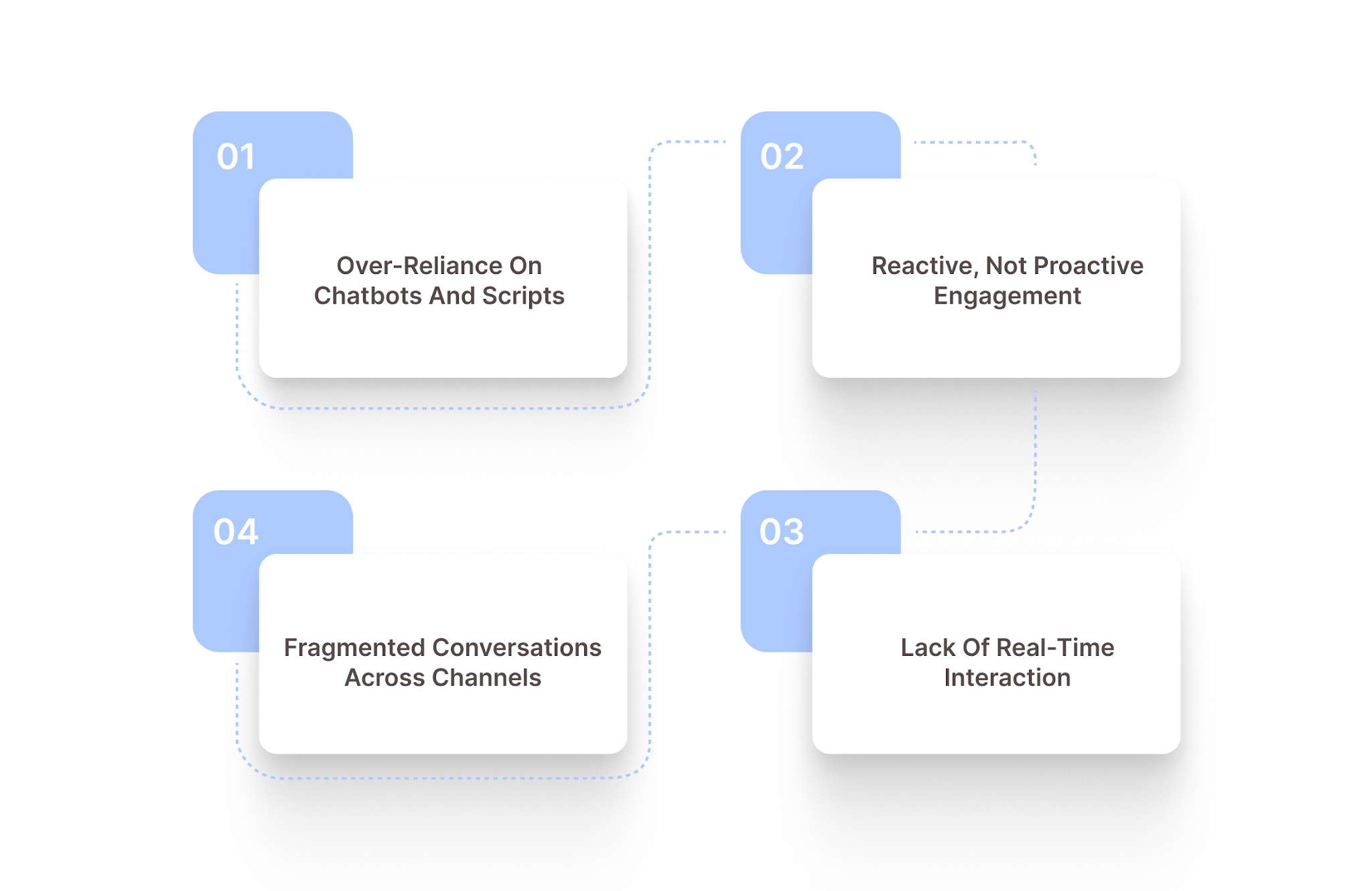
Over-Reliance On Chatbots And Scripts
Most implementations are built around chatbots that follow predefined scripts or decision trees. While this works for simple queries, it breaks down in real-world scenarios where conversations are less predictable.
As a result:
- Interactions feel rigid and repetitive
- Users drop off when responses do not match intent
- Systems fail to handle complexity
Reactive, Not Proactive Engagement
Many systems are designed to respond only when a user initiates interaction. They do not actively engage, follow up, or guide the conversation forward.
This leads to:
- Missed opportunities to continue engagement
- Conversations that end too early
- Limited ability to influence outcomes
Lack Of Real-Time Interaction
Even when automation exists, responses are often delayed or tied to workflows. This creates gaps between user intent and system response.
The impact:
- Loss of momentum during interaction
- Reduced engagement quality
- Lower conversion or completion rates
Fragmented Conversations Across Channels
Users engage across multiple channels, but most systems treat each interaction in isolation. Context is rarely carried forward, leading to disconnected experiences.
This results in:
- Repetitive interactions
- Inconsistent communication
- Poor overall user experience
The pattern is clear. Many conversational AI systems are designed to complete tasks, not manage conversations.
Until this shifts, teams will continue to see limited impact, regardless of how advanced the underlying technology is.
10 Core Conversational AI Best Practices to Follow in 2026
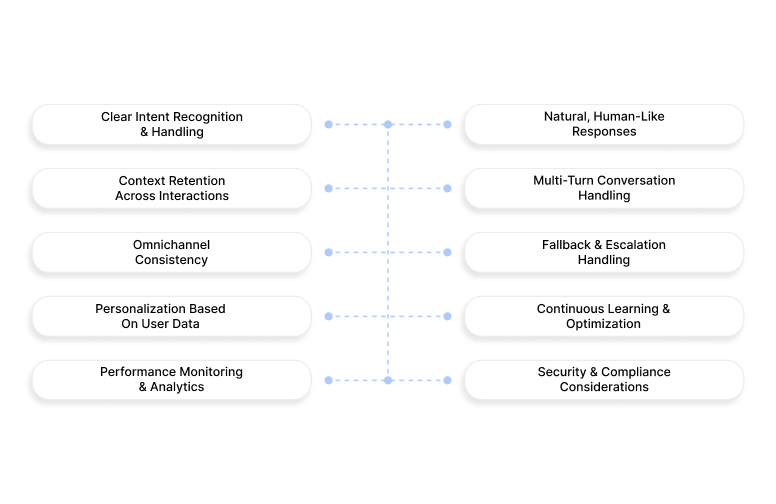
High-performing conversational AI systems are not defined by features alone. They are defined by how well they handle real interaction. Below are ten best practices used by top teams, with clear guidance on how to implement each and what outcomes to expect.
1. Clear Intent Recognition And Handling
Intent recognition is the foundation of any conversational system. Every interaction depends on the system’s ability to correctly interpret what the user is trying to achieve. Even small errors at this stage compound quickly, leading to irrelevant responses, broken flows, and user frustration.
How to implement:
- Train models on real conversation data, not synthetic examples
- Continuously refine intent mapping based on failed or ambiguous queries
- Use fallback classification to capture edge cases instead of forcing incorrect matches
Accurate intent handling reduces early friction, improves response relevance, and creates a stable foundation for the entire conversation experience.
2. Natural, Human-Like Responses
Conversational AI is judged not just by what it says, but how it says it. Responses that feel rigid or scripted reduce trust and make interactions feel transactional rather than conversational.
How to implement:
- Use simple, conversational language instead of technical phrasing
- Vary responses to avoid repetition and scripted patterns
- Design replies that acknowledge user context before answering
Natural responses increase user trust, improve engagement quality, and make conversations feel intuitive rather than forced.
3. Context Retention Across Interactions
Users expect conversations to carry forward context, whether within a single session or across multiple interactions. Systems that fail to retain context create fragmented experiences and force users to repeat information.
How to implement:
- Store and reference session-level context within conversations
- Maintain user-level memory across interactions where relevant
- Use context to avoid asking repetitive questions
Strong context retention enables smoother, more efficient conversations, reduces redundancy, and creates a more cohesive user experience.
4. Multi-Turn Conversation Handling
Real conversations are not linear. Users ask follow-up questions, change direction, and provide incomplete information. Systems must handle this complexity without breaking flow or forcing users into rigid paths.
How to implement:
- Design flows that allow clarification and follow-up questions
- Break complex tasks into guided conversational steps
- Handle interruptions or topic changes without losing progress
Effective multi-turn handling improves task completion rates, supports more complex interactions, and allows conversations to progress naturally rather than mechanically.
5. Omnichannel Consistency
Users no longer interact through a single channel. They move between chat, voice, email, and messaging platforms, often within the same journey. If conversations do not carry over seamlessly, it creates friction and forces users to repeat themselves, breaking the experience.
How to implement:
- Standardize conversation logic across chat, voice, and messaging platforms
- Sync user data and interaction history across channels
- Ensure tone and response style remain consistent
Consistent omnichannel experiences reduce repetition, improve continuity, and build trust by making interactions feel connected rather than fragmented.
6. Fallback And Escalation Handling
No conversational AI system can handle every possible query. What differentiates strong systems is how they respond when they fail, whether they recover gracefully or create frustration.
How to implement:
- Detect low-confidence responses and trigger clarification prompts
- Provide clear paths to human escalation when needed
- Log fallback scenarios to improve future performance
Well-designed fallback handling keeps conversations moving, reduces user frustration, and ensures that gaps in capability do not lead to complete interaction breakdowns.
7. Personalization Based On User Data
Generic interactions limit the value of conversational AI. Personalization allows systems to respond based on who the user is, what they have done, and what they are trying to achieve, making interactions more relevant and efficient.
How to implement:
- Use available data such as preferences, history, or behavior
- Tailor responses based on user context and intent
- Avoid over-personalization that may feel intrusive
Personalized interactions increase engagement, reduce user effort, and create a more intuitive experience that aligns with individual needs.
8. Continuous Learning And Optimization
Conversational AI is not a one-time deployment. User behavior evolves, new queries emerge, and edge cases appear over time. Systems that do not adapt quickly become outdated and less effective.
How to implement:
- Analyze conversation logs to identify failure points and gaps
- Regularly retrain models with updated data
- Test variations of responses to improve effectiveness
Continuous optimization ensures the system stays relevant, improves accuracy over time, and adapts to changing user behavior and expectations.
9. Performance Monitoring And Analytics
Without clear visibility into performance, teams cannot identify what is working and what is not. Conversational AI requires ongoing measurement to ensure it delivers meaningful outcomes, not just activity.
How to implement:
- Track key metrics such as engagement, resolution rates, and drop-offs
- Identify patterns in unsuccessful interactions
- Use insights to refine conversation design and logic
Strong analytics enable data-driven decisions, helping teams improve interaction quality, reduce drop-offs, and align performance with business outcomes.
10. Security And Compliance Considerations
Conversational AI often handles sensitive user data, making security and compliance critical. Without proper safeguards, even effective systems can create risk and erode trust.
How to implement:
- Ensure secure data storage and transmission
- Apply access controls and audit trails
- Align with relevant compliance requirements based on industry
Robust security and compliance practices build user trust, protect sensitive information, and ensure the system can scale sustainably without regulatory or operational risks.
These best practices create a solid foundation for conversational AI. However, most teams stop here. The next level of performance comes from how these principles are applied to enable real-time, adaptive conversations that drive outcomes.
If you want to turn conversations into qualified opportunities at scale, see how Loro enables real-time outbound engagement—book a live demo.
What High-Performing Teams Do Differently in 2026
Most teams follow conversational AI best practices at a surface level. They build chatbots, automate responses, and optimize flows. But high-performing teams take a different approach. They design conversational AI as a core execution layer, not just a support system.
The difference lies in how they approach interaction.
Prioritize Real-Time Engagement Over Delayed Workflows
Most implementations rely on scheduled responses, triggers, or batch workflows. High-performing teams remove this delay and engage users the moment intent appears.
They focus on:
- Responding instantly when a user takes action
- Maintaining momentum during interaction
- Reducing gaps between intent and response
Real-time engagement captures attention at the right moment, increasing interaction quality and improving conversion or completion rates.
Design For Continuous Conversations, Not Single Interactions
Basic systems treat each interaction as a separate event. High-performing teams design for conversations that evolve over time, with context carrying forward.
They focus on:
- Maintaining continuity across multiple touchpoints
- Building conversations that progress naturally
- Avoiding resets or repeated questions
Continuous conversations create a more cohesive experience, helping users move forward without friction or repetition.
Use Multi-Channel, Especially Voice-First Interaction
Many systems are limited to a single channel, typically chat. High-performing teams expand interaction across channels, with increasing emphasis on voice as a natural interface.
They focus on:
- Supporting interaction across chat, voice, and messaging
- Enabling seamless transitions between channels
- Prioritizing voice where speed and accessibility matter
Multi-channel and voice-first approaches improve accessibility, increase engagement, and allow users to interact in the way that feels most natural.
Focus On Outcomes, Not Just Interaction Metrics
Most teams measure success through activity metrics such as message volume or response rates. High-performing teams align conversational AI with business outcomes.
They focus on:
- Tracking conversion, completion, or resolution rates
- Designing conversations that guide users to a clear next step
- Connecting interaction data to broader performance goals
Outcome-driven design ensures conversational AI contributes directly to measurable impact, rather than just increasing interaction volume.
The shift is clear. High-performing teams do not just implement best practices. They apply them in a way that enables real-time, continuous, and outcome-driven conversations, turning conversational AI into a system that actively drives results.
Loro: From Conversational AI To Real Execution
Most conversational AI tools help teams design better conversations, but fall short in execution. They support workflows and responses, yet struggle to deliver real-time, continuous interaction at scale.
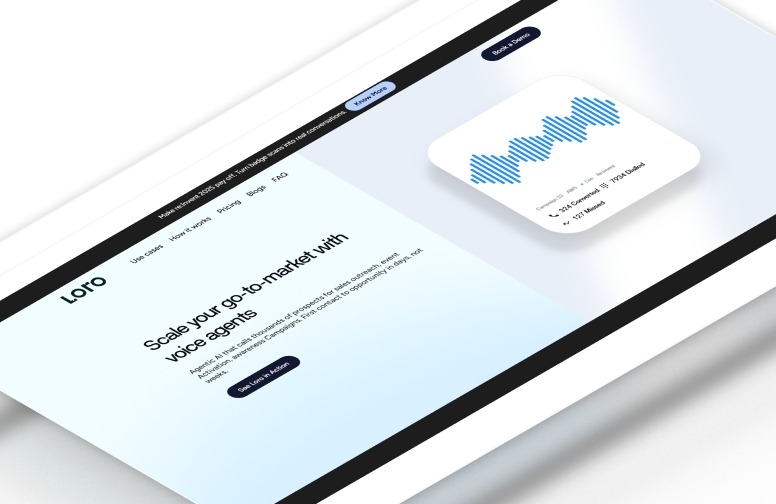
This creates a clear gap between best practices and actual performance.
Platforms like Loro are built to close this gap by enabling real-time, conversation-driven engagement.
With Loro, teams move:
- From delayed workflows → real-time conversations
- From reactive responses → proactive engagement
- From activity metrics → measurable outcomes
Loro turns conversational AI into live, execution-ready interaction, helping teams move beyond automation into conversations that actively drive results.
What Loro Enables
1. Real-time voice-to-voice engagement at scale: Loro initiates and manages live conversations, enabling instant engagement instead of relying on delayed responses or user-triggered interaction.
2. Immediate engagement without workflow delays: Instead of waiting for scheduled follow-ups, Loro responds the moment intent appears, maintaining momentum throughout the interaction.
3. Adaptive conversations, not predefined flows: Loro adjusts responses dynamically based on context, behavior, and input, allowing conversations to evolve naturally.
4. In-conversation qualification and prioritization: It identifies intent during the interaction, filters low-value engagement, and ensures focus remains on meaningful conversations.
5. Seamless transition from conversation to outcome: Loro connects interaction directly to next steps, turning conversations into measurable results rather than isolated exchanges.
Proven Impact
- 130K+ calls dialed
- 10K+ conversations handled
- 8–25% pickup rates
Instead of managing workflows, teams can focus on running real-time conversations that consistently drive outcomes at scale.
Conclusion: From AI To Real-Time Engagement
Most teams are already using conversational AI, but many still struggle to apply it where it matters most: real interaction and outcomes. Automation improves efficiency, but conversations often remain reactive, delayed, and disconnected.
Loro helps close that gap by turning conversational AI into real-time execution. Its agentic, voice-to-voice AI enables live conversations, adapts to context, engages proactively, and connects interaction to meaningful outcomes.
The result is a more effective conversational layer where AI does more than respond, it helps drive engagement, progression, and results.
See how Loro powers real-time conversations in action. Book a demo today.
FAQs
1. How Do You Measure the Success of Conversational AI Systems?
Success should be measured beyond basic metrics like response rate or interaction volume. High-performing teams track outcomes such as conversion rates, task completion, resolution time, and how effectively conversations move users toward a clear next step.
2. What Are the Common Mistakes in Conversational AI Implementation?
Common mistakes include over-reliance on scripted flows, lack of real-time responsiveness, ignoring context across interactions, and focusing on automation instead of user experience and outcomes.
3. How Can Conversational AI Be Scaled Without Losing Quality?
Scaling requires strong intent handling, consistent conversation design, real-time processing, and continuous monitoring. Systems must maintain context and adaptability even as interaction volume increases.
4. What Role Does Voice Play in Conversational AI Strategy?
Voice is becoming a key interaction channel because it enables faster and more natural communication. It is especially useful in time-sensitive or high-engagement scenarios where typing is inefficient.
5. How Do You Improve User Adoption of Conversational AI?
Adoption improves when interactions are fast, relevant, and easy to use. Clear value, minimal friction, natural responses, and consistent performance across channels all contribute to higher user acceptance.