

Outbound sales is being reshaped by how buyers interact with AI. Today, more than 50% of consumers use generative AI as an answer engine, turning conversations into a primary way of finding information.
This shift has changed expectations. Buyers no longer rely on static content or linear journeys. They expect instant, contextual responses that feel conversational and adaptive.
This is where the distinction between conversational AI chatbots and assistants becomes important. While both enable interaction, they are built differently and serve different roles.
For sales teams, the real question is not just how these systems respond, but whether they can engage, adapt, and move a conversation forward.
This blog breaks down conversational AI chatbots vs assistants, their key differences, and what GTM teams actually need to drive outbound pipeline in 2026.
Key takeaways:
- Understand the real difference between conversational AI chatbots and assistants, and why both struggle with outbound sales execution in 2026.
- Learn why reactive AI systems fail in dynamic sales conversations where timing, context, and real-time adaptability drive pipeline growth.
- Explore how outbound sales is shifting toward proactive, voice-led AI conversations that engage prospects and qualify intent faster.
- Discover how agentic conversational AI moves beyond support workflows to initiate, manage, and progress outbound conversations at scale.
- See how Loro positions voice-to-voice AI as an outbound execution layer focused on pipeline generation, not passive assistance.
What is a conversational AI chatbot?
A conversational AI chatbot is a system designed to interact with users through text-based conversations. It uses natural language processing (NLP) to understand inputs and deliver responses, typically within a defined scope.
Most chatbots operate on predefined flows or decision trees, where responses are mapped to expected inputs. This makes them effective for structured interactions where the path is predictable.
In practice, chatbots are commonly used for:
- Customer support and FAQs
- Website chat and basic assistance
- Guided workflows like booking or troubleshooting
They are built to be reactive, meaning they respond when a user initiates interaction and follow a controlled path to resolve queries.
This approach works well for support scenarios, where consistency and accuracy matter more than flexibility.
However, in outbound sales, this model shows clear limitations. Conversations are less predictable, require real-time adaptation, and depend on context, timing, and intent. Chatbots, built around predefined logic, often struggle to handle this level of variability.
As a result, while chatbots can process inputs effectively, they are not designed to manage dynamic, sales-driven conversations.
What is a conversational AI assistant?
A conversational AI assistant is a more advanced system designed to handle broader, context-aware interactions across tasks and channels. Unlike chatbots, assistants are built to understand context over multiple exchanges and maintain continuity within a conversation.
They typically support:
- Multi-turn interactions, where the conversation evolves over several steps
- Context awareness, using past inputs to shape responses
- Voice and text interfaces, enabling more natural interaction
- Task execution, such as retrieving information, scheduling, or triggering actions
Because of this, assistants can manage more complex interactions than chatbots and provide a more fluid user experience.
However, they are still largely reactive systems. They respond when prompted and are usually designed to assist users within existing workflows rather than initiate or drive conversations.
In outbound sales, this becomes a limitation. While assistants can handle deeper interactions, they are not typically built to proactively engage prospects, manage unpredictable dialogue, or move conversations toward pipeline outcomes.
They improve interaction quality, but they do not fully address the demands of outbound execution.
Conversational AI chatbot vs assistants: Key differences
While both chatbots and assistants enable conversational interaction, the differences become clearer when viewed through a sales lens.
The key distinction is not just capability, but how each system handles real-world conversations.
For GTM teams, the difference is practical. Chatbots are effective for structured, repeatable interactions, while assistants offer more flexibility and context handling.
However, both are still primarily designed to respond, not initiate or manage outbound sales conversations. That gap is where most teams struggle when trying to apply conversational AI to pipeline generation.
Why both fall short for outbound sales in 2026
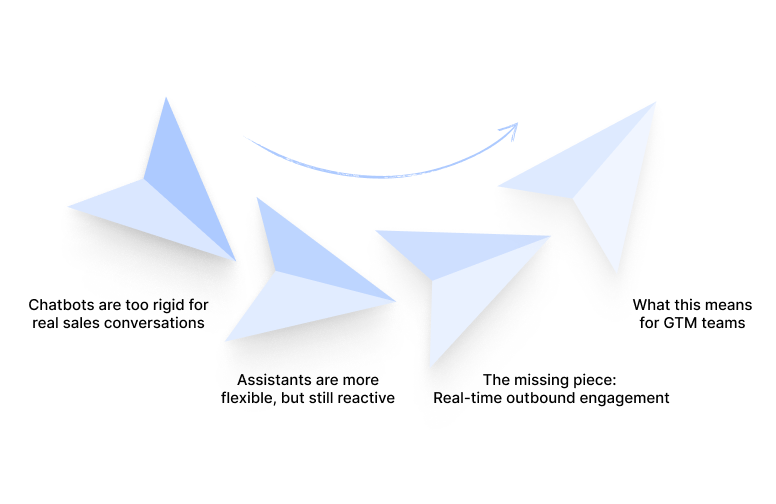
At a surface level, chatbots and assistants appear capable of handling conversations. But outbound sales introduces a different level of complexity that neither is designed to handle effectively.
The limitation is not just technical. It is structural.
Chatbots are too rigid for real sales conversations
Chatbots rely on predefined flows and decision trees. This works in predictable environments, but outbound conversations rarely follow a fixed path.
In practice, this leads to:
- Broken conversations when prospects respond unexpectedly
- Inability to handle nuanced objections
- Interactions that feel scripted rather than natural
For outbound, where timing and adaptability matter, this rigidity becomes a major constraint.
Assistants are more flexible, but still reactive
Assistants improve on chatbots by adding context awareness and multi-turn interaction. However, they are still designed to respond, not initiate or drive conversations.
This creates gaps such as:
- No proactive engagement with prospects
- Limited ability to control conversation direction
- Dependence on user input to move forward
They can support conversations, but they do not own them.
The missing piece: Real-time outbound engagement
Outbound sales requires more than responding to inputs. It requires the ability to:
- Initiate conversations at the right moment
- Adapt continuously as the interaction evolves
- Guide the conversation toward a clear outcome
Neither chatbots nor assistants are built for this.
What this means for GTM teams
For teams trying to use conversational AI in outbound, this results in:
- Conversations that stall instead of progressing
- Missed opportunities during early engagement
- Continued reliance on manual outreach
The core issue is simple; chatbots and assistants can interact, but they are not designed to initiate and sustain outbound sales conversations at scale.
That gap is what defines the next evolution of conversational AI in sales.
What outbound sales actually needs in 2026
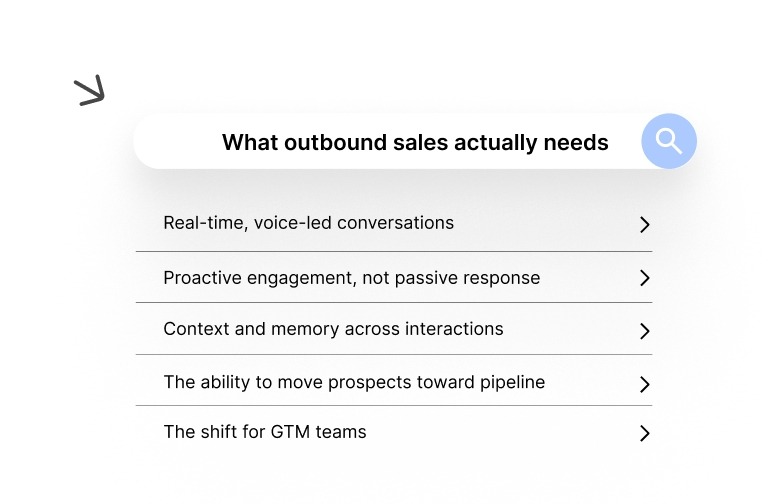
The conversation around conversational AI often focuses on features. But for GTM teams, the real shift is not about capability, it is about how outbound is executed.
In 2026, outbound sales is no longer a sequence of touchpoints. It is a continuous, real-time interaction model.
Real-time, voice-led conversations
Outbound is moving closer to how real sales conversations happen. Voice-led interaction enables faster, more natural engagement compared to delayed, text-based outreach. This allows teams to:
- Engage prospects instantly
- Capture intent as it emerges
- Create more human-like interactions at scale
Proactive engagement, not passive response
Modern outbound cannot wait for prospects to respond. It needs systems that can initiate and sustain conversations. This includes:
- Starting conversations at the right moment
- Following up without delays
- Keeping interactions active without manual effort
Context and memory across interactions
Conversations are not isolated events. Each interaction builds on the previous one. Effective outbound requires:
- Carrying context across touchpoints
- Using past interactions to guide future responses
- Maintaining continuity without restarting conversations
The ability to move prospects toward pipeline
Engagement alone is not enough. Outbound systems must be designed to progress conversations toward outcomes. That means:
- Qualifying intent in real time
- Handling objections naturally
- Driving toward clear next steps like meetings
The shift for GTM teams
The requirement is no longer just better outreach. It is the ability to run conversations as a core part of pipeline generation. Teams that adopt this model move from:
- Sending messages → managing interactions
- Waiting for responses → driving engagement
- Tracking activity → generating pipeline
This is what defines outbound sales in 2026.
From chatbots and assistants to agentic conversational AI
The evolution of conversational AI is not just about better responses. It is about shifting from systems that react to systems that can act.
Chatbots were built to answer. Assistants were built to help. But outbound sales requires something else entirely.
Why the shift is happening
As conversations become more central to how buyers engage, the limitations of both chatbots and assistants become clear. Neither is designed to initiate, manage, and progress conversations independently.
This has led to the rise of a new category: agentic conversational AI.
What defines agentic conversational AI
Agentic systems are built to operate with a level of autonomy. They do not just respond to inputs. They can initiate actions, adapt in real time, and drive interactions toward outcomes.
In outbound sales, this means:
- Starting conversations without waiting for prompts
- Adapting dynamically as the conversation evolves
- Managing the flow of dialogue across multiple turns
- Driving toward clear outcomes like qualification or meetings
The key difference
The distinction is simple but important:
- Chatbots → respond within predefined paths
- Assistants → support tasks and interactions
- Agentic systems → own and drive conversations
This is not an incremental improvement. It is a shift in how conversational AI is applied.
What this means for outbound in 2026
As outbound moves toward real-time, conversation-driven engagement, systems need to do more than assist. They need to execute.
Agentic conversational AI represents that shift. It turns conversational AI from a supporting layer into a core outbound capability that can initiate, sustain, and progress conversations at scale.
Where Loro fits in the evolution of conversational AI
Loro does not sit within the traditional categories of conversational AI. It is not a chatbot, and it is not a passive assistant. It represents a different layer altogether.
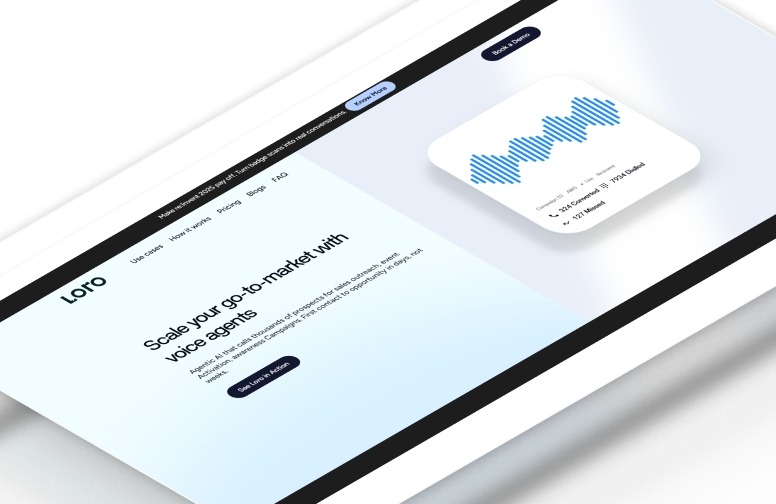
Loro is a voice-to-voice, agentic conversational AI platform built specifically for outbound sales execution.
Not a chatbot: Chatbots are designed to respond within predefined flows. Loro does not follow scripts or decision trees. It engages in live, adaptive conversations that evolve based on how prospects respond.
Not a passive assistant: Assistants support interactions when prompted. Loro does not wait. It initiates conversations, keeps them active, and drives them forward without relying on user input to begin.
Built for outbound execution
Loro is designed around one goal: turning conversations into pipeline. It does this by:
- Initiating outbound conversations in real time
- Handling objections as they arise during the interaction
- Qualifying intent within the conversation itself
- Routing only relevant, sales-ready opportunities forward
What this means for GTM teams
Instead of supporting outbound workflows, Loro becomes the execution layer of outbound sales. It allows teams to:
- Start more conversations without increasing headcount
- Maintain consistent engagement across leads
- Focus human effort on high-intent opportunities
In the context of conversational AI, Loro represents the shift from systems that assist conversations to one that owns and drives them from first touch to pipeline.
Chatbots respond. Assistants help. Loro drives outbound conversations.
Conclusion: Turning conversational AI into outbound execution
Most GTM teams are already using conversational AI, but many still struggle to apply it where it matters most: pipeline creation and buyer engagement. Chatbots and assistants improve interaction, but first-touch outreach, qualification, and follow-up often remain reactive and difficult to scale.
Loro helps close that gap by turning conversational AI into real outbound execution. Its agentic, voice-to-voice AI initiates live conversations, handles objections in real time, qualifies intent, and routes sales-ready opportunities to reps with context already attached.
The result is a more connected outbound motion where conversational AI does more than support interactions, it helps drive pipeline.
See how Loro powers outbound GTM in action. Book a demo today.
FAQs
1. How Is Conversational AI Used in Sales Workflows?
Conversational AI is used across prospecting, follow-ups, qualification, and engagement. In sales workflows, it helps manage interactions, capture intent signals, and support continuous communication without relying on manual outreach at every step.
2. What Is the Difference Between Reactive and Proactive AI in Sales?
Reactive AI responds only when a user initiates interaction, while proactive AI can start conversations, follow up at the right time, and maintain engagement. This distinction is critical in outbound sales, where timing and initiation directly impact results.
3. Can Conversational AI Replace SDRs in Outbound Sales?
Conversational AI does not replace SDRs but changes how they work. It can handle early-stage interactions and qualification, allowing SDRs to focus on high-intent prospects and more complex sales conversations.
4. What Challenges Do Teams Face When Implementing Conversational AI?
Common challenges include handling unpredictable conversations, maintaining context across interactions, integrating with existing systems, and ensuring consistent performance without excessive manual configuration or oversight.
5. How Does Conversational AI Impact Sales Cycle Length?
Conversational AI can shorten sales cycles by reducing response delays, maintaining continuous engagement, and qualifying prospects earlier. This helps move opportunities forward faster and reduces drop-offs between stages.