

Today, more than half of shoppers (55%) already use AI-powered customer support to resolve self-service issues, and 61% say they prefer this autonomy for quick interactions. This shift reflects a growing expectation for faster, more convenient engagement throughout the buying journey.
Yet despite this adoption, most ecommerce experiences still rely on delayed responses, static product journeys, and reactive support systems.
This creates a gap. Shoppers are ready for real-time interaction, but many brands are not equipped to deliver it. Conversational AI is helping bridge this gap, but its impact depends on how it is applied.
This blog explores how conversational AI is used in ecommerce, where current systems fall short, and why real-time engagement is key to driving conversions.
Key Highlights:
- Conversational AI is reshaping ecommerce by turning static browsing into real-time, guided interactions that help customers move faster from discovery to purchase.
- While many brands use conversational AI for support, the biggest impact comes when it is applied to high-intent moments that directly influence conversions.
- Key use cases such as product discovery, checkout assistance, and post-purchase engagement improve both customer experience and revenue outcomes.
- Real-time engagement is critical, as delays during decision-making and checkout are among the biggest causes of cart abandonment.
- Platforms like Loro enable real-time, proactive conversations at scale, helping ecommerce teams turn interactions into measurable conversions and revenue.
What Is Conversational AI in Ecommerce?
Conversational AI in ecommerce refers to the use of artificial intelligence systems that can understand, process, and respond to customer queries across chat, voice, and messaging channels. These systems enable brands to interact with shoppers in a more natural, conversational way rather than relying solely on static pages or traditional interfaces.
At its core, conversational AI powers what is often called conversational commerce, where customers can discover products, ask questions, and complete purchases through real-time interaction instead of navigating complex menus or search filters.
Conversational Commerce Across Channels
In ecommerce, conversational AI is applied across multiple touchpoints:
- Chat interfaces on websites and apps for product queries and support.
- Messaging platforms for ongoing engagement and follow-ups.
- Voice interactions that enable faster, more natural communication.
These channels allow brands to meet customers where they already spend time, making interactions more accessible and convenient.
Role in Modern Ecommerce Journeys
Conversational AI is no longer limited to customer support. It plays a role across the entire ecommerce journey:
- Product discovery through guided recommendations.
- Consideration by answering questions and addressing objections.
- Purchase by assisting during checkout.
- Post-purchase through updates, tracking, and support.
This shift moves ecommerce from static browsing to guided interaction, where customers are supported throughout their journey rather than left to navigate it alone.
While conversational AI is becoming a core part of ecommerce, most implementations still focus on isolated interactions. The next step is enabling real-time, continuous conversations that actively drive purchasing decisions.
How Conversational AI Is Changing the Ecommerce Customer Journey
The ecommerce journey has traditionally been linear. Customers browse products, compare options, and eventually decide whether to purchase. Most of this process has relied on static pages, filters, and delayed support.
Conversational AI is changing this model by turning each stage of the journey into an interactive, guided experience.
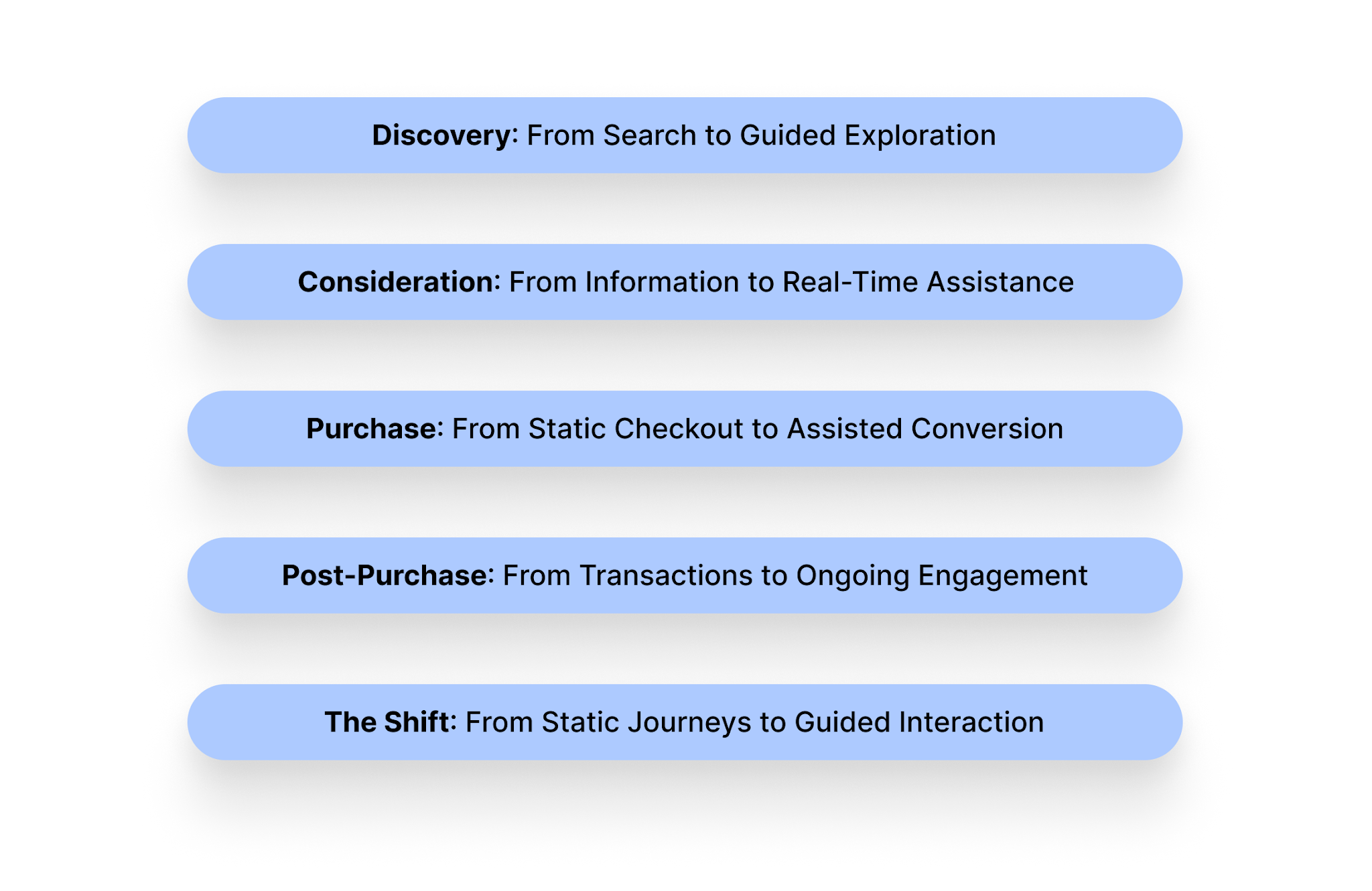
Discovery: From Search to Guided Exploration
Instead of relying on keywords or browsing categories, customers can describe what they are looking for in natural language. Conversational AI responds with relevant suggestions, narrowing options quickly.
This shifts discovery from manual search and filtering to guided, conversational product exploration.
Consideration: From Information to Real-Time Assistance
During the decision phase, customers often have questions about products, pricing, or fit. Traditionally, this required navigating FAQs or waiting for support.
Conversational AI enables:
- Instant answers to product-related questions.
- Context-aware recommendations.
- Real-time clarification of doubts.
This reduces friction and helps customers move forward without delay.
Purchase: From Static Checkout to Assisted Conversion
Checkout is one of the highest drop-off points in ecommerce. Small uncertainties or delays can lead to abandoned carts.
Conversational AI improves this stage by:
- Assisting users during checkout in real time.
- Addressing last-minute concerns or objections.
- Guiding users toward completion.
This transforms checkout from a passive step into an actively supported interaction.
Post-Purchase: From Transactions to Ongoing Engagement
After a purchase, engagement often drops to transactional updates. Conversational AI extends interaction beyond this point.
It enables:
- Order updates and tracking through conversation.
- Easy access to support and returns.
- Opportunities for re-engagement and repeat purchases.
The Shift: From Static Journeys to Guided Interaction
Across all stages, the core shift is clear. Ecommerce is moving from self-service navigation to guided, conversational experiences.
Instead of leaving customers to figure things out, conversational AI:
- Engages at each step.
- Reduces delays and uncertainty.
- Keeps momentum throughout the journey.
This transformation sets the stage for the next evolution. As journeys become more interactive, the ability to engage customers in real time becomes critical to driving conversions.
Why Real-Time Engagement Drives Ecommerce Conversions
For enterprise ecommerce teams, conversion is not just about traffic. It is about how effectively intent is captured and acted on in the moment. Most drop-offs do not happen because of lack of interest, but because of delay, friction, or unanswered questions at critical points in the journey.
Real-time engagement addresses this by turning high-intent moments into active, guided interactions rather than passive browsing experiences.
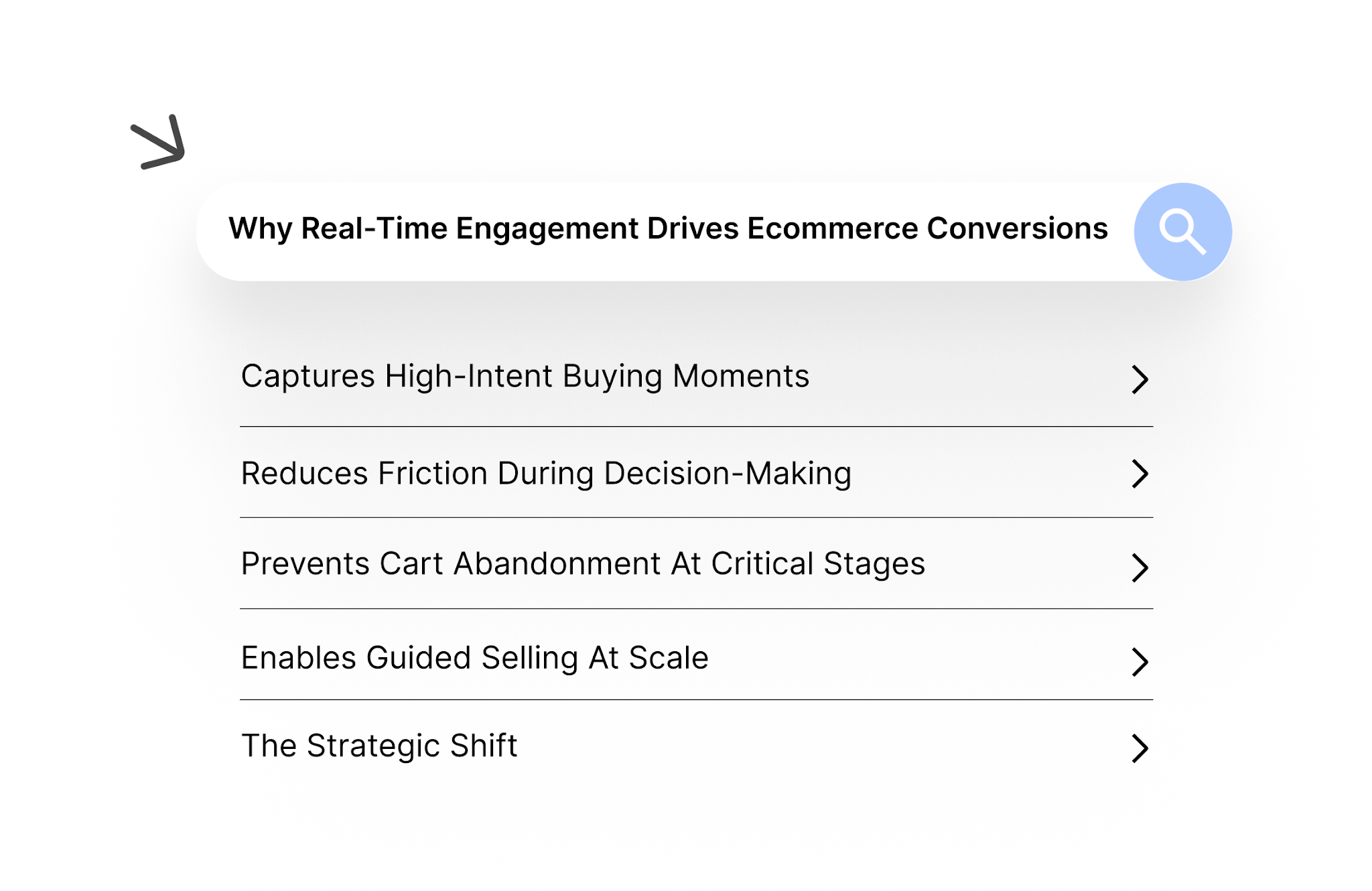
Captures High-Intent Buying Moments
Enterprise ecommerce systems generate large volumes of behavioral signals such as product views, repeat visits, cart additions, and checkout attempts. These signals indicate when a customer is close to making a decision.
However, in most setups:
- These signals are logged but not acted on immediately.
- Engagement is delayed through campaigns or retargeting.
- High-intent sessions are lost before follow-up occurs.
Real-time engagement enables teams to:
- Act on intent signals as they happen.
- Trigger interaction during peak decision windows.
- Engage customers before they exit the session.
By aligning engagement with real-time intent, teams can significantly improve conversion rates and reduce leakage from high-value sessions.
Reduces Friction During Decision-Making
Enterprise catalogs are complex. Customers often need clarity on specifications, pricing tiers, delivery timelines, compatibility, or policies before completing a purchase.
Without real-time support:
- Customers leave to search for answers elsewhere.
- Decision cycles are extended or abandoned.
- Confidence in the purchase drops.
Real-time engagement allows brands to:
- Provide contextual answers based on product and user behavior.
- Address objections immediately during evaluation.
- Support decision-making without breaking the flow.
Reducing decision friction shortens the path to purchase and increases the likelihood of conversion, especially for higher-value transactions.
Prevents Cart Abandonment At Critical Stages
Cart abandonment is not just a marketing problem. It is often an interaction failure at the point of conversion.
Common causes include:
- Uncertainty around pricing or fees.
- Lack of trust or reassurance.
- Technical or process-related confusion.
Traditional systems rely on:
- Email reminders.
- Delayed follow-ups.
- Static checkout flows.
Real-time engagement changes this by:
- Intervening during checkout when hesitation occurs.
- Resolving last-mile objections instantly.
- Guiding users through completion.
Reducing abandonment at checkout directly improves revenue efficiency and maximizes return on existing traffic.
Enables Guided Selling At Scale
Self-service ecommerce works for simple purchases, but breaks down in scenarios involving:
- Large product catalogs.
- Complex decision criteria.
- High-consideration purchases.
Real-time conversational engagement enables guided selling, where the system actively supports the customer throughout the journey.
This includes:
- Recommending products based on intent and context.
- Adjusting suggestions dynamically during interaction.
- Leading customers toward a clear next step.
Guided selling increases conversion rates, improves average order value, and creates a more personalized buying experience without increasing manual effort.
The Strategic Shift
For enterprise teams, the shift is not just from chat to AI, but from passive experience design to active engagement execution.
Real-time engagement:
- Connects behavioral data to immediate action.
- Reduces dependency on delayed marketing interventions.
- Turns customer journeys into dynamic, responsive systems.
The result is a more efficient conversion engine, where engagement happens when it matters most, and every interaction contributes directly to revenue outcomes.
Key Use Cases Of Conversational AI In Ecommerce
Conversational AI in ecommerce is not limited to support. It enables end-to-end conversational commerce, where customers can discover, evaluate, and purchase products through real-time interaction across chat, messaging, and voice channels.
The most effective use cases align with high-intent moments in the customer journey, where real-time engagement directly impacts conversion.
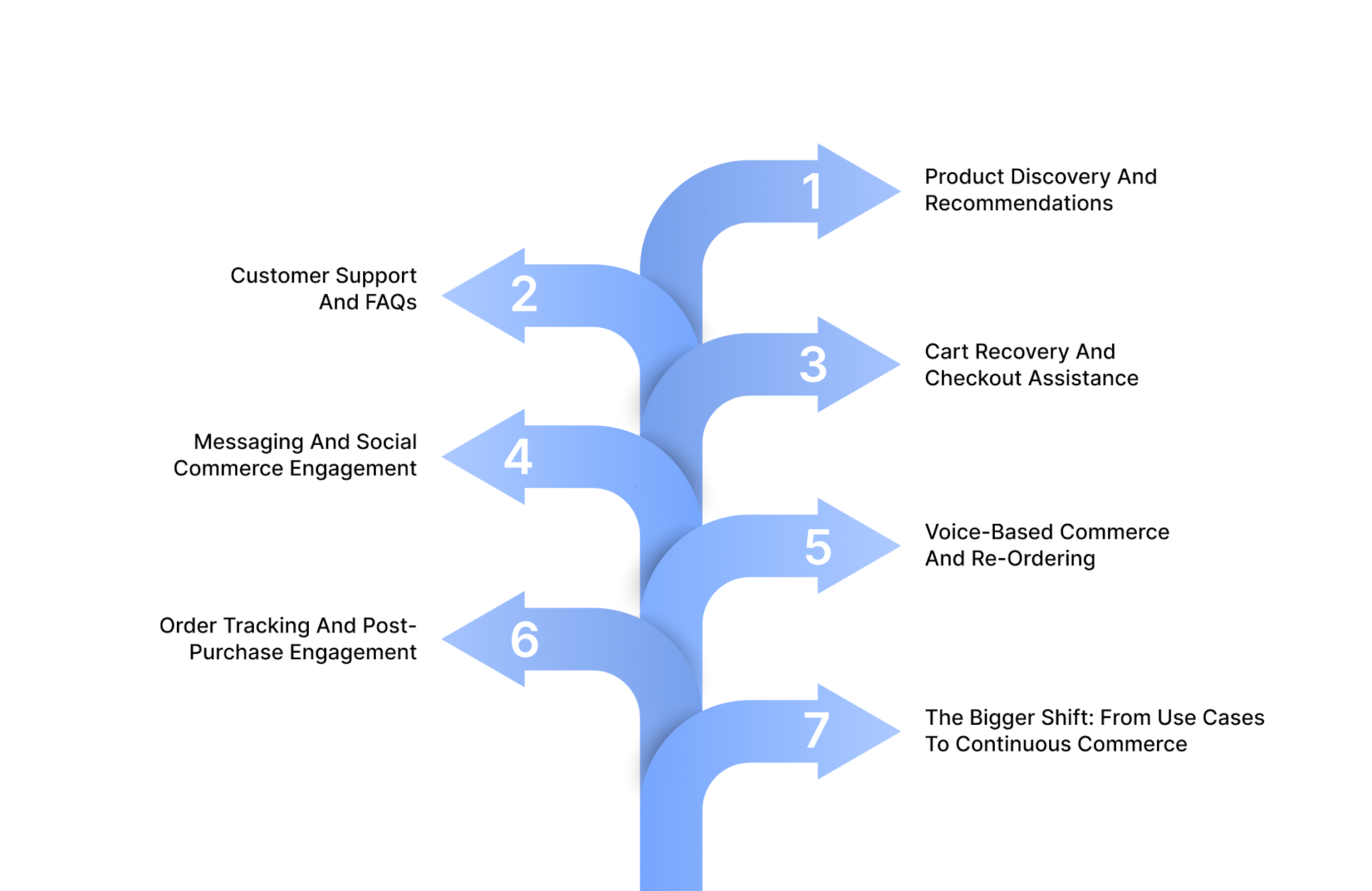
Product Discovery And Recommendations
Product discovery is one of the most critical and complex stages in ecommerce. Traditional search relies on keywords and filters, which often fail when customer intent is unclear.
Conversational AI transforms this into a guided experience.
It enables teams to:
- Interpret natural language queries to understand intent beyond keywords.
- Recommend products dynamically based on preferences, behavior, and context.
- Refine recommendations through multi-turn interaction in real time.
Customers find relevant products faster, reducing drop-offs during browsing and increasing progression into consideration. AI-driven recommendations also improve engagement and conversion by aligning with user preferences.
Customer Support And FAQs (Conversational Service Layer)
Support is the most common entry point for conversational AI, but in ecommerce, it directly influences purchase decisions.
Conversational AI enables a real-time service layer across channels.
It enables teams to:
- Provide instant responses across chat, messaging apps, and voice interfaces.
- Maintain context across conversations for more accurate support.
- Resolve high-volume queries without scaling support teams.
Faster resolution improves customer satisfaction while preventing support-related friction from impacting conversions. Real-time service also aligns with the expectation of immediate responses in digital commerce.
Cart Recovery And Checkout Assistance (Conversational Selling)
Cart abandonment is often caused by hesitation at the point of purchase. Traditional recovery methods rely on delayed emails or retargeting, which miss the moment of intent.
Conversational AI enables real-time conversational selling during checkout.
It enables teams to:
- Intervene during checkout when hesitation signals appear.
- Address objections such as pricing, delivery, or policies instantly.
- Guide customers step-by-step toward completing the purchase.
Real-time intervention reduces abandonment and improves conversion efficiency by capturing decisions at the moment they are made. Conversational engagement at this stage has been shown to reduce friction and increase conversion rates.
Messaging And Social Commerce Engagement
A major shift in ecommerce is happening outside traditional websites. Customers increasingly engage through messaging platforms like WhatsApp, Instagram, and Messenger.
Conversational AI enables commerce within these channels.
It enables teams to:
- Engage customers directly within messaging apps and social platforms.
- Share product links, catalogs, and recommendations within conversations.
- Drive discovery, consideration, and purchase without redirecting users.
Reducing channel switching shortens the path to purchase and increases conversion rates by meeting customers where they already interact. Conversational commerce turns messaging platforms into full sales channels.
Voice-Based Commerce And Re-Ordering
Voice interaction is an emerging but high-impact use case, particularly for repeat purchases and quick decision scenarios.
Conversational AI enables hands-free, natural interaction.
It enables teams to:
- Support voice-based product search and reordering.
- Enable faster interactions for routine or repeat purchases.
- Reduce effort in time-sensitive or mobile-first scenarios.
Voice reduces friction for repeat transactions and improves accessibility, especially in mobile and multitasking environments. It also aligns with the growing shift toward more natural interaction models in ecommerce.
Order Tracking And Post-Purchase Engagement
Post-purchase is often treated as a transactional phase, but it plays a critical role in retention and lifetime value.
Conversational AI extends engagement beyond the purchase.
It enables teams to:
- Provide real-time order tracking through conversational interfaces.
- Handle returns, exchanges, and support queries efficiently.
- Re-engage customers with relevant updates or recommendations.
Improved post-purchase engagement builds trust, increases retention, and creates opportunities for repeat purchases and upsell.
The Bigger Shift: From Use Cases To Continuous Commerce
Across all these use cases, the pattern is consistent. Conversational AI is moving ecommerce from isolated interactions to continuous, real-time engagement.
Instead of:
- Static pages
- Delayed responses
- Channel fragmentation
Ecommerce is shifting toward:
- Real-time conversations
- Cross-channel interaction
- Guided, end-to-end journeys
This is what defines modern conversational commerce. Not just where AI is used, but how consistently it engages customers across the entire buying lifecycle.
If you want to turn conversations into qualified opportunities at scale, see how Loro enables real-time outbound engagement—book a live demo.
Benefits Of Conversational AI For Ecommerce in 2026
Conversational AI creates value in ecommerce by improving how customers interact, decide, and convert.
While many benefits are tied to efficiency, the real impact comes from enabling faster, more relevant, and more continuous engagement throughout the buying journey.
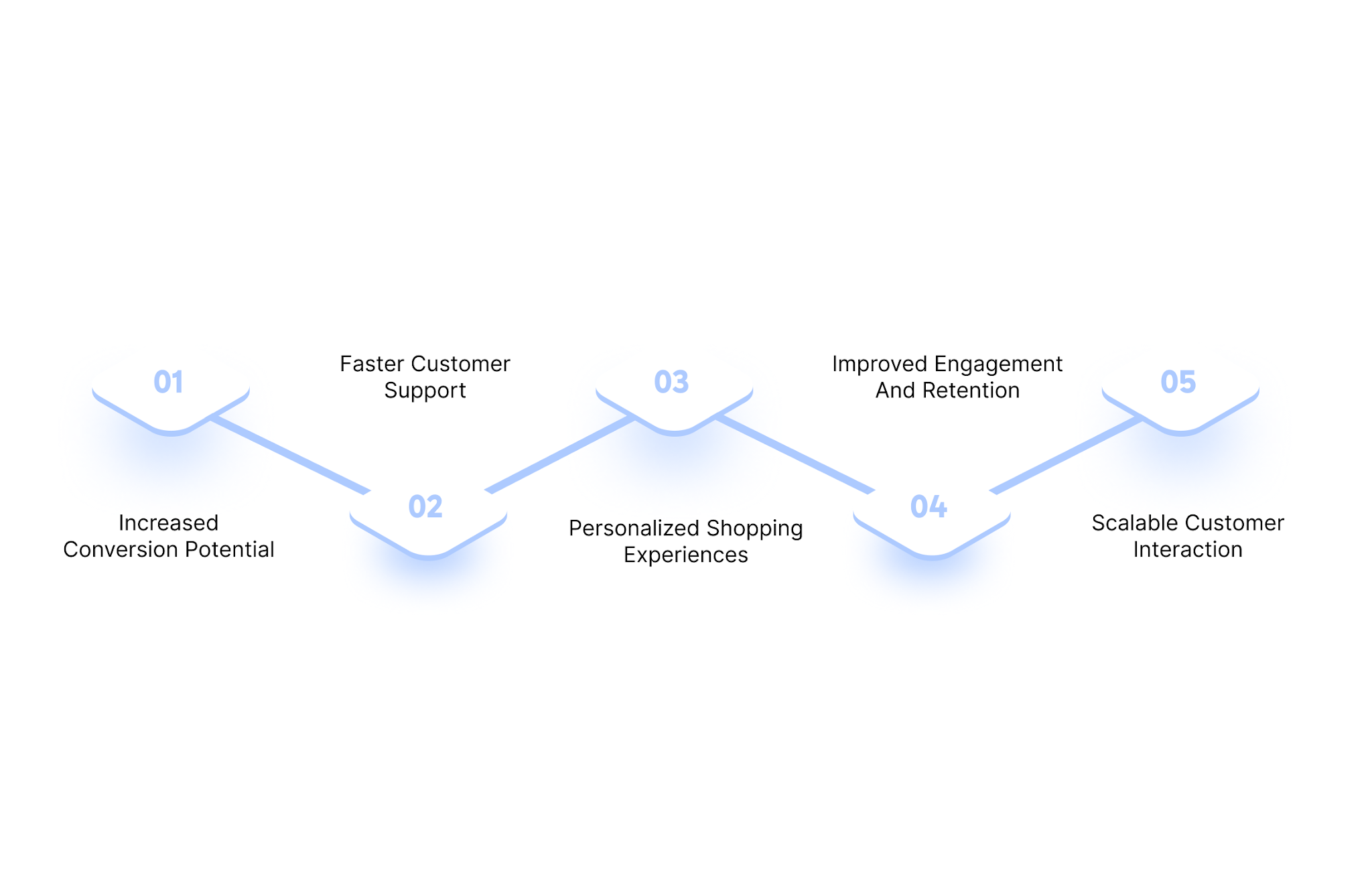
1. Increased Conversion Potential: Ultimately, the value of conversational AI is measured by its ability to drive conversions. By engaging customers at high-intent moments, reducing friction during decision-making, and guiding them toward purchase, it helps turn more sessions into completed transactions.
2. Faster Customer Support: Speed is critical in ecommerce. Conversational AI provides instant responses across channels, ensuring customers get answers when they need them most, especially during the purchase journey.
3. Personalized Shopping Experiences: Conversational AI adapts interactions based on user behavior, preferences, and context. This allows brands to deliver relevant recommendations and responses in real time, improving decision confidence.
4. Improved Engagement And Retention: By turning static journeys into interactive conversations, conversational AI keeps customers engaged across the lifecycle, increasing repeat visits and long-term retention.
5. Scalable Customer Interaction: Conversational AI enables teams to handle large volumes of interactions simultaneously while maintaining consistency, making it easier to scale engagement without increasing operational complexity.
These benefits are widely recognized, but their impact depends on how they are applied. The greatest gains come when conversational AI is used not just for automation, but for real-time, continuous engagement that directly influences customer decisions.
From Conversational AI To Real-Time Commerce Execution
Most ecommerce teams have already adopted conversational AI in some form. They use it for support, recommendations, and basic automation. But in many cases, these systems remain reactive and workflow-driven, limiting their impact on actual conversions.
The gap is not in capability, but in execution.
What Effective Systems Require
To truly influence buying behavior, conversational AI needs to operate as a real-time engagement layer, not just a support tool.
This requires:
- Real-time interaction: Engaging customers instantly at the moment of intent, not after delays.
- Context-aware personalization: Adapting responses based on behavior, preferences, and journey stage.
- Continuous conversation handling: Maintaining context across interactions instead of resetting each time.
- Multi-channel and voice support: Enabling seamless interaction across chat, messaging, and voice.
Where Most Tools Fall Short
Despite strong capabilities, many implementations are limited by how they are deployed. Common limitations include:
- Reactive chatbots: Systems respond only when prompted and do not actively guide the journey.
- Workflow-based engagement: Interactions follow predefined paths, reducing flexibility.
- Lack of continuity: Conversations are fragmented across sessions and channels.
The Shift To Real-Time Commerce Execution
The next phase of ecommerce is not just conversational, it is real-time and execution-driven. This means moving toward:
- Real-time, proactive, conversation-led commerce.
- Scalable interaction that adapts to user behavior instantly.
- Systems that do more than respond, actively drive decisions and conversions.
This shift defines the difference between using conversational AI as a feature and using it as a core conversion engine.
Loro: From Conversational AI To Real-Time Commerce Execution
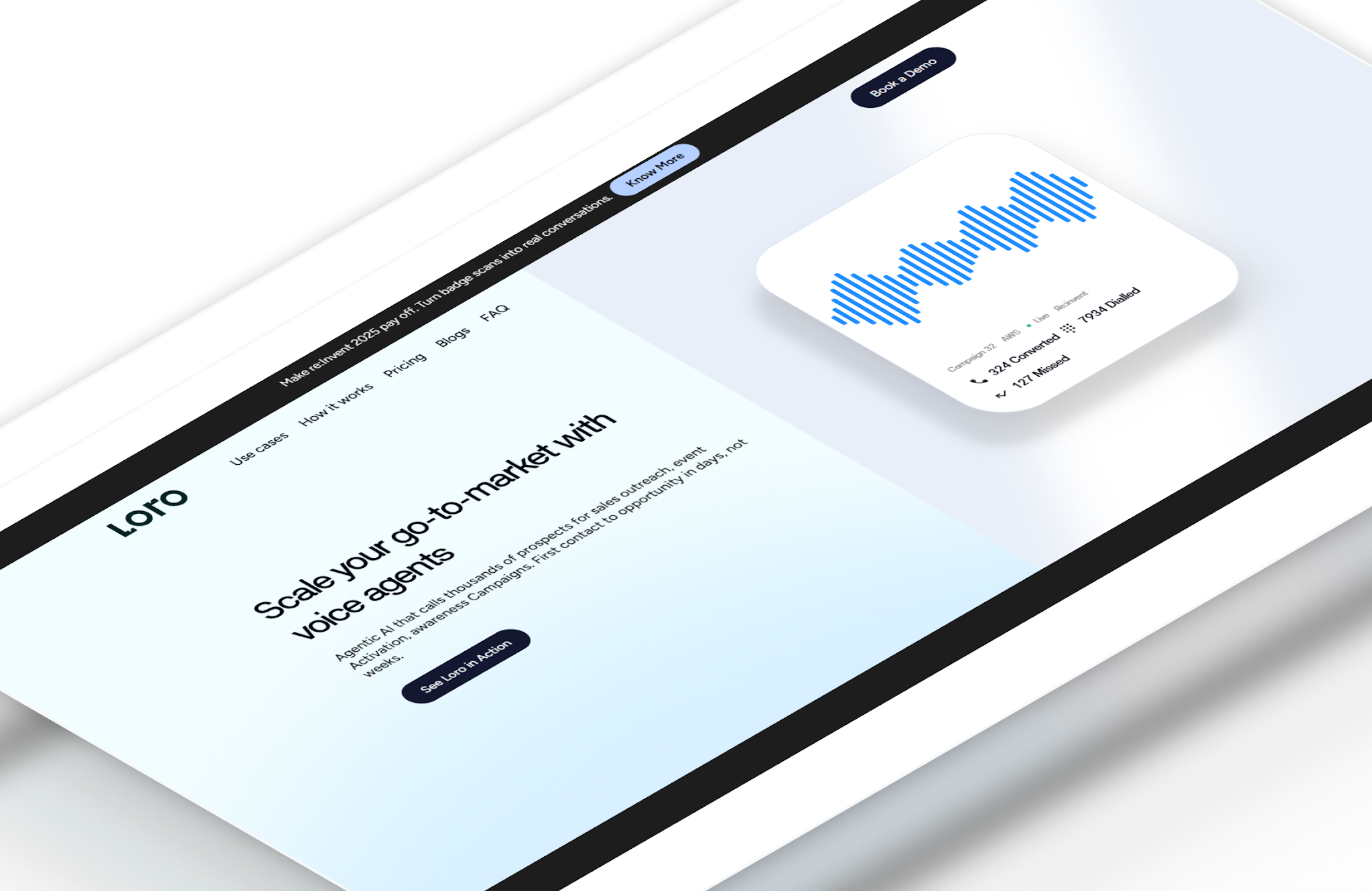
Most conversational AI tools help ecommerce teams design better conversations, but fall short in execution. They support workflows, automate responses, and improve interaction quality, yet struggle to deliver real-time, continuous engagement at scale.
This creates a gap between best practices and actual conversion impact.
Platforms like Loro are built to close this gap by enabling real-time, conversation-driven commerce.
With Loro, ecommerce teams move:
- From delayed workflows → real-time customer conversations
- From reactive support → proactive engagement
- From interaction volume → measurable conversion outcomes
Loro turns conversational AI into live, execution-ready interaction, helping teams move beyond automation into conversations that actively influence buying decisions.
What Loro Enables
1. Real-time voice-to-voice engagement at scale: Loro initiates and manages live conversations with shoppers, enabling instant interaction during high-intent moments instead of relying on delayed or user-triggered engagement.
2. Immediate engagement without workflow delays: Instead of scheduled follow-ups or reactive chat, Loro engages customers the moment intent signals appear, maintaining momentum across the journey.
3. Adaptive conversations, not predefined flows: Loro adjusts responses dynamically based on context, behavior, and inputs, allowing conversations to evolve naturally rather than follow rigid scripts.
4. In-conversation qualification and prioritization: It identifies buying intent during interaction, filters low-value engagement, and focuses attention on customers most likely to convert.
5. Seamless transition from conversation to conversion: Loro connects interaction directly to outcomes, guiding customers toward purchase, checkout completion, or next steps in the journey.
Proven Impact
- 130K+ calls dialed
- 10K+ conversations handled
- 8–25% pickup rates
Instead of managing fragmented workflows and delayed engagement, ecommerce teams can focus on what matters: running real-time conversations that consistently drive conversions and revenue at scale.
Conclusion: From AI To Real-Time Conversions
Most ecommerce teams are already using conversational AI, but many still struggle to apply it where it matters most: conversions. Automation improves efficiency, but customer interactions often remain reactive, delayed, and disconnected from the buying moment.
Loro helps close that gap by turning conversational AI into real-time commerce execution. Its agentic, voice-to-voice AI engages shoppers instantly, adapts to context, guides decisions during interaction, and connects engagement directly to purchase outcomes.
The result is a more effective ecommerce experience where conversational AI does more than assist, it actively drives conversions and revenue.
See how Loro powers real-time commerce engagement in action. Book a demo today.
FAQs
1. How Does Conversational AI Improve Ecommerce Conversion Rates?
Conversational AI improves conversions by engaging shoppers during high-intent moments, answering questions instantly, and guiding decisions in real time, reducing delays that often lead to drop-offs.
2. What Is the Difference Between Chatbots and Conversational AI in Ecommerce?
Chatbots typically follow predefined scripts and workflows, while conversational AI can understand context, adapt responses dynamically, and handle more complex, multi-turn interactions.
3. Can Conversational AI Integrate With Ecommerce Platforms?
Yes, conversational AI can integrate with ecommerce systems such as product catalogs, CRM platforms, and order management tools to deliver context-aware responses and support end-to-end customer journeys.
4. Is Conversational AI Suitable for High-Traffic Ecommerce Stores?
Conversational AI is well-suited for high-traffic environments because it can handle large volumes of interactions simultaneously while maintaining consistent response quality.
5. How Long Does It Take to Implement Conversational AI in Ecommerce?
Implementation timelines vary based on complexity, integrations, and use cases, but modern platforms allow teams to deploy conversational AI much faster than traditional custom-built systems.