

Manual outreach has a ceiling. As teams grow and target lists expand, it becomes harder to reach every prospect at the right moment, follow up consistently, and still keep conversations personal. The result is often more activity, but fewer meaningful interactions.
Sales conversational AI solves this problem in an impactful manner. Instead of relying on one-way messages or rigid sequences, it brings real, voice-based conversations into the earliest stages of engagement. These systems listen, respond, and adapt as the dialogue unfolds, allowing teams to connect with customers in a way that feels natural, timely, and relevant.
In this article, we’ll break down how sales conversational AI improves customer interactions, from starting better first conversations to maintaining context across follow-ups.
Key insights at a glance
- Sales conversational AI enables GTM teams to engage prospects the moment interest emerges, reducing delays and making conversations feel timely, personal, and relevant.
- Instead of scripted outreach, AI listens, responds, and adjusts in real time, handling objections, questions, and tone to create natural, two-way conversations.
- Information captured in early interactions like priorities, objections, and intent carries forward, reducing repetition and ensuring smooth handoffs to human sellers.
- AI qualifies leads, identifies intent, and filters uninterested prospects, allowing sales teams to focus on opportunities that show genuine engagement and momentum.
- Conversational AI preserves brand voice, respects customer time, and creates more human, informed, and inclusive interactions, turning first conversations into meaningful relationships.
How sales conversational AI optimizes customer interactions
In 2026, customer interactions look very different from a few years ago. Buyers expect faster responses, clearer context, and conversations that respect their time.
At the same time, sales teams are managing larger audiences, longer buying journeys, and more fragmented engagement paths.
Traditional outreach methods struggle to keep interactions both timely and personal.
Sales conversational AI becomes relevant here not as a productivity shortcut, but as a way to improve the quality of every interaction. Instead of relying on static messages or delayed follow-ups, conversational AI enables real, voice-based conversations that adapt in the moment.
Prospects are engaged when interest is fresh, and interactions unfold naturally rather than feeling scripted or transactional.
Rather than pushing buyers through predefined flows, conversational AI listens, responds, and adjusts based on what the customer actually says.
Tone, hesitation, questions, and objections are handled in real time, making each interaction feel more like a genuine conversation than an outreach attempt.
Key ways sales conversational AI optimizes customer interactions:
- Earlier, more relevant engagement: Conversational AI initiates contact at the right moment, reducing delays between interest and conversation. Buyers aren’t left waiting for follow-ups or forced to re-engage through multiple channels.
- Interactions that adapt instead of repeating scripts: Each conversation evolves based on the buyer’s responses. This avoids rigid questioning and allows discussions to move at the customer’s pace.
- Context is preserved across touchpoints: Intent, priorities, objections, and timing captured during conversations carry forward. Customers don’t need to restate their needs when a human seller steps in.
- Fewer interruptions, better handoffs: Only interactions with real interest progress further, ensuring customers engage with sales teams when there’s clear relevance, not premature pressure.
- More respectful follow-ups: Follow-ups are driven by actual conversational signals, not arbitrary sequences, making outreach feel helpful rather than intrusive.
Ultimately, sales conversational AI optimizes customer interactions by making them more human, more responsive, and more intentional.
Instead of increasing outreach volume, it improves interaction quality, ensuring every conversation respects the buyer’s time and moves the relationship forward naturally.
10 ways to improve GTM interactions with conversational AI
Sales conversational AI is no longer about redirecting queries or automating responses. In modern GTM motions, it directly shapes how prospects experience a brand during first contact, follow-ups, and early qualification.
Customer expectations are higher than ever, with over 82% of customer-facing professionals agreeing that buyers now expect faster, more responsive interactions, and nearly half of customers willing to switch vendors after a poor experience.
This pressure is one reason AI adoption across customer-facing teams has surged, with close to 69% of companies now using AI to manage growing interaction volumes without sacrificing quality. In sales, the biggest impact shows up at the top of the funnel.
Agentic, voice-to-voice conversational AI enables teams to engage prospects immediately, hold natural conversations, and interpret intent as it emerges, rather than relying on delayed callbacks or static digital touchpoints.
When conversational AI is designed to listen, respond, and move conversations forward in real time, it improves customer interactions by making outreach more timely, more contextual, and more human, while ensuring sales teams step in only when interest is real and momentum already exists.
Here are ten practical ways sales conversational AI improves customer interactions across the funnel:
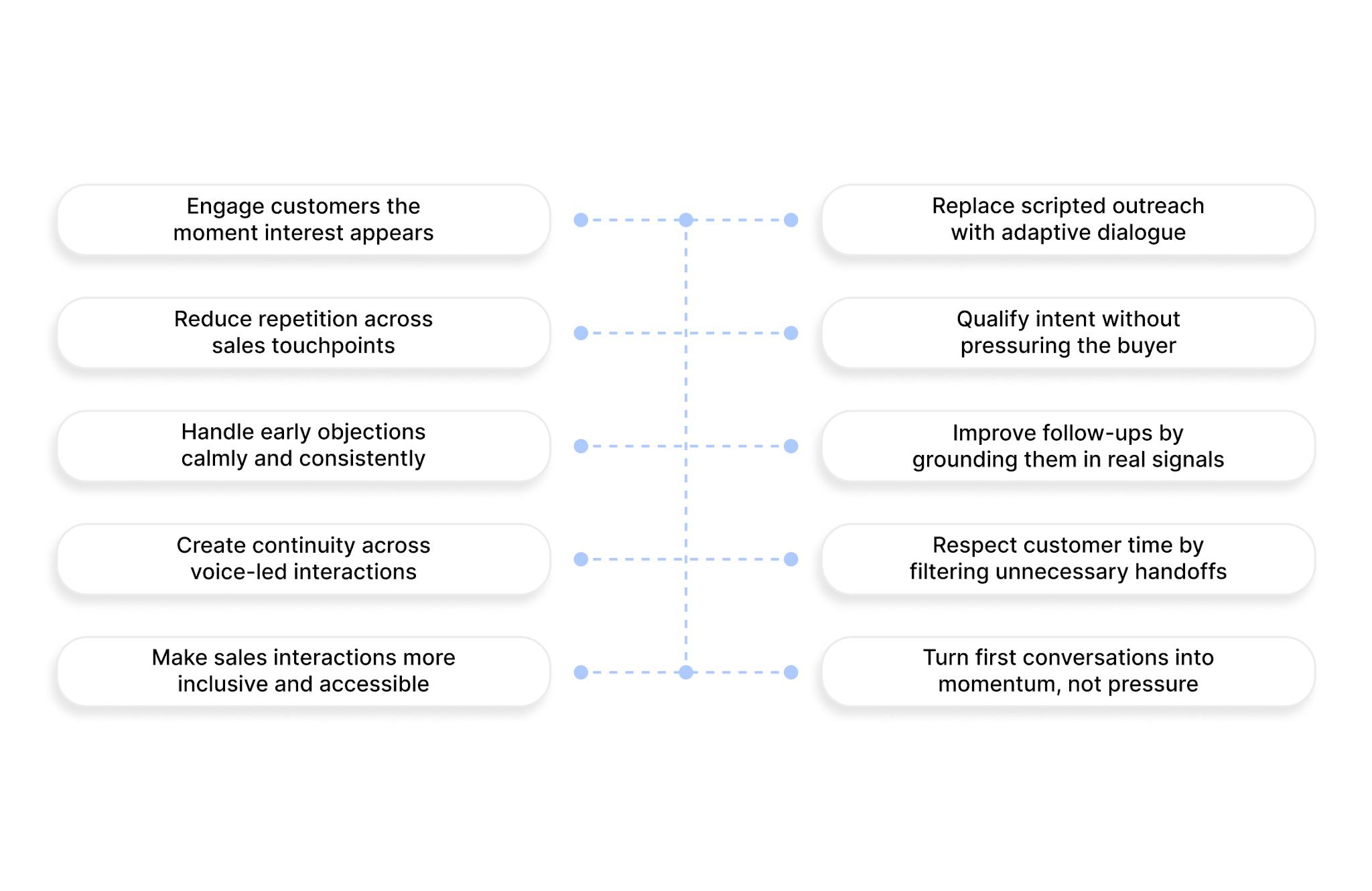
1. Engage customers the moment interest appears: Sales conversational AI can initiate conversations as soon as intent signals emerge, whether from events, inbound interest, or outbound lists. This removes delays that often cause interest to fade and makes interactions feel responsive rather than reactive.
2. Replace scripted outreach with adaptive dialogue: Instead of fixed talk tracks, conversational AI listens and adjusts in real time. Questions, objections, and curiosity shape how the conversation unfolds, making interactions feel natural rather than rehearsed.
3. Reduce repetition across sales touchpoints: Context gathered during early conversations, such as needs, timing, and objections, carries forward. When a human seller joins later, customers don’t need to restate their situation, creating smoother, more respectful interactions.
4. Qualify intent without pressuring the buyer: Sales conversational AI can explore interest, budget range, and timelines conversationally, without forcing buyers into forms or premature sales calls. Customers stay in control of the pace while still moving forward.
5. Handle early objections calmly and consistently: Common concerns around pricing, relevance, or timing can be addressed during the conversation itself. This prevents unnecessary escalation while ensuring customers feel heard, not dismissed.
6. Improve follow-ups by grounding them in real signals: Instead of generic follow-ups, conversational AI bases re-engagement on what was actually discussed. This leads to outreach that feels relevant and thoughtful rather than repetitive or intrusive.
7. Create continuity across voice-led interactions: When prospects engage over multiple calls, conversational AI maintains continuity. Each interaction builds on the last, making the experience feel like an ongoing relationship instead of disconnected outreach attempts.
8. Respect customer time by filtering unnecessary handoffs: Only conversations that show genuine interest progress to human sellers. Customers avoid premature sales calls, and sellers enter conversations when there’s clear value on both sides.
9. Make sales interactions more inclusive and accessible: Voice-based conversational AI allows prospects to engage naturally, without needing to navigate forms, emails, or complex scheduling steps. This lowers friction for different communication styles and preferences.
10. Turn first conversations into momentum, not pressure: Sales conversational AI focuses on understanding before advancing. By prioritizing clarity and timing over volume, interactions feel collaborative, helping customers move forward without feeling rushed.
When sales conversational AI is built to participate in conversations, not automate them, customer interactions become faster, clearer, and more human. The result isn’t just better efficiency, it’s a buying experience that feels intentional from the very first conversation.
Benefits of sales conversational AI for customer interactions
Sales conversational AI improves customer interactions by reshaping how prospects experience your brand at moments that traditionally feel slow, impersonal, or disconnected. Its value shows up less in operational efficiency and more in how conversations feel to the person on the other end.
Here are some key benefits of conversational AI for GTM teams:
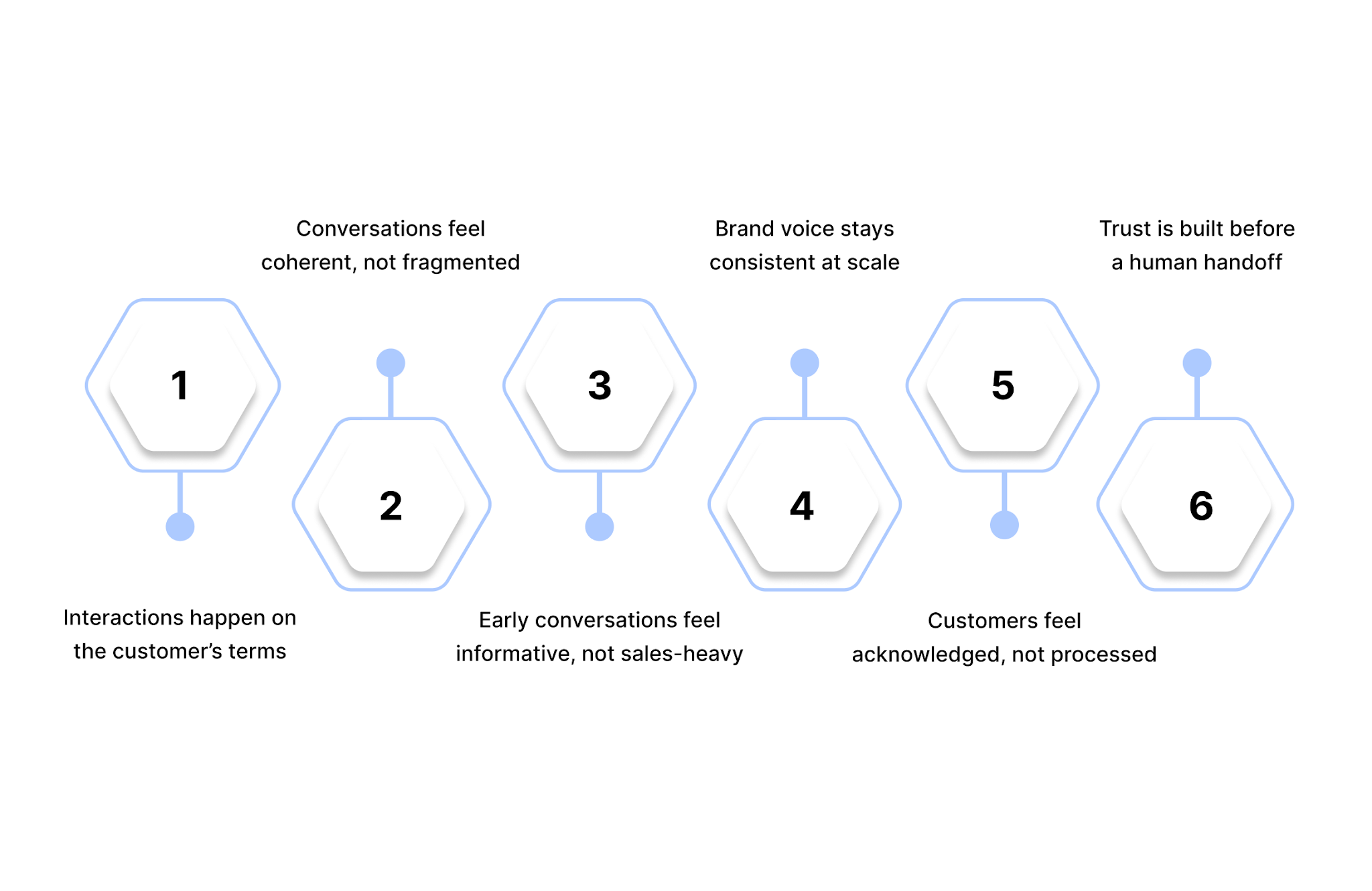
- Interactions happen on the customer’s terms: Voice-led conversational AI meets prospects where they are, without forcing them into forms, email threads, or scheduling loops. Customers engage when it’s convenient, creating a lower-friction and more respectful experience.
- Conversations feel coherent, not fragmented: Instead of disjointed handoffs between campaigns, reps, and follow-ups, conversational AI maintains continuity across interactions. Prospects aren’t asked to repeat themselves, and conversations progress naturally rather than restarting at every touchpoint.
- Early conversations feel informative, not sales-heavy: Well-designed conversational AI focuses on understanding needs before pushing outcomes. Prospects experience the interaction as helpful and exploratory, which builds trust earlier in the relationship.
- Brand voice stays consistent at scale: Every conversation reflects the same tone, positioning, and messaging, regardless of volume. This prevents the uneven experiences that often happen when multiple reps handle early outreach differently.
- Customers feel acknowledged, not processed: By listening, responding, and adapting in real time, conversational AI creates the sense of being heard. Even short interactions feel intentional, rather than like another step in a funnel.
- Trust is built before a human handoff: When a sales rep eventually joins, the prospect already has context and confidence in the interaction. The transition feels like a continuation, not a reset, which strengthens credibility and rapport.
In practice, sales conversational AI improves customer interactions by making early engagement feel more human, more connected, and less transactional, setting a stronger foundation for every relationship that follows.
Where conversational AI makes the biggest impact
Sales conversational AI improves customer interactions by changing how early sales conversations actually happen. Instead of delayed follow-ups, scripted exchanges, or context-less handoffs, it enables real-time, two-way conversations that adapt to customer intent as it unfolds.
This matters in a market where expectations for speed and relevance are rising, and where poor interaction quality quickly drives prospects away. At the interaction level, conversational AI keeps conversations fluid across first contact, follow-ups, and qualification. It listens, responds, and maintains context so customers don’t feel like they’re restarting every time they engage.
Here are some areas where sales conversational AI makes the most impact:
1. SDR managers enforcing consistency across distributed teams: SDR leaders can use conversational AI to ensure every prospect hears the same value narrative, objection handling, and positioning, regardless of rep tenure or geography. This removes performance variance without micromanagement.
2. Account executives re-engaging stalled opportunities: AEs deploy conversational AI to reconnect with accounts that went cold after demos, pricing discussions, or procurement delays. The AI resumes conversations with full context, uncovering blockers before deals quietly die.
3. Sales ops teams fixing lead leakage in CRM-heavy motions: Sales operations teams use conversational AI to engage leads that are marked “open” or “working” but haven’t been contacted. This closes the gap between CRM activity and actual customer interaction.
4. Partner sales teams following up on shared pipeline: Channel and partner managers use conversational AI to follow up on co-sourced leads where ownership is unclear. The AI confirms interest, validates ownership, and routes opportunities cleanly without friction.
5. RevOps teams validating pipeline quality before forecasting: Revenue teams use conversational AI to re-confirm intent, timelines, and stakeholders across late-stage pipeline. This improves forecast accuracy by replacing assumed interest with live confirmation.
6. Enablement teams pressure-testing messaging in live markets: Sales enablement leaders use conversational AI to test new positioning, pricing language, or event-specific offers in real conversations. Insights from these calls inform training and messaging updates faster than surveys.
7. Field sales teams warming accounts ahead of meetings: Field reps use conversational AI to engage accounts days before scheduled meetings. The AI gathers context, surfaces objections, and identifies priorities so reps walk into meetings informed, not guessing.
8. Sales leaders covering gaps during hiring or ramp periods: Sales leadership deploys conversational AI when headcount is constrained or new reps are ramping. It maintains customer coverage without burning out top performers or lowering interaction quality.
9. ABM teams activating named accounts, not just tracking them: Account-based marketing teams use conversational AI to turn target accounts into live conversations. Instead of measuring clicks or impressions, they validate real buying interest inside priority accounts.
10. Customer expansion teams identifying upsell readiness: Expansion and growth teams use conversational AI to engage existing customers around renewals, usage changes, or new initiatives. The AI identifies readiness signals before account managers step in.
The result is a sales experience that feels timely, human, and intentional, helping GTM teams build trust earlier while guiding prospects forward without friction:
Why Loro is the right conversational AI platform for GTM teams
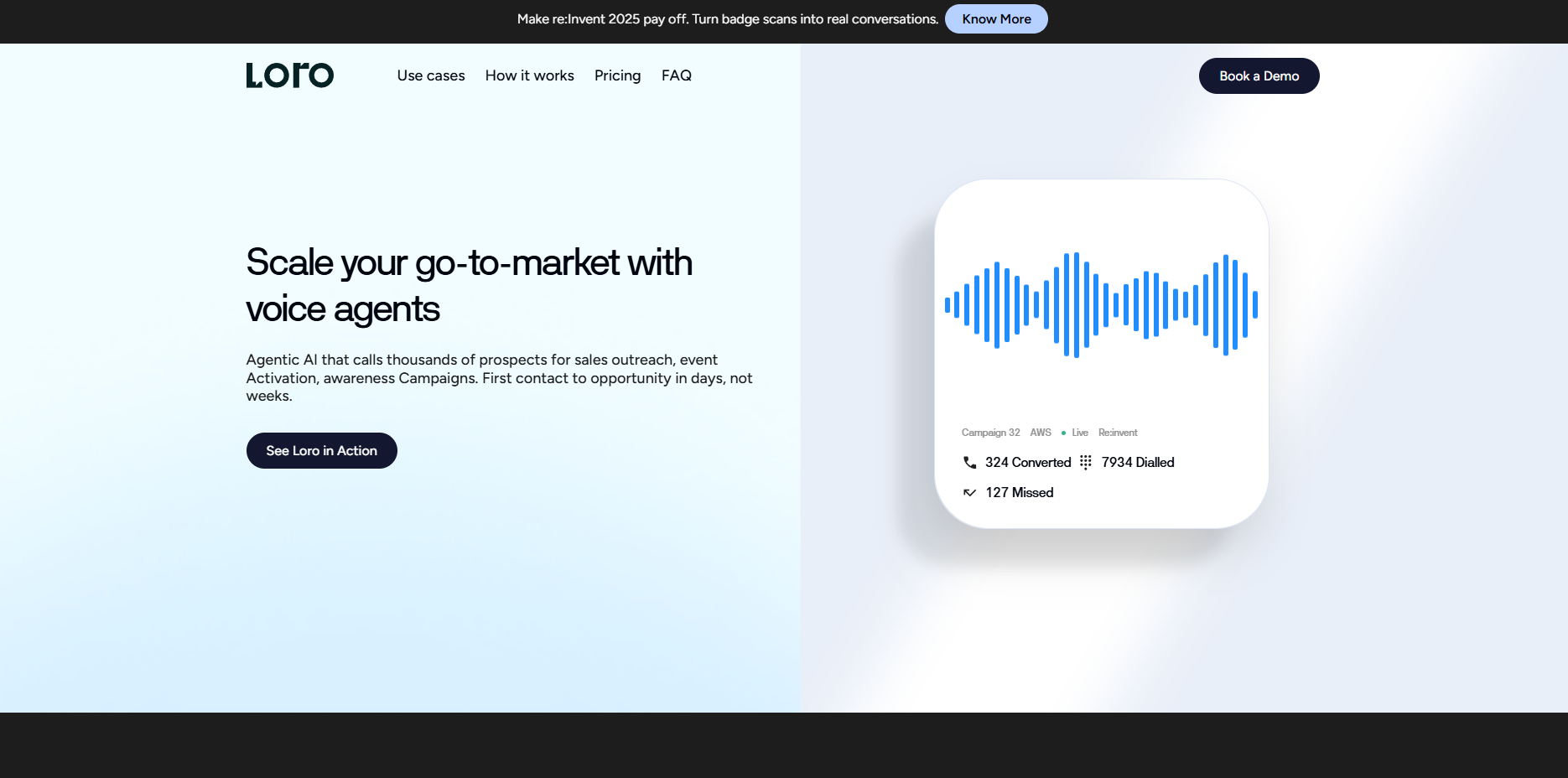
Loro is designed for the part of the GTM motion that determines everything downstream: first conversation. Instead of organizing sales work or analyzing outcomes after the fact, Loro operates inside outbound execution itself, initiating live, voice-to-voice conversations and progressing only those that show real buying intent.
This shifts how GTM teams use AI. Loro doesn’t prepare reps for conversations; it creates momentum before reps step in. By the time a handoff happens, context is already established and sellers enter with clarity, not guesswork.
What makes Loro different for GTM teams:
- Agentic voice-led execution: Loro initiates and manages outbound conversations autonomously, listening and responding in real time rather than following scripts.
- Intent-first qualification: Prospects are evaluated based on live signals like interest, hesitation, objections, and timing, not form fills or email clicks.
- Conversation-ready handoffs: Opportunities reach sellers with full context on why the prospect engaged and what matters to them.
- Built for outbound-led GTM: Purpose-built for cold, warm, event-driven, and partner-led outreach where speed and pickup rates matter.
- AWS-native and partner-focused: Designed specifically for AWS Partner Network teams running high-volume outbound and event-based motions.
Loro becomes the execution layer that turns campaigns, lists, and events into a qualified pipeline, allowing human reps to take over after interest is confirmed.
Conclusion: Creating Real Impact with Sales Conversational AI
In 2026, improving customer interactions isn’t about adding more channels or faster responses. It’s about meeting buyers at the moment they’re ready to engage and making those early conversations feel natural, relevant, and worth their time.
Sales conversational AI like Loro plays a direct role here by shaping how prospects experience your brand from the very first interaction. When designed as an agentic, voice-to-voice system, sales conversational AI doesn’t deflect or automate interactions, it elevates them. It listens, responds, and adapts in real time, ensuring customers feel heard rather than processed.
For GTM teams, the result is a more connected customer journey where conversations drive progress, not tasks. Sales conversational AI becomes the bridge between outreach and trust, turning first interactions into meaningful dialogue that moves relationships forward.
See how Loro applies conversational AI to outbound sales execution. Book a Demo Today to experience agentic voice-driven selling in action.
FAQs
1. What makes conversational AI effective for customer interactions?
The best conversational AI actively engages customers in human-like dialogue, understands intent, and responds contextually. It doesn’t just answer queries, it enhances the overall experience from first touch to follow-up.
2. How does conversational AI improve engagement and response times?
By handling early-stage conversations instantly, conversational AI ensures customers get timely responses, reducing wait times and increasing satisfaction. It keeps interactions relevant and personalized, even at scale.
3. Can conversational AI replace human sales reps?
No. The goal is to complement human sellers, not replace them. AI manages early engagement, qualification, and intent discovery, freeing reps to focus on high-value conversations and closing deals.
4. How does conversational AI help in understanding customer intent?
AI interprets tone, hesitation, and language cues in real time, identifying what matters most to the customer. This insight allows teams to tailor follow-ups and prioritize leads more effectively.
5. What should GTM teams look for when evaluating sales conversational AI?
Focus on platforms that drive meaningful interactions, interpret intent accurately, and integrate into outbound and inbound workflows. Platforms that create qualified opportunities, rather than just automate tasks, deliver the most impact.