

Healthcare is rapidly adopting artificial intelligence, but patient engagement has not kept pace. Today, 22% of healthcare organizations have already implemented domain-specific AI tools, a sevenfold increase year over year, signaling how quickly the industry is evolving.
Yet despite this growth, most interactions between providers and patients still rely on delayed responses, fragmented systems, and limited accessibility.
This creates a gap. Patients expect timely, responsive communication, but existing systems often fail to deliver real-time engagement.
Conversational AI is emerging as a way to bridge this gap. But its impact depends not just on automation, but on how effectively it enables immediate, continuous interaction.
This blog explores why real-time engagement matters, how conversational AI is transforming healthcare communication, and what it takes to move from reactive systems to meaningful patient conversations.
Key Takeaways:
- Healthcare is rapidly adopting AI, with 22% of organizations already implementing it, but patient engagement still relies on delayed, reactive systems.
- Rising expectations for speed and efficiency are driven by AI, with 90% of users saying it helps them save time, pushing healthcare toward real-time interaction.
- Traditional patient engagement models struggle with delays, fragmented communication, and limited availability, creating gaps in access and responsiveness.
- Conversational AI improves access through instant responses, 24/7 availability, and automation, but most systems remain reactive and task-focused.
- The shift to real-time, continuous conversations is critical, with platforms like Loro enabling voice-driven engagement that improves patient access and care continuity.
What Is Conversational AI In Healthcare?
Conversational AI in healthcare refers to the use of artificial intelligence systems that can understand, process, and respond to human language across voice and text. These systems are designed to support interactions between patients and healthcare providers, making communication faster, more accessible, and more efficient.
At its core, conversational AI combines natural language processing, machine learning, and speech technologies to handle patient queries, guide interactions, and assist with routine tasks.
Today, conversational AI is most commonly used in structured, task-based scenarios:
- Chatbots for patient queries: Handling frequently asked questions related to symptoms, services, or procedures
- Virtual assistants for scheduling: Booking, rescheduling, and managing appointments
- Patient intake and triage support: Collecting basic information before consultations
- Automated reminders and follow-ups: Sending alerts for appointments, medications, or care plans
These applications help reduce administrative burden and improve access to basic services.
Current Role In Patient Communication
Despite growing adoption, conversational AI in healthcare is still largely reactive and workflow-driven.
Most systems:
- Respond only when prompted
- Follow predefined scripts or decision trees
- Handle isolated tasks rather than continuous interaction
As a result, they improve efficiency but often fall short in delivering real-time, dynamic patient engagement. This gap becomes more apparent as patient expectations shift toward faster, more responsive communication.
Why Traditional Patient Engagement Models Are Failing
Patient engagement in healthcare has historically relied on phone calls, manual coordination, and delayed follow-ups. While these systems created structure, they struggle to meet the speed and accessibility patients expect today.
The issue is not a lack of effort. It is that engagement models have not evolved with patient behavior.
The Core Challenges
- Delayed responses across key interactions: Appointment scheduling, query resolution, and follow-ups often involve wait times, callbacks, or manual processing, slowing down the entire experience.
- Fragmented communication channels: Patients interact through calls, emails, portals, and in-person visits, but these channels are rarely connected, leading to inconsistent and repetitive communication.
- Limited availability of staff: Healthcare teams operate within fixed hours and capacity constraints, making it difficult to handle high volumes of patient inquiries in real time.
- Mismatch between expectations and systems: Patients increasingly expect quick, seamless responses, but existing systems are built for batch processing, not continuous interaction.
The Impact of Missed Access
This gap becomes more visible in how patients attempt to engage with providers. Healthcare organizations miss a significant share of incoming calls, especially during peak hours.
More importantly, a large percentage of patients do not attempt a second call if their first attempt fails, leading to lost opportunities for care and engagement.
The result is a system where patients are ready to engage, but the infrastructure cannot respond quickly enough.
Traditional models are built around availability and schedules, while patients expect immediacy and continuity, creating a growing disconnect in healthcare communication.
How Conversational AI Is Transforming Healthcare Engagement
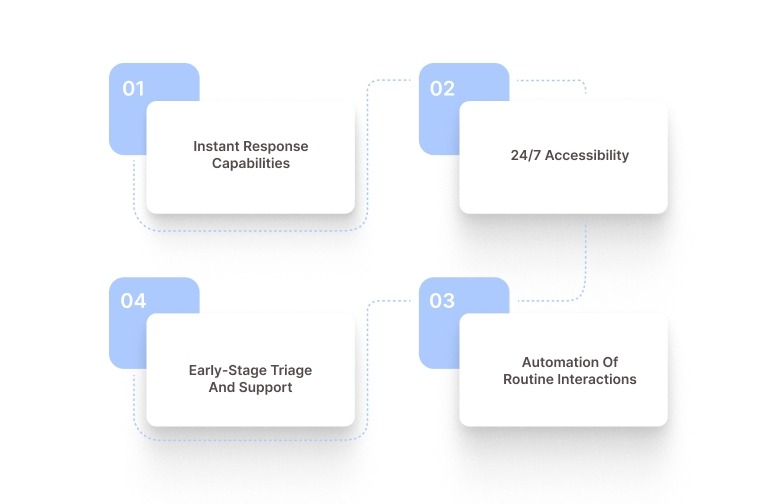
Conversational AI is changing how healthcare organizations interact with patients by making communication faster, more accessible, and less dependent on manual processes. Instead of relying solely on staff availability, these systems enable continuous, technology-driven engagement across common patient touchpoints.
At a foundational level, the impact is seen in how quickly and consistently patients can get responses.
Instant Response Capabilities
Conversational AI allows providers to respond to patient queries the moment they are received. Whether it is a question about symptoms, services, or appointment availability, patients no longer need to wait for callbacks or office hours.
This helps:
- Reduce response delays
- Improve patient satisfaction
- Capture intent when it is highest
24/7 Accessibility
Unlike traditional systems, conversational AI operates around the clock. Patients can engage at any time, regardless of staff availability or time zones.
This enables:
- After-hours support
- Continuous access to basic services
- Greater convenience for patients
Automation of Routine Interactions
Many patient interactions are repetitive and administrative in nature. Conversational AI can handle these tasks efficiently, freeing up staff for more complex responsibilities.
Common examples include:
- Appointment scheduling and reminders
- Answering frequently asked questions
- Collecting patient information
Early-Stage Triage and Support
Conversational AI can guide patients through initial assessments by asking structured questions and directing them to the appropriate next step.
This allows providers to:
- Streamline patient intake
- Prioritize urgent cases
- Improve care coordination
Together, these capabilities show how conversational AI is improving healthcare engagement at a basic level. However, most implementations still focus on automation and efficiency, leaving a gap when it comes to real-time, continuous patient interaction.
If you’re looking to turn initial conversations into qualified opportunities at scale, see how Loro enables real-time outbound engagement—book a live demo.
Why Real-Time Engagement Is Now Critical In Healthcare
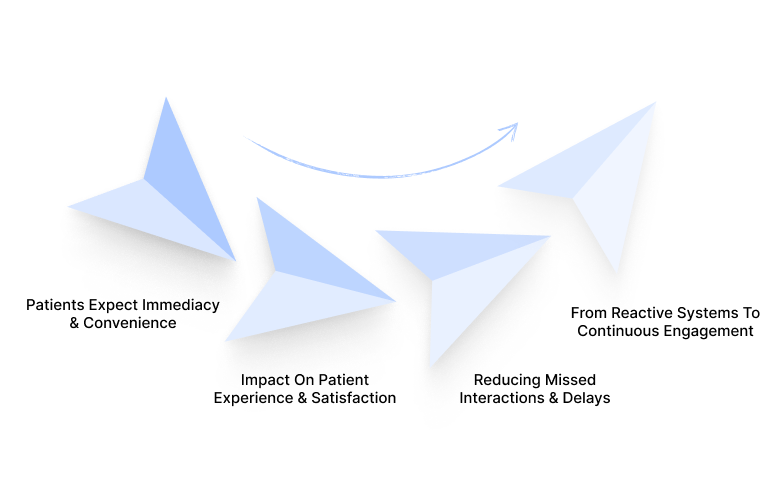
Healthcare is no longer just about access to services. It is about how quickly and effectively patients can interact with providers. As digital adoption accelerates, expectations around speed, convenience, and responsiveness have fundamentally changed.
This shift is happening alongside growing reliance on AI. Today, 90% of users say AI helps them save time, 85% say it helps them focus on important work, and 84% say it improves creativity, highlighting how strongly people value faster, more efficient interactions.
But in healthcare, these expectations are not fully met. Most systems still rely on delays and manual processes, leaving a gap between what patients expect and what providers can deliver in real time.
Patients Expect Immediacy And Convenience
Patients are increasingly used to real-time interactions in other industries. They expect the same from healthcare, whether they are booking appointments, asking questions, or seeking guidance.
This means:
- Faster response times are no longer optional
- Delays directly impact patient experience
- Convenience is becoming a key differentiator
Impact On Patient Experience And Satisfaction
The speed and quality of communication directly influence how patients perceive care. Delayed responses or fragmented interactions can lead to frustration, missed appointments, and lower satisfaction.
Real-time engagement helps:
- Improve responsiveness and trust
- Reduce friction in patient interactions
- Create a more connected care experience
Reducing Missed Interactions And Delays
Traditional systems often fail to capture patient intent at the right moment. Missed calls, delayed callbacks, and limited availability result in lost opportunities to engage.
Real-time engagement addresses this by:
- Capturing interactions as they happen
- Reducing drop-offs between touchpoints
- Ensuring continuity across the patient journey
From Reactive Systems To Continuous Engagement
Most healthcare communication systems today are reactive. They respond when triggered but do not sustain interaction.
The shift is toward:
- Continuous, always-available engagement
- Context-aware interactions across channels
- More natural communication formats, including voice
As conversational AI evolves, voice-based interaction is becoming increasingly important, enabling more accessible and intuitive communication for patients.
The implication is clear. Healthcare organizations are adopting AI at scale, but the real advantage lies in how effectively they use it to deliver immediate, continuous engagement. That is what defines modern patient communication in 2026.
Key Use Cases Of Conversational AI In Healthcare
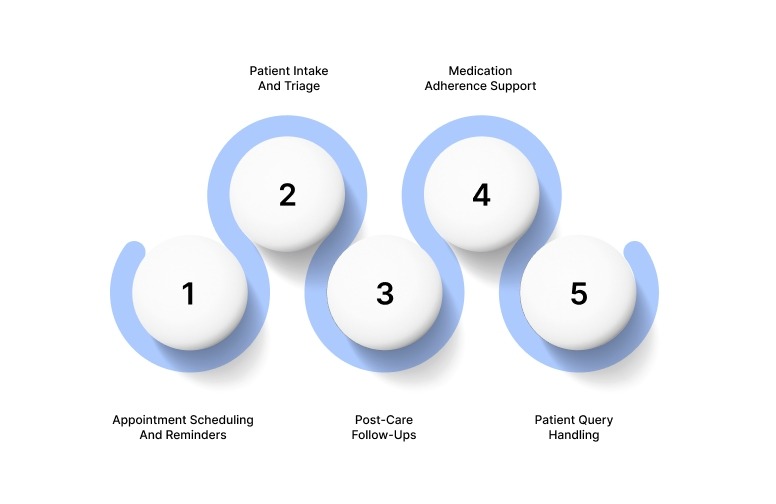
Conversational AI is most effective in healthcare when applied to high-frequency, time-sensitive interactions. These are the moments where delays, missed communication, or manual processes directly impact patient experience and operational efficiency.
Appointment Scheduling And Reminders
Scheduling is one of the most common friction points in healthcare. Conversational AI simplifies this by allowing patients to book, reschedule, or cancel appointments in real time.
It helps:
- Reduce call volumes for front-desk staff
- Minimize scheduling delays
- Lower no-show rates through automated reminders
Patient Intake And Triage
Collecting patient information before a visit is often time-consuming and inconsistent. Conversational AI streamlines this by guiding patients through structured intake processes.
This enables:
- Faster check-ins
- More accurate data collection
- Early identification of urgent cases through basic triage
Post-Care Follow-Ups
After a consultation or procedure, timely follow-up is critical but often delayed. Conversational AI can proactively check in with patients, ensuring continuity of care.
It supports:
- Monitoring recovery progress
- Identifying complications early
- Keeping patients engaged after treatment
Medication Adherence Support
Many patients struggle to follow prescribed medication schedules. Conversational AI can send reminders, answer questions, and provide guidance to improve adherence.
This leads to:
- Better treatment outcomes
- Reduced risk of missed doses
- Ongoing patient support without manual intervention
Patient Query Handling
Patients frequently have questions about symptoms, treatments, or services. Conversational AI can handle these queries instantly, providing consistent and accurate responses.
This helps:
- Reduce response time
- Improve patient satisfaction
- Free up staff for more complex interactions
These use cases show how conversational AI improves efficiency and accessibility in healthcare. However, most implementations still focus on task completion, leaving room for more continuous, real-time engagement across the patient journey.
From Automation To Real-Time Patient Conversations
Most conversational AI systems in healthcare today are designed to automate tasks, not manage ongoing interaction. They help with scheduling, reminders, and basic queries, but they often stop at completing individual actions rather than sustaining meaningful engagement.
As patient expectations evolve, this approach is no longer enough. The shift is toward continuous, real-time patient conversations.
What Effective Conversational AI Requires
To move beyond automation, healthcare systems need to support interaction that feels immediate, connected, and responsive. This includes:
- Real-time interaction: Engaging patients the moment they reach out, without delays or callbacks.
- Context awareness: Using past interactions and patient history to provide relevant responses.
- Multi-channel communication, especially voice: Supporting natural interaction across channels patients prefer, including voice-based communication.
- Continuous conversation handling: Maintaining context across multiple interactions instead of treating each as a separate task.
Where Current Systems Fall Short
Despite advancements, many implementations still rely on outdated interaction models. Common limitations include:
- Reactive chatbots: Systems respond only when prompted and cannot proactively engage or guide patients.
- Workflow-based interactions: Conversations follow predefined paths, limiting flexibility and adaptability.
- Lack of continuity: Each interaction is treated in isolation, leading to repetitive and fragmented experiences.
Moving From Support To Engagement
The next phase of conversational AI in healthcare is not about adding more automation. It is about enabling real-time, voice-driven conversations that feel natural and continuous.
Platforms designed for this shift focus on:
- Engaging patients instantly
- Adapting to context during interaction
- Supporting more natural, conversational experiences
The change is clear. Healthcare is moving from systems that complete tasks to systems that sustain conversations, turning patient interaction into a more connected and responsive experience.
Where Platforms Like Loro Fit
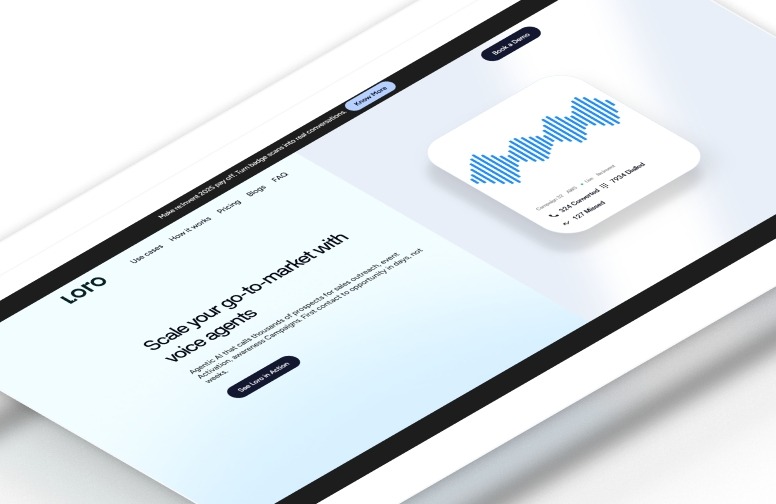
Platforms like Loro are built to address this gap by enabling real-time, voice-driven engagement that moves beyond traditional, task-based healthcare systems.
With Loro, healthcare organizations move:
- From reactive responses → real-time patient conversations
- From fragmented interactions → continuous engagement
- From task completion → patient experience and outcomes
In 2026, success in healthcare engagement comes down to one capability: turning patient interactions into real, continuous conversations that improve access, responsiveness, and care delivery.
Loro: From Patient Interaction To Real-Time Engagement
Conversational AI in healthcare improves efficiency, but most systems stop at automating tasks like scheduling and reminders. They rarely enable continuous, real-time patient interaction.
This is where platforms like Loro fit.
Loro is built to turn conversational AI into real-time, conversation-led engagement, helping healthcare organizations move beyond reactive systems into continuous patient interaction that improves access and responsiveness.
What Loro Enables For Healthcare Teams
1. Real-time voice-to-voice patient engagement at scale: Loro enables live, natural conversations with patients, allowing providers to respond instantly instead of relying on callbacks or delayed communication.
2. Immediate interaction without delays: Instead of waiting between touchpoints, Loro engages patients the moment they reach out, reducing missed interactions and improving access to care.
3. Adaptive conversations, not scripted responses: Loro adjusts responses based on context and patient input in real time, enabling more natural and flexible communication.
4. In-conversation guidance and triage: It helps identify patient needs during the interaction, guiding them to the appropriate next step while reducing manual coordination.
5. Seamless transition from interaction to action: Loro connects conversations to outcomes, whether it is scheduling, follow-up, or directing patients to the right care pathway.
Proven Impact At Scale
- 130K+ calls dialed
- 10K+ conversations handled
- 8–25% pickup rates achieved
These outcomes reflect how conversational AI, when applied to real-time engagement, improves responsiveness and reduces gaps in patient communication.
Instead of managing fragmented interactions and delayed responses, healthcare teams can focus on what matters: delivering timely, continuous conversations that improve patient experience and access to care.
Conclusion: Turning Conversational AI Into Real-Time Engagement
Most healthcare organizations are already using conversational AI, but many still struggle to apply it where it matters most: patient access and engagement. Automation improves efficiency, but interactions often remain reactive, delayed, and fragmented.
Loro helps close that gap by turning conversational AI into real-time patient engagement. Its agentic, voice-to-voice AI enables live conversations, adapts to context, guides patients during interaction, and connects engagement to meaningful outcomes such as scheduling and care coordination.
The result is a more connected healthcare experience where conversational AI does more than automate tasks, it helps improve responsiveness, access, and continuity of care.
See how Loro powers real-time patient engagement in action. Book a demo today.
FAQs
1. How Is Conversational AI Used in Healthcare Settings?
Conversational AI is used across patient-facing and operational workflows, including appointment management, symptom assessment, patient education, and post-care communication, helping streamline interactions and reduce administrative burden.
2. Is Conversational AI Safe and Compliant for Healthcare Use?
Yes, when implemented correctly, conversational AI systems can meet healthcare compliance standards such as HIPAA by ensuring secure data handling, encryption, and controlled access to patient information.
3. Can Conversational AI Reduce Workload for Healthcare Staff?
Conversational AI helps reduce workload by handling repetitive interactions like scheduling, reminders, and basic queries, allowing staff to focus on more complex and high-value patient care tasks.
4. What Challenges Do Healthcare Organizations Face When Implementing Conversational AI?
Common challenges include integrating with existing systems, ensuring data accuracy, maintaining compliance, and designing interactions that feel natural and context-aware for patients.
5. How Does Conversational AI Improve Patient Access to Care?
By enabling 24/7 availability, instant responses, and multi-channel interaction, conversational AI helps patients connect with providers more easily, reducing delays and improving overall access to healthcare services.