

Conversational AI is no longer a niche capability. It is becoming embedded in how people interact with technology every day. 62% of global users now use generative AI tools at least weekly, and 24% use them daily, showing how quickly conversational interaction is becoming the default.
This shift is now extending into sales.
Platforms built on AWS make it easier to develop conversational AI using services for speech recognition, language understanding, and response generation. The building blocks are in place.
But for most GTM teams, the challenge is not access. It is turning these capabilities into real outbound execution. Building conversational AI on AWS is one thing. Turning it into real-time conversations that drive pipeline is another.
This blog explores how AWS enables conversational AI, where teams struggle, and how to bridge the gap to outbound execution.
Key takeaways:
- AWS conversational AI enables core capabilities, but turning them into outbound execution requires significant integration, design, and ongoing optimisation.
- Creating a system that can handle real-time, adaptive sales conversations involves orchestration, training, and maintenance beyond most GTM team capabilities.
- The advantage is not having access to AI tools but using them to consistently engage prospects and move conversations toward pipeline outcomes.
- Modern outbound requires immediate, natural interaction that can adapt to buyer behaviour, rather than relying on delayed, text-based workflows.
- By turning AWS capabilities into a ready-to-use outbound system, Loro enables teams to run conversations at scale and convert them into qualified pipeline.
Why build conversational AI on AWS in 2026?
AWS has become a common foundation for conversational AI because it provides the core capabilities needed to process and respond to human language at scale.
At a high level, it offers services like Amazon Lex for language understanding, Amazon Transcribe for converting speech to text, and Amazon Polly for generating voice responses. Together, these services allow teams to build systems that can listen, interpret, and respond in real time.
For GTM teams, this creates a few clear advantages:
- Scalability: Handle large volumes of interactions without infrastructure constraints
- Flexibility: Combine multiple services to design custom conversational workflows
- Integration: Connect with CRM systems, data platforms, and internal tools
- Reliability: Built on infrastructure designed for high availability and performance
This is why many teams start with AWS when exploring conversational AI.
However, these are still building blocks, not a finished system. AWS enables teams to create conversational capabilities, but it does not define how those conversations should work in outbound sales.
That distinction matters. Because while AWS makes conversational AI possible, turning it into consistent, pipeline-driving conversations requires more than infrastructure alone.
Benefits of building conversational AI on AWS
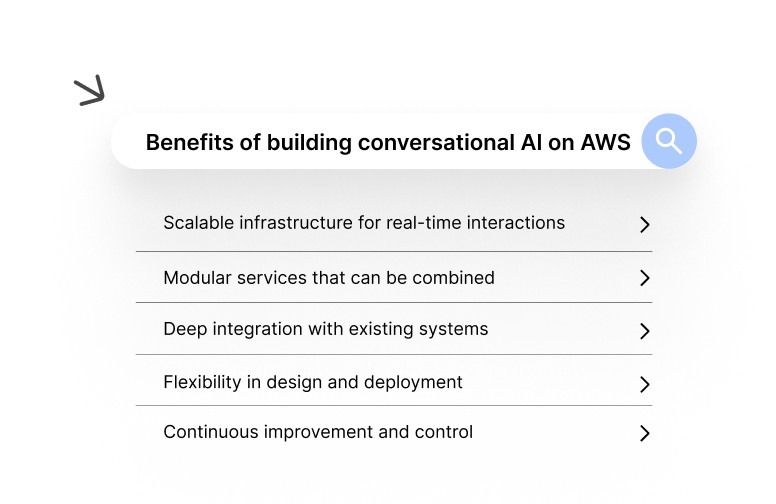
Building conversational AI on AWS gives teams access to a flexible and scalable foundation for creating language-driven systems. It is particularly useful for organizations that want control over how their AI is designed, integrated, and deployed.
Here are the key benefits:
1. Scalable infrastructure for real-time interactions
AWS is built to handle high volumes of requests across regions. This allows conversational systems to scale as usage grows, whether that is handling thousands of interactions or expanding across markets.
2. Modular services that can be combined
AWS provides individual services for different parts of the conversation stack, such as:
- Amazon Lex for understanding intent
- Amazon Transcribe for voice input
- Amazon Polly for voice output
Teams can combine these to build custom conversational systems based on their needs.
3. Deep integration with existing systems
Conversational AI on AWS can connect with CRMs, databases, and internal tools. This allows conversations to be informed by real data, improving relevance and personalization.
4. Flexibility in design and deployment
Teams can design how conversations work, define logic, and choose how systems are deployed. This is useful for organizations with specific workflows or compliance requirements.
5. Continuous improvement and control
Because teams build and manage the system, they can refine models, adjust logic, and improve performance over time based on real usage.
What this means in practice
These benefits make AWS a strong foundation for conversational AI. It gives teams the tools to build powerful systems tailored to their needs.
But it is important to recognize that these benefits apply to building capability. Turning that capability into consistent, real-world outcomes like outbound conversations and pipeline generation requires additional layers beyond infrastructure.
How to build conversational AI on AWS: step-by-step process
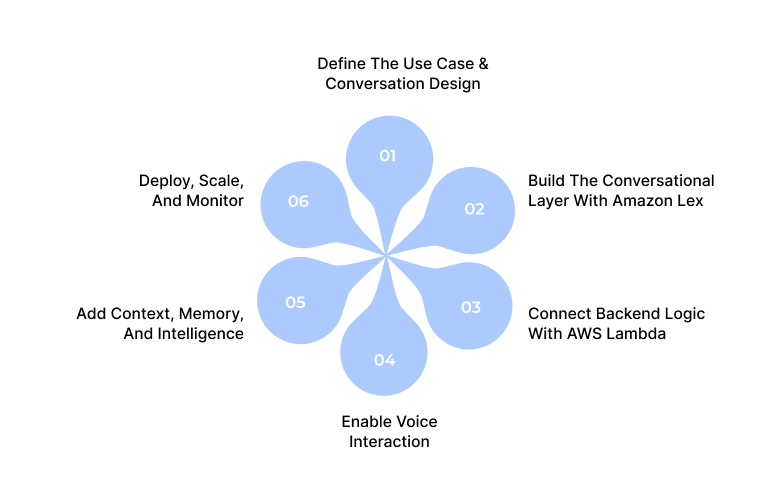
AWS provides a clear path to building conversational AI, but each step involves multiple layers of design, integration, and iteration. What looks like a linear process quickly becomes a system-level effort.
Step 1: Define the use case and conversation design
Before touching AWS services, you need to define:
- What the conversation is trying to achieve (support, qualification, booking, etc.)
- Key user intents and expected outcomes
- Conversation flows, including edge paths
This is where most projects go wrong. Without clear conversation design, the system becomes fragmented later.
AWS best practice: start with intents, utterances, and slots before implementation
Step 2: Build the conversational layer with Amazon Lex
Start by building a bot using Amazon Lex, which handles natural language understanding and dialogue management.
- Define intents (e.g., “book demo,” “ask pricing”)
- Add utterances to train recognition
- Configure slots to collect required data
- Set up dialogue management (prompts, confirmations, fallbacks)
This layer determines how well the system understands and guides conversations.
Step 3: Connect backend logic with AWS Lambda
Conversational AI needs to take action, not just respond. So, integrate the bot with backend systems using services like AWS Lambda and databases.
Using AWS Lambda:
- Trigger workflows based on intent
- Query CRMs, databases, or APIs
- Execute business logic (qualification, routing, etc.)
This is where conversational AI becomes operational. AWS enables bots to connect directly with external systems and services for real-world use cases
Step 4: Enable voice interaction
To support real-time voice conversations, integrate Amazon Transcribe for converting speech to text and Amazon Polly for generating responses.
This adds another layer of complexity:
- Handling accents, noise, and interruptions
- Maintaining low latency for natural conversation
This allows the system to process spoken language and respond naturally.
Step 5: Add context, memory, and intelligence
Basic bots reset every interaction. More advanced systems require:
- Session management (tracking ongoing conversations)
- Context retention across interactions
- Integration with knowledge bases or LLMs (e.g., via Amazon Bedrock)
This step ensures responses are relevant, personalized, and context-aware.
Step 6: Deploy, scale, and monitor
Once built, the system must be production-ready:
- Deploy across channels (web, mobile, voice)
- Handle concurrency and scaling
- Monitor performance, fallback rates, and errors
- Continuously retrain and refine
AWS allows conversational AI systems to be deployed across multiple environments and scale automatically.
On paper, this looks like a straightforward workflow. In reality, each step introduces complexity across architecture, logic, and scaling.
Because building conversational AI on AWS is not just about creating a bot. It is about designing and maintaining a system that can handle real conversations in real time.
If you’re looking to turn first conversations into qualified meetings at scale. See how Loro enables outbound GTM—book a live demo.
Challenges sales teams face when building conversational AI on AWS
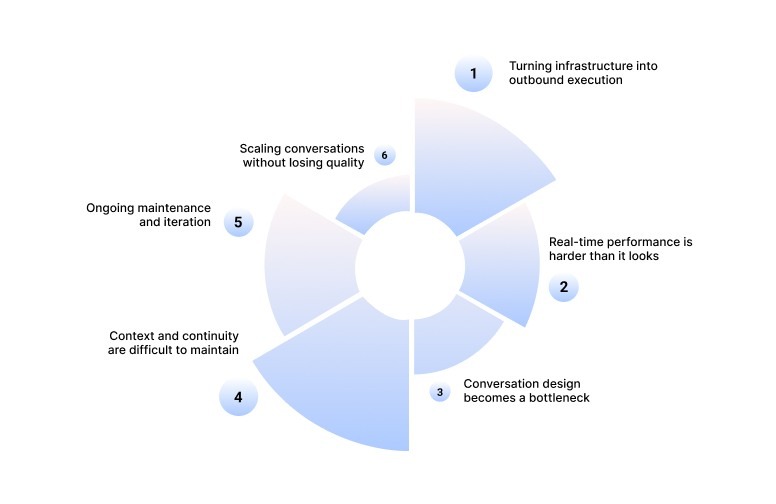
AWS provides strong building blocks for conversational AI, but most sales teams quickly realise that building something functional is very different from building something that actually works in outbound.
The core challenge is not technology. It is translating infrastructure into real, revenue-driving conversations.
1. Turning infrastructure into outbound execution
AWS services like Amazon Lex and Amazon Transcribe handle language processing well. But they do not define how a sales conversation should progress.
Sales teams must still figure out how to:
- Guide conversations toward outcomes like meetings
- Handle objections naturally
- Decide what happens next in real time
This often leads to systems that can respond, but not move prospects forward.
2. Real-time performance is harder than it looks
Outbound conversations depend on immediacy. A delayed response can break engagement instantly.
When multiple AWS services are stitched together, teams must manage:
- Latency across speech, processing, and response layers
- Interruptions and overlapping dialogue in voice interactions
- Consistent response times under load
Achieving a natural, real-time experience requires more engineering than most teams expect.
3. Conversation design becomes a bottleneck
Unlike traditional software, conversational AI is not just logic. It is interaction design.
Teams need to define:
- How conversations flow across different scenarios
- How the system reacts to unexpected inputs
- How to keep dialogue natural while still structured
In outbound sales, where conversations are unpredictable, rigid designs break quickly. This leads to stalled interactions or unnatural responses.
4. Context and continuity are difficult to maintain
Sales conversations rarely happen in a single interaction. They evolve over time.
To make this work, systems must:
- Retain conversation history
- Use past context to inform current responses
- Avoid repeating questions or losing track of intent
Without strong context management, conversations feel disconnected, reducing engagement and conversion.
5. Ongoing maintenance and iteration
Building conversational AI on AWS is not a one-time effort. It requires continuous improvement.
Teams must:
- Update intents and training data
- Refine conversation logic
- Monitor failures and edge cases
- Adjust based on real user behaviour
For sales teams, this creates ongoing dependency on technical resources, slowing down iteration.
6. Scaling conversations without losing quality
Handling a few conversations is manageable. Scaling thousands while maintaining quality is much harder.
Teams need to ensure:
- Consistent performance across interactions
- Reliable handling of concurrent conversations
- Stable experience across regions and channels
Without this, scaling outbound efforts often leads to inconsistent results.
What this means for GTM teams
The challenge is not building conversational AI on AWS. It is making it work reliably in outbound sales. Most teams can get a system running. Few can turn it into a consistent, scalable engine for pipeline generation.
What outbound conversational AI actually requires in 2026
Building conversational AI on AWS gives teams access to powerful capabilities. But outbound sales does not fail because of missing infrastructure. It fails because turning those capabilities into real, revenue-driving conversations is far more complex than it appears.
For GTM teams, the requirement is not to build conversational AI. It is to operationalize it for pipeline generation.
Real-time engagement, not delayed workflows
Outbound breaks in the gaps between touchpoints. Effective conversational AI must engage prospects the moment they respond, without relying on sequences or manual follow-ups.
This requires:
- Instant response handling
- Continuous interaction without reset
- Zero dependency on rep availability
Voice-first interaction, not text-only systems
Sales conversations are inherently voice-driven. Systems built only for chat struggle to handle nuance, timing, and natural dialogue.
Outbound-ready conversational AI should:
- Support real-time voice interaction
- Handle tone, pacing, and interruptions
- Mirror how actual sales conversations happen
Adaptive conversation handling, not predefined logic
Real buyers do not follow scripts. They ask unexpected questions, raise objections, and change direction mid-conversation.
This requires systems that can:
- Adjust responses dynamically based on context
- Handle objections without breaking flow
- Maintain continuity across multiple turns
Pipeline-driven outcomes, not activity metrics
Most AI systems optimize for responses or engagement. Outbound sales requires a different outcome.
The system must:
- Qualify intent during the conversation
- Filter low-intent prospects early
- Move qualified leads toward meetings and pipeline
Why GTM teams should not build this from scratch
While AWS provides the building blocks, assembling all of this into a reliable outbound system requires:
- Complex orchestration across services
- Continuous tuning of conversation logic
- Ongoing maintenance and optimisation
For most teams, this turns into a high-effort, low-leverage exercise.
This is why effective GTM teams do not spend time building conversational AI systems from scratch. They adopt platforms that are already designed for outbound execution.
Platforms like Loro are built on AWS but focus on what matters:
- Initiating real, voice-to-voice conversations
- Engaging prospects in real time
- Handling objections and qualifying intent
- Converting interactions into sales-ready pipeline
Instead of assembling infrastructure, teams get a system that is already aligned to how outbound sales actually works.
Loro: From AWS capabilities to outbound execution
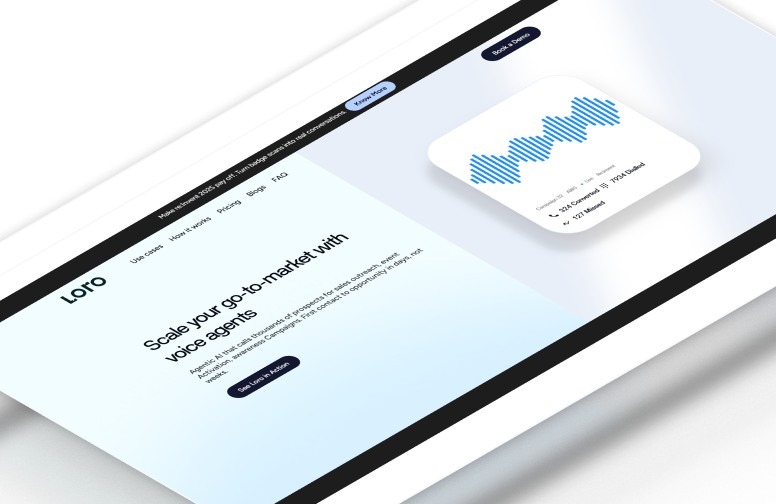
Building conversational AI on AWS gives teams the foundation. But outbound sales requires more than infrastructure. It requires a system that can consistently turn conversations into pipeline.
This is where platforms like Loro fit.
Loro is built on top of AWS capabilities, but it is designed for outbound execution from day one, removing the need to stitch together services or manage complex systems.
What Loro enables for GTM teams:
1. Real-time voice-to-voice conversations at scale: Loro initiates live outbound conversations with prospects, enabling teams to engage thousands of leads without relying on manual calling or SDR bandwidth.
2. Instant engagement without delays: Instead of waiting between touchpoints, Loro responds the moment a prospect engages, maintaining momentum and reducing drop-offs across outreach.
3. Adaptive conversations, not scripted flows: Loro adjusts responses based on context, intent, and objections in real time, allowing conversations to evolve naturally rather than follow predefined paths.
4. In-conversation qualification and filtering: It identifies buying intent during the interaction, filters out low-intent prospects early, and ensures only relevant opportunities move forward to sales.
5. Seamless conversion to sales-ready pipeline: Loro turns conversations into qualified meetings, passing context-rich insights to reps so they can focus on closing rather than early-stage qualification.
At scale, this shift is already visible:
- 130K+ calls dialed
- 10K+ conversations handled
- 8–25% pickup rates achieved
These are not test metrics. They reflect real outbound execution powered by conversational AI.
Instead of building and managing conversational AI systems, GTM teams can focus on what matters: running conversations that consistently generate pipeline.
Conclusion: Turning conversational AI into execution
Most GTM teams are already using conversational AI, but many still struggle to apply it where it matters most: pipeline creation and buyer engagement. Chatbots and assistants improve interaction, but first-touch outreach, qualification, and follow-up often remain reactive and difficult to scale.
Loro helps close that gap by turning conversational AI into real outbound execution. Its agentic, voice-to-voice AI initiates live conversations, handles objections in real time, qualifies intent, and routes sales-ready opportunities to reps with context already attached.
The result is a more connected outbound motion where conversational AI does more than support interactions, it helps drive pipeline.
See how Loro powers outbound GTM in action. Book a demo today.
FAQs
1. Do GTM teams need in-house AI expertise to use conversational AI on AWS?
Not necessarily. While AWS tools require technical setup, most GTM teams benefit more from platforms that abstract this complexity and enable immediate outbound execution without engineering effort.
2. How long does it take to deploy a conversational AI system on AWS?
Building from scratch can take weeks or months depending on complexity, integrations, and testing. Pre-built platforms significantly reduce this time by offering ready-to-use outbound capabilities.
3. How does conversational AI handle unpredictable buyer responses?
Advanced systems use context and intent signals to adapt responses dynamically. However, many basic implementations struggle with unexpected inputs unless heavily trained and continuously optimised.
4. What role does data play in conversational AI performance?
High-quality data improves intent recognition, response accuracy, and personalization. Without proper data structuring and training, conversational AI systems can deliver inconsistent or irrelevant interactions.
5. How can conversational AI improve pipeline quality, not just volume?
By qualifying intent during conversations, filtering low-interest prospects early, and passing context-rich insights to sales teams, conversational AI helps focus effort on higher-quality opportunities.