

Retail customer experience is no longer defined by channels. It is defined by how quickly and effectively brands can assist customers in real time. Shoppers move between websites, apps, stores, and support channels while making decisions, often expecting immediate answers, product guidance, and clarity before they commit to a purchase.
That shift is accelerating fast. Gartner predicts agentic AI will autonomously resolve 80% of common customer service issues without human intervention by 2029. For retailers, this is not just about automation. It signals a move toward systems that can actively engage customers, guide decisions, and handle interactions as they happen.
This blog explores how conversational AI is evolving in retail, key use cases across the customer journey, and why real-time assisted engagement is becoming critical in 2026.
Key Highlights:
- Retail is shifting from fragmented journeys to real-time, assisted engagement across online, in-store, and voice-driven customer interactions.
- Conversational AI now supports discovery, decision-making, and purchase by guiding customers in live, high-intent shopping moments.
- Delayed responses and static experiences lead to lost buying momentum and missed opportunities during critical decision points.
- Voice and messaging interactions are becoming essential to scale assisted selling and provide instant, context-aware customer support.
- Loro enables real-time, continuous conversations that guide customers, maintain context, and drive faster, more confident purchase decisions.
What Is Conversational AI in Retail? All You Need to Know in 2026
Conversational AI in retail is evolving into a real-time interaction layer that connects customer engagement across channels. It is no longer limited to handling support queries on websites or apps. Instead, it operates across stores, call centers, messaging platforms, and mobile experiences, supporting customers throughout their buying journey.
Retail interactions are rarely confined to a single touchpoint. A customer might check product availability on a mobile app, ask a question through chat, and visit a store before making a purchase. Conversational AI helps unify these interactions by providing consistent, context-aware responses wherever the customer engages.
What defines conversational AI in retail today:
- Interaction across stores, call centers, apps, and messaging platforms.
- Support for both customer service and assisted selling.
- Handling product discovery, availability checks, and purchase decisions.
- Integration with real-time retail operations such as inventory, store locations, and fulfillment.
This shifts the role of conversational AI from basic support to active participation in the buying process. Instead of responding to isolated queries, these systems help guide customers through decisions, reduce friction, and keep engagement moving across channels.
The key shift is clear. Retail is moving from chatbot-style support to AI-driven, real-time customer interaction across every touchpoint.
Why Retail Customer Experience Needs to Update in 2026
Retail customer experience is under pressure because the way people shop has changed, but support and engagement models have not kept up. Customers move fluidly between online and in-store environments, often expecting the same level of speed, context, and assistance at every step.
What breaks down is not just the ability to answer questions. It is the inability to support customers during real-time decision moments, when guidance actually influences whether a purchase happens or not.
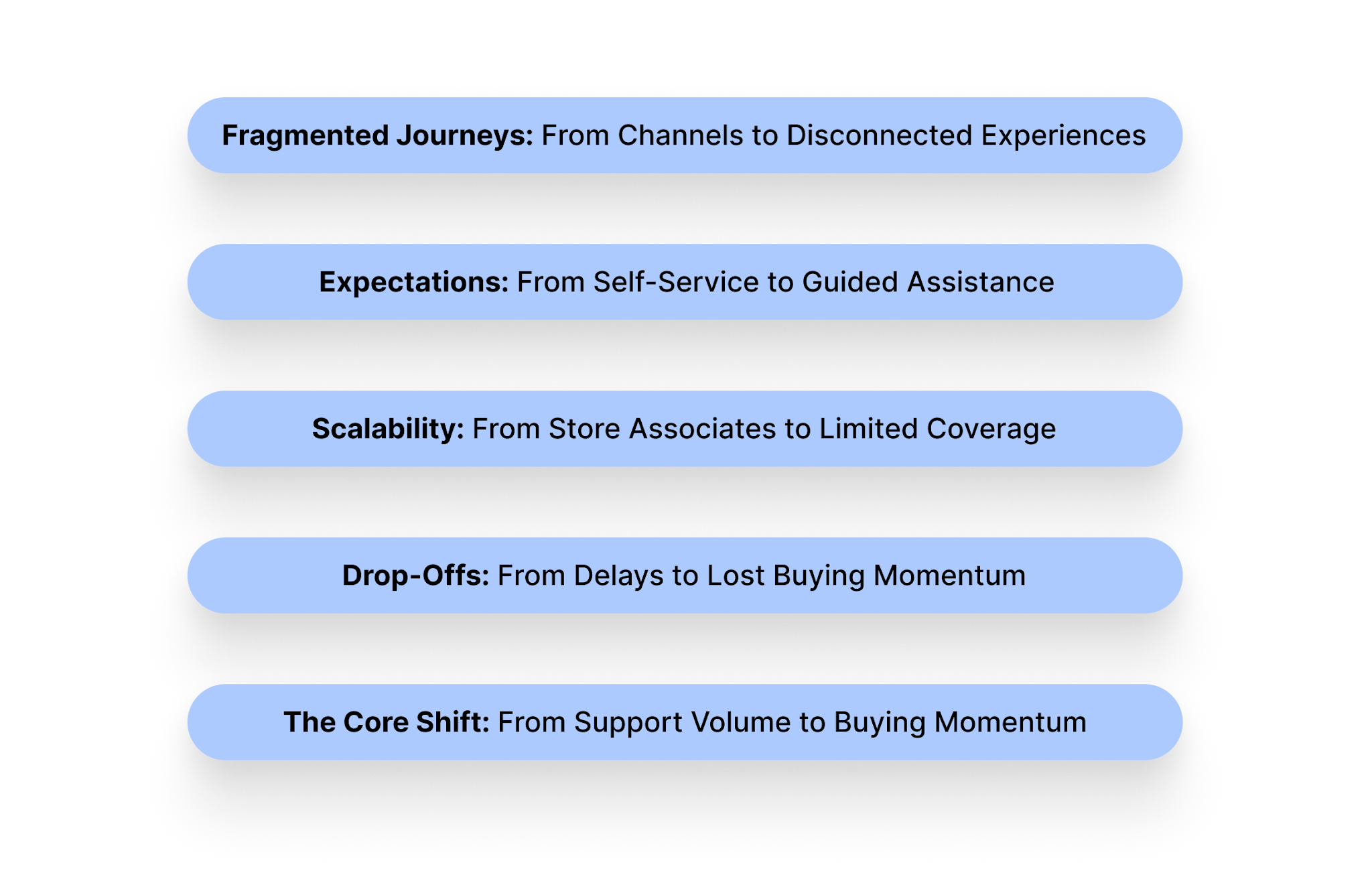
Fragmented Journeys: From Channels to Disconnected Experiences
Retail journeys are no longer linear. A customer might browse online, check availability, visit a store, and return to an app before making a decision.
This creates:
- Gaps between digital and in-store interactions.
- Inconsistent information across touchpoints.
- Repeated effort for customers to find answers.
Without continuity, each step feels disconnected, slowing down the buying process.
Expectations: From Self-Service to Guided Assistance
Customers no longer want to search and figure things out on their own. They expect assistance that helps them move forward quickly.
This includes:
- Instant answers to product and availability questions.
- Personalized recommendations based on intent.
- Guidance during high-consideration decisions.
When this support is missing or delayed, customers often drop off instead of continuing.
Scalability: From Store Associates to Limited Coverage
In physical retail, assisted selling depends heavily on store staff. In digital channels, support teams face similar limits.
Retailers struggle with:
- Scaling human-assisted selling across channels.
- Providing consistent guidance during peak traffic.
- Maintaining quality of interaction at volume.
This creates uneven experiences, especially during high-demand periods.
Drop-Offs: From Delays to Lost Buying Momentum
Timing plays a critical role in retail decisions. When customers cannot get answers immediately, they hesitate or abandon the purchase.
Common outcomes include:
- Customers leaving during product evaluation.
- Abandoned carts or incomplete purchases.
- Missed opportunities during high-intent moments.
The Core Shift: From Support Volume to Buying Momentum
The challenge is not just handling more support requests. It is about maintaining momentum while customers are actively making decisions.
Retail is moving from delayed, reactive support to real-time, guided customer engagement.
This shift sets the foundation for how conversational AI is being used in modern retail environments.
How Conversational AI Supports the Retail Customer Journey in 2026
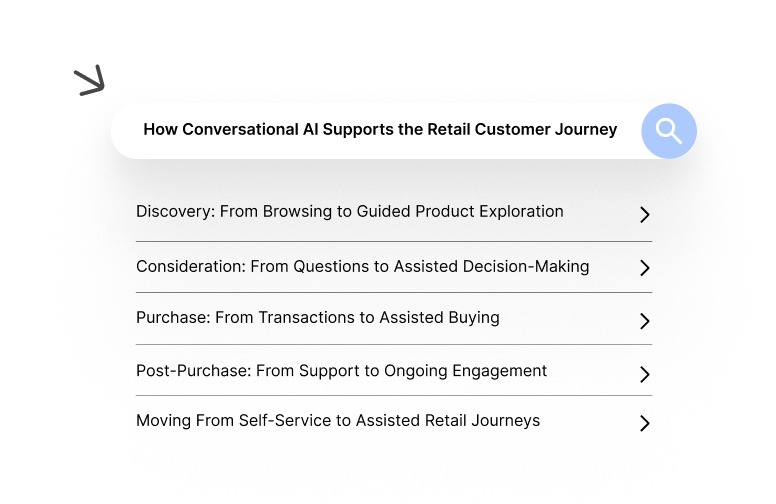
Conversational AI in retail delivers the most value when aligned with how customers actually shop. Instead of isolated features, it supports continuous interaction across key decision moments, helping customers move forward without delays.
Discovery: From Browsing to Guided Product Exploration
Product discovery in retail is often overwhelming, especially with large catalogs and multiple channels. Customers need faster ways to find relevant options.
Conversational AI enables:
- Natural language product search instead of keyword filtering.
- Personalized recommendations based on intent and behavior.
- Store availability and location-based queries.
- Voice and messaging-based discovery across channels.
This shifts discovery from manual browsing to guided exploration.
Outcome: Faster product discovery, reduced search friction, and quicker movement toward relevant options.
Consideration: From Questions to Assisted Decision-Making
During the evaluation phase, customers look for clarity before committing. Delays or missing information often lead to drop-offs.
Conversational AI supports:
- Product questions, comparisons, and feature explanations.
- Fit, compatibility, and usage guidance.
- Context-aware suggestions based on customer needs.
- Real-time assistance through voice and messaging.
This reduces hesitation and helps customers make decisions faster.
Outcome: Lower drop-offs during evaluation and faster, more confident purchase decisions.
Purchase: From Transactions to Assisted Buying
The purchase stage is where intent is highest, but also where friction can break momentum.
Conversational AI helps by:
- Assisting customers during checkout in real time.
- Clarifying payment, delivery, and fulfillment options.
- Supporting decisions between store pickup and online delivery.
- Enabling voice-based assistance for immediate help.
This turns checkout from a passive step into an actively supported interaction.
Outcome: Higher purchase completion rates, fewer drop-offs during checkout, and smoother progression from intent to final purchase.
Post-Purchase: From Support to Ongoing Engagement
Customer interaction does not end after a purchase. Post-purchase experience plays a key role in retention and repeat buying.
Conversational AI enables:
- Order tracking and delivery updates.
- Returns, exchanges, and issue resolution.
- Loyalty program interactions and rewards.
- Re-engagement for future purchases.
Outcome: Improved customer retention, stronger long-term relationships, and increased likelihood of repeat purchases and ongoing engagement.
Moving From Self-Service to Assisted Retail Journeys
Across all stages, the change is clear. Retail is moving away from self-service navigation toward guided, conversational interaction.
Instead of leaving customers to figure things out, conversational AI:
- Engages at key decision moments.
- Reduces delays and uncertainty.
- Maintains momentum across the buying journey.
This shift sets the stage for real-time engagement, where assistance happens exactly when customers need it.
Benefits of Conversational AI in Retail for 2026
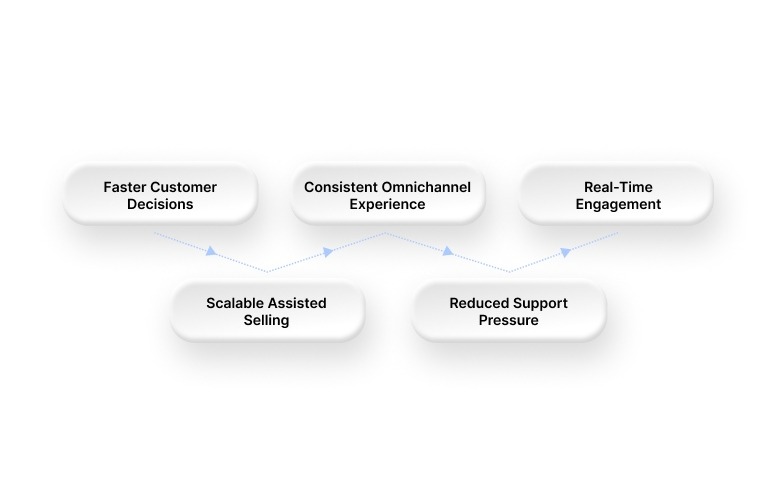
Conversational AI in retail delivers value where it matters most; during active customer decision-making.
Instead of focusing only on automation or cost savings, its impact is seen in how quickly customers move forward, how consistently they are supported across channels, and how effectively retailers handle demand at scale.
1. Faster Customer Decisions: Customers often hesitate when they cannot find answers quickly. Conversational AI removes this delay by providing immediate, relevant responses during product discovery and evaluation.
It enables faster movement from browsing to purchase by reducing uncertainty and keeping customers engaged in the moment.
2. Scalable Assisted Selling: In traditional retail, assisted selling depends on store associates. Conversational AI extends this capability across digital channels, allowing retailers to guide thousands of customers simultaneously.
This makes it possible to deliver consistent assistance without being limited by staffing capacity, especially during high-traffic periods.
3. Consistent Omnichannel Experience: Customers expect the same level of support whether they are online, on mobile, or in-store. Conversational AI helps unify interactions across these touchpoints, ensuring continuity and consistency.
This reduces friction when customers switch channels and creates a more connected retail experience.
4. Reduced Support Pressure: Retail support teams often face spikes in demand during sales events, holidays, and peak shopping periods. Conversational AI absorbs a large portion of routine and high-frequency interactions.
This reduces the load on support teams and allows them to focus on more complex or high-value customer needs.
5. Real-Time Engagement: Timing is critical in retail. When customers do not receive immediate assistance, they are more likely to drop off. Conversational AI enables real-time interaction, ensuring customers get support when they need it.
This helps maintain buying momentum and prevents delays that can interrupt the decision-making process.
The core benefit of conversational AI in retail is not just efficiency. It is the ability to engage customers in real time, support decisions as they happen, and maintain momentum across the buying journey.
If you want to turn conversations into qualified opportunities at scale, see how Loro enables real-time outbound engagement—book a live demo.
Where Conversational AI Falls Short in Retail and How to Close the Gap
While conversational AI is becoming central to modern retail, many implementations fall short in real-world scenarios. The gap is not in capability, but in how these systems are applied across channels, data, and live customer interactions.
Fragmented Customer Data Across Channels
Retail interactions often happen across websites, apps, stores, and support channels. When data is not unified, conversations lose context.
Solution: Integrate conversational systems with customer data platforms, inventory systems, and order history to enable context-aware interactions that persist across touchpoints.
Limited Real-Time Responsiveness
Many systems rely on predefined workflows or delayed triggers, which fail to support customers during active decision moments.
Solution: Adopt real-time interaction models that respond instantly based on customer behavior, intent signals, and live session activity.
Over-Reliance on Scripted Flows
Rigid, rule-based interactions cannot handle complex product queries or evolving customer needs.
Solution: Use adaptive conversational systems that can understand intent, adjust responses dynamically, and guide customers naturally through decisions.
Lack of Continuity Across Channels
Customers often have to restart conversations when switching between app, website, store, or support channels.
Solution: Enable cross-channel continuity by maintaining conversation history and context, allowing seamless transitions between touchpoints.
Scaling Assisted Selling
Providing personalized guidance at scale is difficult with limited human resources, especially during peak traffic periods.
Solution: Extend assisted selling through conversational AI that can engage multiple customers simultaneously while maintaining quality and consistency.
The biggest challenge in retail conversational AI is not adoption; it is execution. Retailers that solve for real-time interaction, context continuity, and scalable engagement are the ones that turn conversational AI into a true driver of customer experience and revenue.
What Matters in 2026: Real-Time Retail Engagement
Retail is moving from fragmented interactions to continuous, real-time customer engagement. This shift is driven by how customers actually make decisions today; across channels, in the moment, and with the expectation of immediate assistance.
Why Delayed Engagement Fails
Traditional retail experiences are built around static pages and delayed support. That approach breaks down when customers need help while actively deciding. When engagement is delayed:
- Customers drop off if they do not get instant answers.
- Static experiences cannot guide complex product decisions.
- Support arrives too late to influence the purchase.
The result is not just lost interactions, it is lost buying momentum.
Why Retail Is Moving to Real-Time Interaction
To keep pace with customer behavior, retailers are shifting toward systems that engage during active decision moments. This includes:
- In-session assistance while customers are browsing or evaluating products.
- Live product guidance based on context and intent.
- Voice-driven interaction for immediate, hands-free support.
- Proactive engagement triggered by customer behavior.
Instead of waiting for customers to ask, support becomes part of the buying journey itself.
Why Continuity Across Channels Matters
Customers do not follow a single path. They move fluidly across:
- Website.
- Mobile app.
- Physical store.
- Messaging platforms.
- Voice interactions.
Without continuity:
- Context resets between interactions.
- Customers repeat information.
- Buying momentum is lost at each transition.
The Shift: From Fragmented Interactions to Continuous Conversations
The next phase of retail is not about improving individual touchpoints. It is about maintaining continuous, context-aware conversations across the entire journey. Real-time engagement ensures:
- Customers receive support without interruption.
- Context carries across channels and interactions.
- Decisions happen within the flow of the experience, not outside it.
This shift defines what effective conversational AI looks like in 2026—and how retailers turn interaction into measurable business outcomes.
Loro: From Retail Automation to Real-Time Interaction Execution
Most conversational AI systems in retail improve interaction quality but fall short in execution. They assist with queries, automate responses, and support workflows, yet struggle to engage customers during real-time decision moments.
This creates a gap between customer intent and actual outcomes.
Platforms like Loro are built to close this gap by enabling real-time, conversation-driven retail engagement.
With Loro, retail teams move:
- From delayed responses → real-time customer conversations
- From reactive support → proactive engagement during buying moments
- From fragmented touchpoints → continuous, context-aware interactions
Loro turns conversational AI into live, execution-ready interaction, helping retailers guide customers while decisions are actively being made.
What Loro Enables
1. Real-time voice-to-voice customer engagement at scale: Loro initiates and manages live conversations with customers, enabling immediate interaction during high-intent moments instead of relying on delayed or user-triggered engagement.
2. Immediate engagement during active buying decisions: Instead of waiting for customers to ask questions, Loro engages as intent signals appear, supporting product discovery, evaluation, and purchase decisions in real time.
3. Adaptive conversations, not scripted workflows: Loro adjusts responses dynamically based on customer context, behavior, and inputs, allowing conversations to evolve naturally rather than follow rigid flows.
4. Continuous interaction across channels: It maintains context across voice, messaging, and digital touchpoints, ensuring customers do not have to restart conversations or repeat information.
5. Seamless transition from interaction to purchase: Loro connects conversations directly to outcomes, guiding customers toward decisions, whether it is selecting a product, completing a purchase, or taking the next step.
Proven Impact
- 130K+ calls dialed
- 10K+ conversations handled
- 8–25% pickup rates
Instead of relying on delayed workflows and fragmented engagement, retail teams can operate with real-time conversational infrastructure that supports customers as they shop, maintains momentum, and drives measurable outcomes at scale.
Conclusion: Using Conversational AI for Retail Engagement
Most retailers are already using conversational AI, but many still struggle to apply it where it matters most: during active customer decision moments. Automation improves response capacity, yet interactions often remain reactive, delayed, and disconnected from the buying journey.
Loro helps close that gap by turning conversational AI into real-time interaction execution. Its agentic, voice-to-voice AI engages customers instantly, adapts to context, supports decisions as they happen, and connects interaction directly to purchase outcomes.
The result is a more effective retail experience, where conversational AI does more than assist. It actively guides customers, maintains continuity across channels, and drives faster, more confident decisions.
See how Loro enables real-time retail engagement at scale. Book a demo today.
FAQs
1. How is conversational AI used in physical retail stores?
Conversational AI supports in-store experiences through kiosks, mobile apps, and voice assistants. It helps customers check product availability, get directions inside stores, access promotions, and receive assistance without waiting for staff.
2. Can conversational AI personalize shopping experiences in real time?
Yes, conversational AI can use customer behavior, preferences, and past interactions to tailor responses instantly. This allows retailers to provide relevant product suggestions and guidance during live interactions.
3. What technologies power conversational AI in retail?
Conversational AI typically combines natural language processing (NLP), machine learning, and integrations with retail systems such as inventory, CRM, and order management platforms to deliver accurate and context-aware responses.
4. How does conversational AI impact in-store and online integration?
It helps bridge the gap between digital and physical retail by maintaining consistent information and interaction across channels. Customers can start a conversation online and continue it in-store without losing context.
5. How long does it take to implement conversational AI in retail?
Implementation timelines vary based on complexity and integrations. Basic deployments can be set up in weeks, while more advanced, fully integrated systems may take longer to align with existing retail infrastructure.