

Financial services marketing is shifting from campaigns to conversations. Customers are no longer satisfied with static content or delayed follow-ups. They expect real-time, personalized engagement when exploring products like loans, insurance, or investment options, where clarity and timing directly influence decisions.
That gap is becoming more visible. According to Salesforce, 83% of marketers agree that customers increasingly want two-way conversations, but 69% admit they struggle to respond promptly. For financial institutions, this is not just a marketing challenge. It affects trust, engagement, and conversion during critical decision moments.
This blog explores how conversational marketing is evolving in financial services, key use cases across the customer journey, and why real-time engagement is becoming essential in 2026.
Key Highlights:
- Financial services are shifting from campaign-driven marketing to real-time, conversation-led customer engagement.
- Conversational marketing supports high-stakes decisions by providing instant, contextual guidance during critical moments.
- Delayed responses and fragmented journeys lead to lost trust and reduced conversion.
- Real-time, voice and messaging interactions enable scalable, personalized financial engagement.
- Loro enables continuous, context-aware conversations that drive faster decisions and improve conversion outcomes.
What Is Conversational Marketing in Financial Services?
Conversational marketing in financial services is evolving into a real-time engagement layer that supports customers across their decision journey. It is not limited to lead capture or campaign responses. Instead, it enables ongoing, two-way interactions that help customers explore, evaluate, and act on financial products with confidence.
Financial decisions are rarely simple. Customers often need clarity on eligibility, pricing, risk, and long-term impact before moving forward. Conversational marketing supports these moments by providing immediate, contextual responses across web, mobile apps, messaging, and voice channels.
What defines conversational marketing in financial services:
- Real-time, two-way customer engagement across digital and voice channels.
- Support for lead generation, onboarding, product discovery, and ongoing service.
- Context-aware interactions that guide customers through complex financial decisions.
- Integration with systems that provide accurate, up-to-date financial information.
This shifts the role of marketing from driving one-time interactions to enabling continuous conversations. Instead of static campaigns and delayed follow-ups, financial institutions can engage customers as decisions are being made.
The key shift is clear. Financial services are moving from one-way campaigns to interactive, trust-driven customer engagement, where conversations play a central role in building confidence and long-term relationships.
Why Financial Services Customer Engagement Is Under Pressure
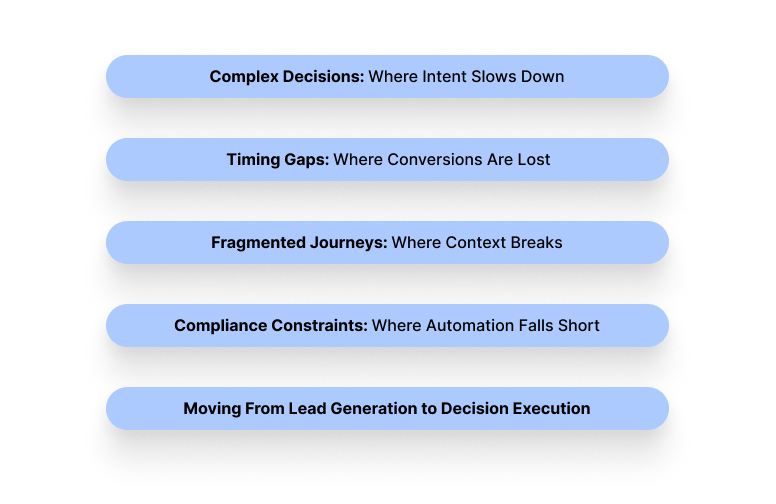
Financial services does not have an engagement problem. It has a timing and trust problem. Most institutions can generate demand. The breakdown happens when customers move from interest to decision. This is where delays, fragmented interactions, and lack of clarity directly impact conversion.
Complex Decisions: Where Intent Slows Down
Financial products are not impulse purchases. Customers evaluate risk, eligibility, pricing, and long-term impact before moving forward. In practice:
- Customers open multiple tabs comparing options.
- They pause when terms or eligibility are unclear.
- They delay action if guidance is not immediately available.
Without real-time support, high-intent users lose momentum during evaluation.
Timing Gaps: Where Conversions Are Lost
In financial services, timing is tightly linked to intent. When a customer explores a loan or insurance product, the window to engage is short. What typically happens:
- Lead forms are filled, but follow-ups are delayed.
- Callbacks happen hours or days later.
- Customers move to competitors who respond faster.
The issue is not lead quality. It is missed engagement during active decision windows.
Fragmented Journeys: Where Context Breaks
Customer journeys span multiple touchpoints, but systems do not carry context across them. A typical flow:
- Website research.
- Mobile app interaction.
- Call center conversation.
- Branch visit.
At each step:
- Context resets.
- Customers repeat information.
- Confidence drops due to inconsistency.
Fragmentation directly impacts trust and slows decision-making.
Compliance Constraints: Where Automation Falls Short
Financial interactions must be accurate, explainable, and compliant. This limits the effectiveness of generic automation or scripted responses.
As a result:
- Responses are often overly cautious or delayed.
- Marketing and support operate in silos.
- Conversations fail to adapt to customer context.
The challenge is not automation. It is delivering real-time, compliant guidance at scale.
Moving From Lead Generation to Decision Execution
The real problem is not generating leads. It is converting intent into action while the customer is still engaged.
Financial services is moving from campaign-driven, delayed engagement to real-time, trust-driven conversations that support decisions as they happen.
This shift defines how conversational marketing needs to operate in 2026.
How Conversational Marketing Supports the Financial Customer Journey
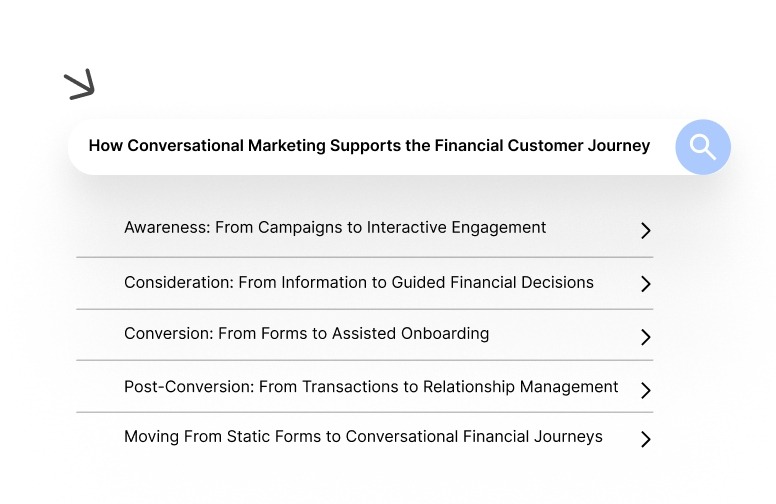
Conversational marketing in financial services is most effective when aligned with how customers actually make decisions. Instead of isolated campaigns or static touchpoints, it supports continuous interaction across key moments, helping customers move forward with clarity and confidence.
Awareness: From Campaigns to Interactive Engagement
Early-stage engagement in financial services often starts with questions. Customers want to understand options before committing to deeper evaluation.
Conversational marketing enables:
- Conversational ads and interactive landing pages.
- Instant responses to product-related queries.
- Lead qualification through real-time interaction.
This shifts awareness from passive content consumption to active engagement.
Outcome: Higher engagement rates and better-qualified leads entering the decision process.
Consideration: From Information to Guided Financial Decisions
As customers evaluate financial products, they need clarity on eligibility, pricing, and suitability. Delays or confusion often lead to hesitation.
Conversational marketing supports:
- Product comparisons across loans, insurance, and accounts.
- Eligibility checks and pre-qualification guidance.
- Context-aware recommendations based on customer inputs.
This reduces uncertainty and helps customers move forward with confidence.
Outcome: Faster decision-making and reduced drop-offs during evaluation.
Conversion: From Forms to Assisted Onboarding
The transition from interest to application is a critical point where many customers drop off due to complexity or lack of support.
Conversational marketing helps by:
- Providing real-time application assistance.
- Guiding document submission and KYC processes.
- Enabling voice and messaging-based onboarding support.
This transforms onboarding from a static process into an assisted interaction.
Outcome: Higher application completion rates and smoother onboarding experiences.
Post-Conversion: From Transactions to Relationship Management
Customer engagement does not end after onboarding. Financial relationships require ongoing communication and support.
Conversational marketing enables:
- Account support and servicing interactions.
- Payment reminders and transaction updates.
- Cross-sell and upsell conversations based on context.
This extends engagement beyond transactions into long-term relationship building.
Outcome: Improved customer retention, stronger trust, and increased lifetime value.
Moving From Static Forms to Conversational Financial Journeys
Across all stages, the shift is clear. Financial services are moving away from static forms and delayed follow-ups toward guided, real-time conversations.
Instead of leaving customers to navigate complexity alone, conversational marketing:
- Engages during key decision moments.
- Reduces delays and uncertainty.
- Supports decisions with contextual, real-time guidance.
This sets the foundation for real-time financial engagement, where conversations directly influence outcomes.
Benefits of Conversational Marketing for Financial Services in 2026
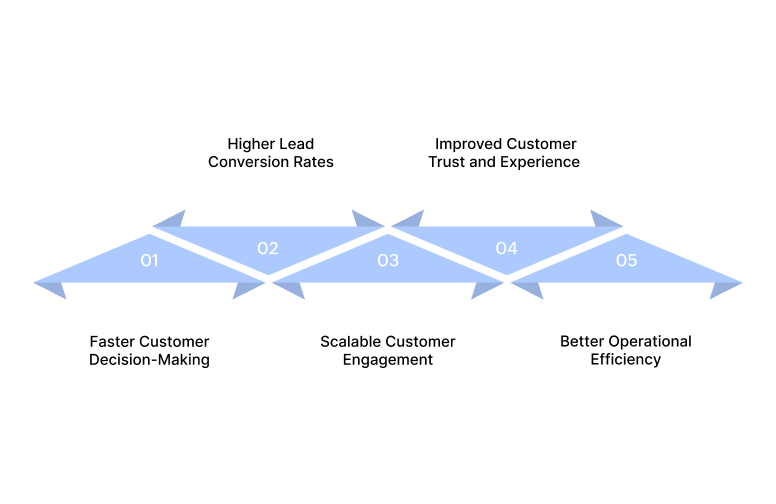
Conversational marketing in financial services delivers value where it matters most, during high-stakes customer decision-making. Instead of focusing only on lead generation or automation, its impact is seen in how effectively institutions build trust, guide decisions in real time, and convert intent into action while maintaining compliance.
1. Faster Customer Decision-Making: Financial decisions often stall when customers cannot get immediate clarity on products, eligibility, or terms. Conversational marketing removes this delay by providing real-time, contextual responses during evaluation.
It helps customers move forward with confidence by reducing uncertainty and supporting decisions as they happen.
2. Higher Lead Conversion Rates: Customer intent in financial services is time-sensitive. When engagement is delayed, prospects lose interest or move to competitors. Conversational marketing enables real-time interaction during high-intent moments.
This reduces drop-offs in applications and increases the likelihood of converting interest into completed actions.
3. Scalable Customer Engagement: Financial institutions must engage large volumes of customers without compromising personalization or accuracy. Conversational marketing allows teams to handle multiple interactions simultaneously across channels.
This ensures consistent, high-quality engagement without being limited by human capacity.
4. Improved Customer Trust and Experience: Trust is central to financial decisions. Generic or delayed responses reduce confidence, while personalized, contextual engagement builds credibility.
Conversational marketing delivers interactions that feel relevant and human-like, helping customers feel supported throughout their journey.
5. Better Operational Efficiency: Support teams often face high volumes of repetitive queries related to products, onboarding, and account servicing. Conversational marketing reduces this burden by handling routine interactions in real time.
This allows teams to focus on complex, high-value cases while improving overall efficiency.
The core benefit of conversational marketing in financial services is not just engagement. It is the ability to build trust, support decisions in real time, and convert customer intent into confident action.
If you want to turn conversations into qualified opportunities at scale, see how Loro enables real-time outbound engagement—book a live demo.
Where Conversational AI Falls Short in Retail and How to Close the Gap
While conversational AI is becoming central to modern retail, many implementations fall short in real-world scenarios. The gap is not in capability, but in how these systems are applied across channels, data, and live customer interactions.
Fragmented Customer Data Across Channels
Retail interactions often happen across websites, apps, stores, and support channels. When data is not unified, conversations lose context.
Solution: Integrate conversational systems with customer data platforms, inventory systems, and order history to enable context-aware interactions that persist across touchpoints.
Limited Real-Time Responsiveness
Many systems rely on predefined workflows or delayed triggers, which fail to support customers during active decision moments.
Solution: Adopt real-time interaction models that respond instantly based on customer behavior, intent signals, and live session activity.
Over-Reliance on Scripted Flows
Rigid, rule-based interactions cannot handle complex product queries or evolving customer needs.
Solution: Use adaptive conversational systems that can understand intent, adjust responses dynamically, and guide customers naturally through decisions.
Lack of Continuity Across Channels
Customers often have to restart conversations when switching between app, website, store, or support channels.
Solution: Enable cross-channel continuity by maintaining conversation history and context, allowing seamless transitions between touchpoints.
Scaling Assisted Selling
Providing personalized guidance at scale is difficult with limited human resources, especially during peak traffic periods.
Solution: Extend assisted selling through conversational AI that can engage multiple customers simultaneously while maintaining quality and consistency.
The biggest challenge in retail conversational AI is not adoption; it is execution. Retailers that solve for real-time interaction, context continuity, and scalable engagement are the ones that turn conversational AI into a true driver of customer experience and revenue.
What Matters in 2026: Real-Time Financial Conversations
Financial services is moving from transactional marketing to continuous, real-time customer conversations. This shift is driven by how decisions actually happen; customers evaluate options, ask questions, and seek clarity in the moment, not after delayed follow-ups.
Why Delayed Engagement Fails
Traditional marketing and support models rely on forms, callbacks, and static content. That approach breaks down when customers are actively making financial decisions.
When engagement is delayed:
- Financial decisions lack immediate clarity.
- Customers hesitate or abandon the process.
- Static content fails to guide complex evaluations.
The result is not just lower engagement, but lost decision momentum during critical moments.
Why Financial Services Are Moving to Real-Time Engagement
To keep up with customer expectations, financial institutions are shifting toward systems that engage during active decision-making.
This includes:
- Live product guidance based on customer needs.
- Instant eligibility checks and onboarding support.
- Voice-driven interactions for high-value or complex queries.
- Proactive engagement triggered by customer intent.
Instead of waiting for customers to act, engagement becomes part of the decision process itself.
Why Continuity Across Channels Matters
Financial journeys are rarely confined to a single channel. Customers move between:
- Website.
- Mobile app.
- Call center.
- Branch interactions.
Without continuity:
- Trust breaks due to inconsistent experiences.
- Context resets at every touchpoint.
- Decisions slow down or stall completely.
Moving From Transactional Marketing to Continuous Conversations
The next phase of financial engagement is not about improving individual touchpoints. It is about maintaining continuous, context-aware conversations across the entire journey.
Real-time financial conversations ensure:
- Customers receive support without interruption.
- Context carries across channels and interactions.
- Decisions happen with confidence and clarity.
This shift defines what effective conversational marketing looks like in 2026 and how financial institutions turn engagement into outcomes.
Where Conversational Marketing Falls Short and How to Fix It
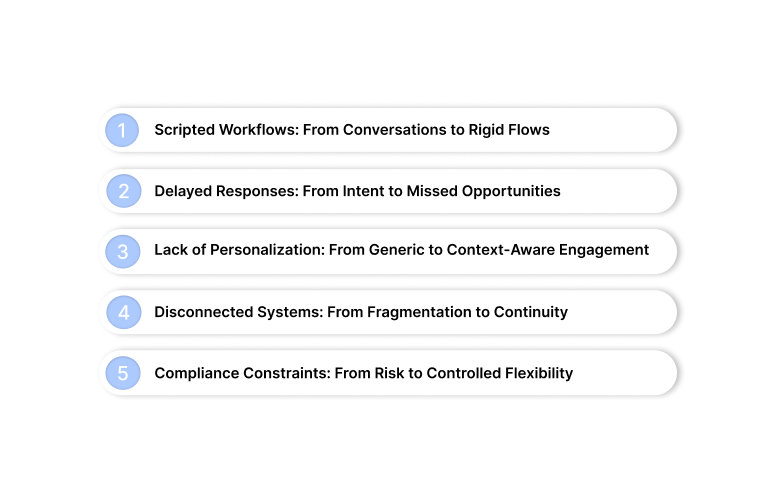
Conversational marketing in financial services is widely adopted, but most implementations break down at the point where decisions actually happen.
The issue is not the presence of conversational tools. It is their inability to operate in real time, maintain context, and support complex, high-trust interactions.
1. Scripted Workflows: From Conversations to Rigid Flows
Most systems are designed around predefined paths and decision trees. While effective for simple queries, they struggle when customers ask nuanced questions about eligibility, pricing, or risk.
In practice:
- Conversations stall when inputs fall outside predefined flows.
- Customers are redirected instead of guided.
- Complex decisions are left unresolved.
Solution: Move to adaptive conversation systems that can interpret intent, adjust responses dynamically, and support multi-step financial decision-making without breaking flow.
2. Delayed Responses: From Intent to Missed Opportunities
Financial decisions are time-sensitive. Customers evaluating loans or insurance expect immediate clarity. Delayed callbacks or follow-ups reduce engagement and conversion.
What typically happens:
- Leads are captured but not engaged instantly.
- Response delays create drop-offs during evaluation.
- Competitors win by responding faster.
Solution: Implement real-time interaction systems that engage customers during active sessions, ensuring support is available at the moment intent is highest.
3. Lack of Personalization: From Generic to Context-Aware Engagement
Many conversational systems deliver standardized responses that do not reflect customer-specific needs or financial context.
This leads to:
- Irrelevant recommendations.
- Repeated questions to gather basic information.
- Lower confidence in the interaction.
Solution: Enable context-aware engagement by integrating customer data, behavioral signals, and financial profiles, allowing responses to adapt to each individual interaction.
4. Disconnected Systems: From Fragmentation to Continuity
Customer journeys span multiple systems, including CRM, onboarding platforms, support tools, and product databases. When these systems are not connected, conversations lose continuity.
The impact:
- Customers repeat information across channels.
- Interactions feel inconsistent and fragmented.
- Trust declines due to lack of cohesion.
Solution: Integrate conversational layers with core financial systems to ensure a unified view of the customer, enabling seamless, continuous interactions across touchpoints.
5. Compliance Constraints: From Risk to Controlled Flexibility
Financial services operate under strict regulatory requirements. This often results in cautious, limited responses that slow down interaction and reduce usefulness.
Challenges include:
- Balancing speed with accuracy.
- Ensuring responses align with regulatory standards.
- Maintaining auditability of interactions.
Solution: Deploy compliant AI frameworks that combine real-time responsiveness with governance, ensuring every interaction is accurate, traceable, and aligned with policy requirements.
The gap in conversational marketing is not about capability. It is about execution under real-world conditions. Financial institutions that enable real-time interaction, maintain context across systems, and operate within compliance constraints will be able to turn conversations into meaningful customer outcomes.
Loro: From Financial Marketing Automation to Real-Time Conversation Execution
Most conversational marketing systems in financial services improve engagement on the surface but fall short where it matters most, during real customer decision moments. They capture leads, automate responses, and support campaigns, yet struggle to engage customers when timing, trust, and clarity are critical.
This creates a gap between customer intent and actual conversion.
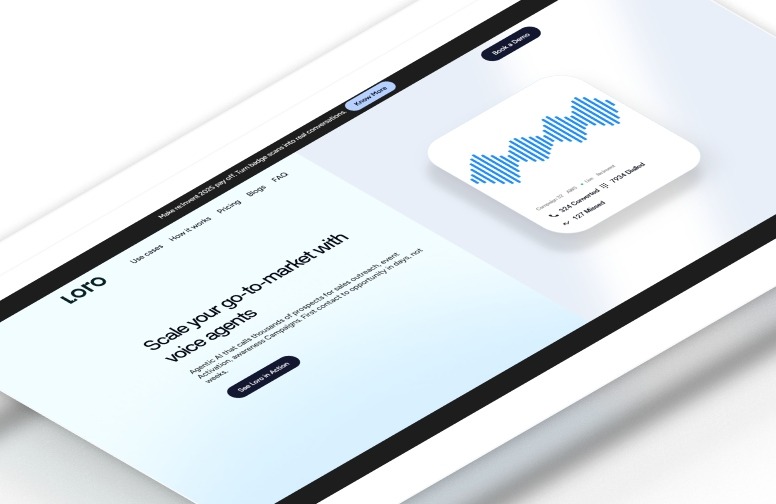
Platforms like Loro are built to close this gap by enabling real-time, conversation-driven financial engagement.
With Loro, financial teams move:
- From delayed follow-ups → real-time customer conversations
- From reactive outreach → proactive engagement during decision moments
- From fragmented interactions → continuous, context-aware financial journeys
Loro turns conversational marketing into live, execution-ready interaction, helping financial institutions guide customers while decisions are actively being made.
What Loro Enables
1. Real-time voice-to-voice customer engagement at scale: Loro initiates and manages live conversations with customers, enabling immediate interaction during high-intent financial moments instead of relying on delayed callbacks or form-based engagement.
2. Immediate engagement during active decision-making: Instead of waiting for customers to complete forms or request follow-ups, Loro engages as intent signals appear, supporting product exploration, eligibility understanding, and decision-making in real time.
3. Adaptive conversations, not scripted workflows: Loro adjusts responses dynamically based on customer context, financial needs, and inputs, allowing conversations to evolve naturally rather than follow rigid, predefined paths.
4. Continuous interaction across channels: It maintains context across voice, messaging, and digital touchpoints, ensuring customers do not have to restart conversations or repeat sensitive financial information.
5. Seamless transition from conversation to conversion: Loro connects interactions directly to outcomes, whether it is completing an application, progressing onboarding, or taking the next step in the financial journey.
Proven Impact
- 130K+ calls dialed
- 10K+ conversations handled
- 8–25% pickup rates
Instead of relying on delayed workflows and fragmented engagement, financial institutions can operate with real-time conversational infrastructure that supports customers during critical decision moments, maintains trust, and drives measurable outcomes at scale.
Conclusion: Using Conversational AI for Real-Time Engagement
Most financial institutions are already using conversational marketing, but many still struggle to apply it where it matters most: during active customer decision moments. Automation improves engagement capacity, yet interactions often remain reactive, delayed, and disconnected from high-stakes financial journeys.
Loro helps close that gap by turning conversational marketing into real-time conversation execution. Its agentic, voice-to-voice AI engages customers instantly, adapts to financial context, supports decisions as they happen, and connects interaction directly to conversion outcomes.
The result is a more effective engagement model, where conversational marketing does more than generate leads. It actively builds trust, maintains continuity across channels, and drives faster, more confident financial decisions.
See how Loro enables real-time financial engagement at scale. Book a demo today.
FAQs
1. What tools are used for conversational marketing in financial services?
Financial institutions use a mix of messaging platforms, voice AI systems, CRM integrations, and customer data platforms. These tools work together to enable real-time conversations while maintaining context and accuracy.
2. How does conversational marketing improve lead qualification?
It qualifies leads in real time by asking relevant questions and capturing intent signals during interaction. This helps teams focus on high-quality prospects instead of relying only on static form data.
3. Can conversational marketing support customer onboarding?
Yes, it can guide customers through onboarding steps like document submission, verification, and account setup. This reduces friction and helps complete processes faster.
4. How does it help with cross-selling financial products?
By understanding customer context and behavior, conversational systems can suggest relevant products during interactions. This makes cross-selling more timely and personalized.
5. What role does data play in conversational marketing?
Data enables context-aware conversations by providing insights into customer behavior, preferences, and history. This ensures interactions are relevant, accurate, and aligned with customer needs.